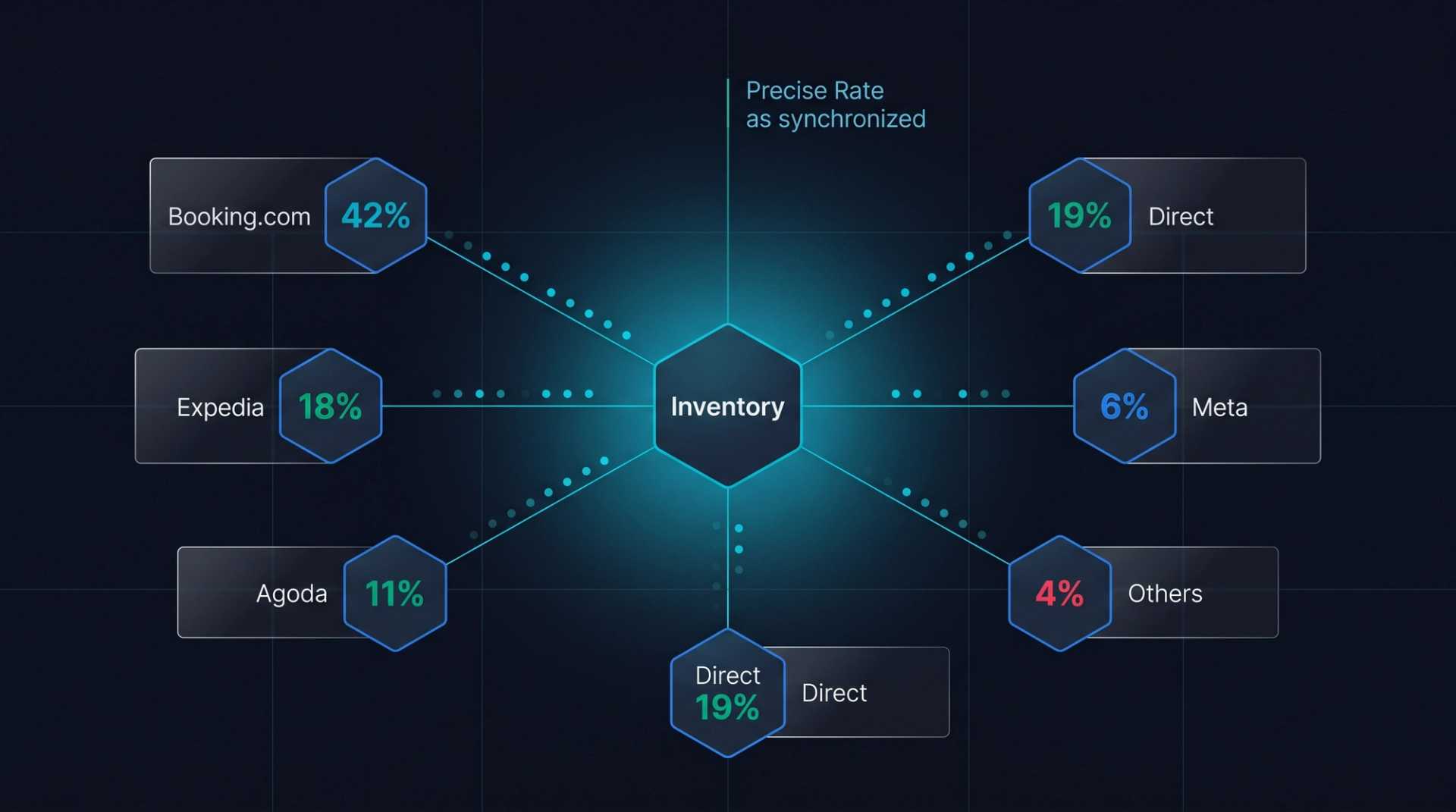
![Optimal OTA Channel Mix Strategy [2026 Guide]](https://cdn.sanity.io/images/1la98t0z/production/6c1d9b3df8e4f4bfc50de490d1e4b59c2b6a9146-1376x768.jpg?w=1920&q=65&auto=format&fit=max)
Key Takeaways
- Avoid Single OTA Reliance: Over-reliance (60-70% from one OTA) creates significant risk and limits negotiation power. Hotels with an optimal channel mix achieve 12-18% higher NRevPAR.
- Define Ideal Channel Distribution: Aim for 35-45% direct bookings, 25-35% Booking.com, 10-15% Expedia, 5-15% GDS, 5-10% Metasearch, and 5-10% Other OTA/Bedbank.
- Implement Dynamic Channel Rules: Adjust channel visibility based on occupancy levels (<50%, 50-80%, >80%, >90%), seasonality (high/low), and lead time (30+ days, 7-30 days, 0-7 days).
- Prioritize Direct Bookings: Increase direct channel share through price advantages, added value, leveraging the billboard effect, SEO/SEM investment, remarketing, email, and social media.
- Monitor Performance & Optimize: Regularly track key metrics like Channel Share, NRevPAR, Conversion Rate, Cancellation Rate, Average Lead Time, and ALOS to refine your strategy.
Don't Put All Your Eggs in One Basket
A significant portion of hotels in Turkey derive 60-70% of their revenue from a single OTA (typically Booking.com). This creates a serious dependency risk: you become vulnerable to commission increases, directly affected by algorithm changes, and your negotiation power remains limited.
According to McKinsey's hospitality research, hotels with an optimal channel mix (not dependent on a single channel for more than 40% of revenue) achieve 12-18% higher NRevPAR compared to dependent hotels.
A channel mix strategy goes beyond "how many rooms will we allocate to each channel" and answers the question of "how can we achieve the highest net revenue from each channel."

Embed this image on your site
<a href="https://otelciro.com/en/news/optimal-ota-channel-mix-strategy-2026-guide">
  <img src="https://cdn.sanity.io/images/1la98t0z/production/6c1d9b3df8e4f4bfc50de490d1e4b59c2b6a9146-1376x768.jpg" alt="Optimal OTA channel mix strategy" width="800" />
</a>
<p>Source: <a href="https://otelciro.com">OtelCiro</a> — AI Hotel Revenue Management</p>
Related reading: Competing with Airbnb: Alternative Accommodation Strategy for Hotels
Factors Determining Your Channel Mix
1. Hotel Type and Location
| Hotel Type | Recommended Direct Share | Recommended OTA Share | GDS |
|---|---|---|---|
| City Business Hotel | 30-40% | 40-50% | 10-20% |
| Holiday/Resort | 25-35% | 50-60% | 5-10% |
| Boutique Hotel | 40-55% | 35-50% | 5-10% |
| Chain Hotel | 35-50% | 35-45% | 10-20% |
| Airport Hotel | 15-25% | 50-60% | 15-25% |
2. Source Markets
Which countries do you receive guests from? Source markets determine channel preference:
- German tourists: Booking.com + metasearch dominant
- US tourists: Expedia Group dominant
- Domestic tourists: Direct channel + Booking.com
- Corporate travelers: GDS + direct channel
3. Channel-Based Cost
Each channel has a different total distribution cost. Determine the most profitable channel mix by conducting a NRevPAR-based analysis.
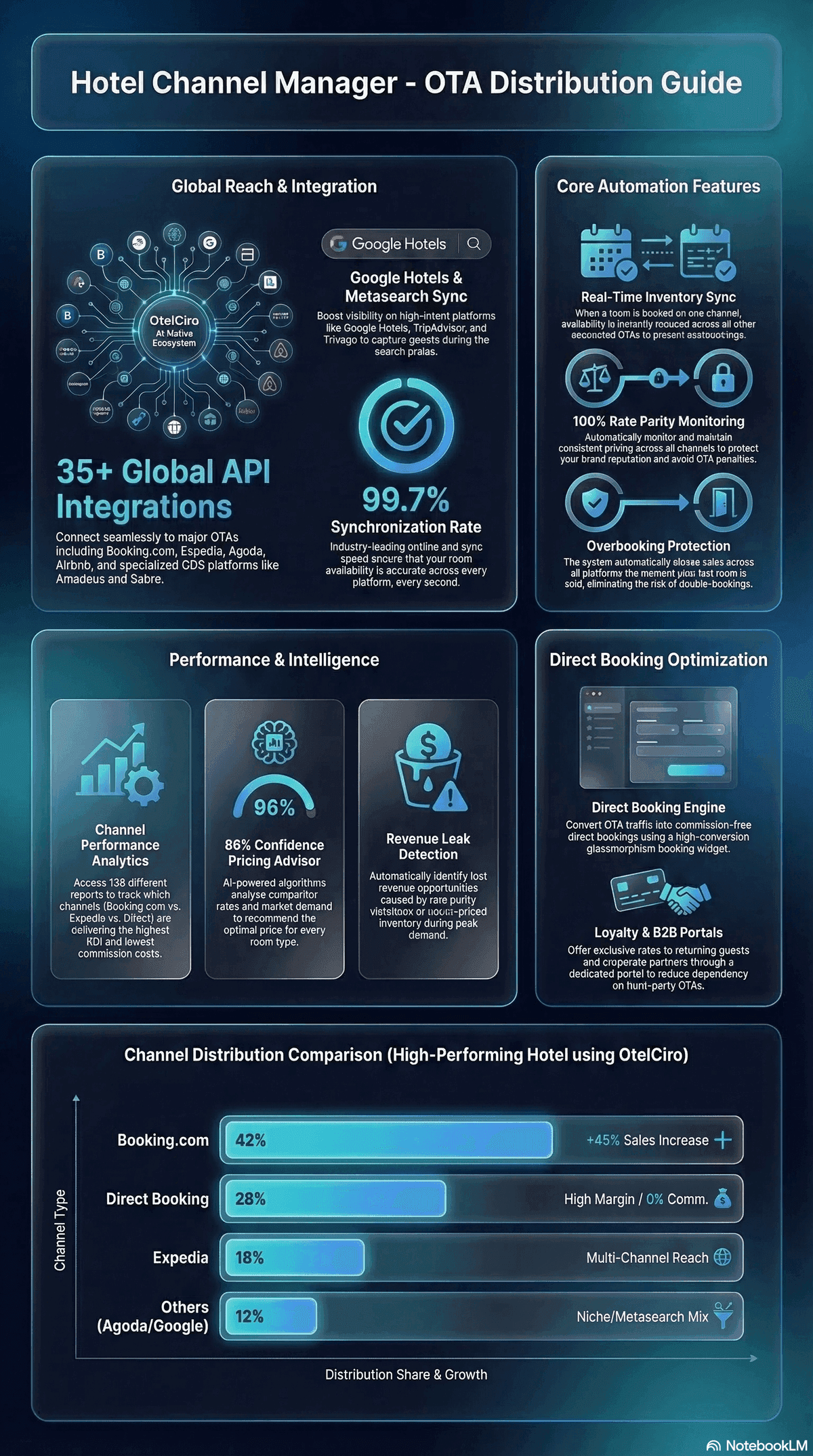
Embed this image on your site
<a href="https://otelciro.com/en/news/optimal-ota-channel-mix-strategy-2026-guide">
  <img src="https://cdn.sanity.io/images/1la98t0z/production/b9cee47e03a0891ad8e615048e78be166bc641de-1200x2150.png" alt="Hotel channel management and OTA distribution strategy" width="800" />
</a>
<p>Source: <a href="https://otelciro.com">OtelCiro</a> — AI Hotel Revenue Management</p>
Channel Mix Optimization Model
Ideal Channel Distribution (General Target)
- Direct channel: 35-45% (lowest cost, highest control)
- Booking.com: 25-35% (high volume, billboard effect)
- Expedia Group: 10-15% (market diversification)
- GDS: 5-15% (corporate segment)
- Metasearch: 5-10% (growing channel)
- Other OTA/Bedbank: 5-10% (niche markets)
Channel Share Management Rules
Rule 1: Occupancy-based channel opening/closing
- Occupancy < 50% → All channels open, aggressive visibility
- Occupancy 50-80% → Standard channel mix
- Occupancy > 80% → Narrow down high-commission channels
- Occupancy > 90% → Direct channel and low-commission channels only
Rule 2: Seasonal channel strategy
- High season: Increase direct channel share, exit OTA promotions
- Low season: Increase OTA visibility, participate in promotions
Rule 3: Lead time-based channel preference
- 30+ days in advance: All channels open (volume generation)
- 7-30 days: Start narrowing down high-cost channels
- 0-7 days: Direct channel and low-cost channels prioritized
Related reading: Increase Direct Bookings: Reduce OTA Dependency
Risks of Channel Diversification
Too many channels also create problems:
- Inventory management complexity: Managing 15+ channels can challenge a channel manager
- Rate inconsistency risk: Different rates and restrictions for each channel, risk of rate parity violation
- Quality control: Keeping profiles updated and optimized on every platform takes time
- Bedbank rate leakage: Wholesale rates being undersold on retail channels
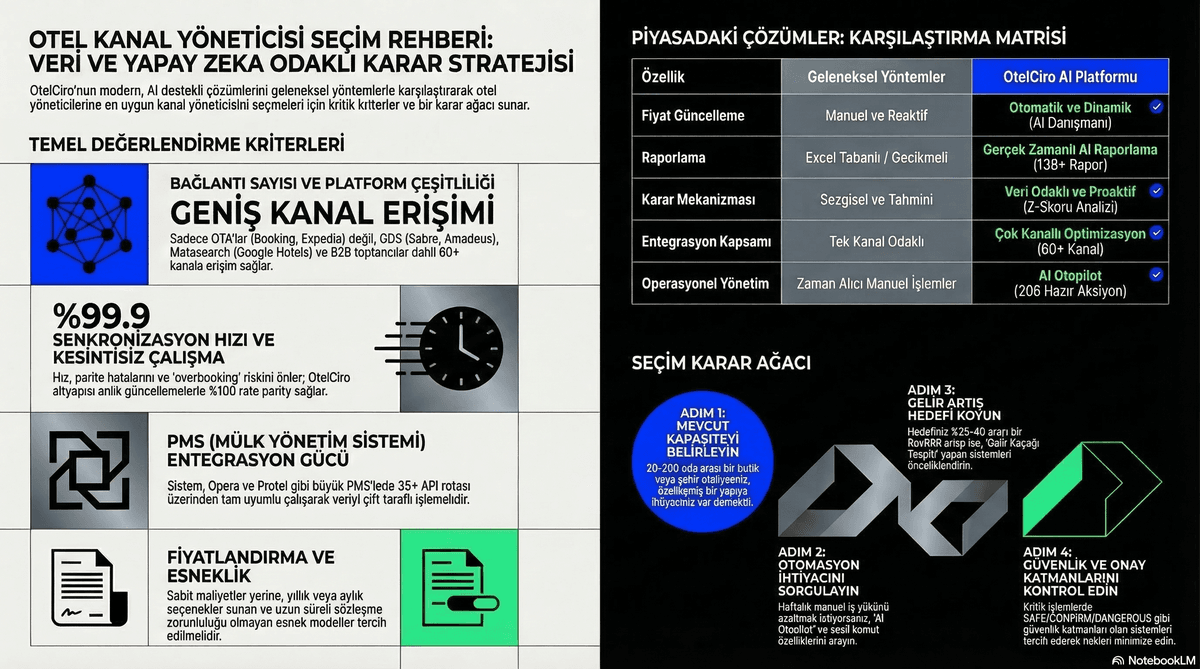
Optimal number of channels: 5-8 active channels (2-3 major OTAs + direct + GDS + 1-2 niche channels)
Embed this image on your site
<a href="https://otelciro.com/en/news/optimal-ota-channel-mix-strategy-2026-guide">
  <img src="https://cdn.sanity.io/images/1la98t0z/production/d7d8dd717a0471ca7d480294091db24c1186f694-1200x669.png" alt="2026 hotel channel manager selection guide" width="800" />
</a>
<p>Source: <a href="https://otelciro.com">OtelCiro</a> — AI Hotel Revenue Management</p>
Strategies to Increase Direct Channel Share
The key to channel mix optimization is increasing direct channel share:
- Price advantage: Always the lowest rate on the direct channel
- Added value: Free breakfast, late check-out for direct bookings
- Utilize the Billboard Effect: Visibility on OTAs, bookings from the direct channel
- SEO and SEM investment: First rank for hotel name searches
- Remarketing: Ads for visitors coming from OTAs to your website
- Email marketing: Direct offers to past guests
- Social media: Direct booking referrals from Instagram and Facebook
Channel Performance Monitoring
Monitor each channel's performance monthly with the following metrics:
| Metric | Definition | Target |
|---|---|---|
| Channel share (%) | Ratio within total revenue | Close to target |
| NRevPAR | Net revenue / available room | High |
| Conversion rate | Views / bookings | Upward trend |
| Cancellation rate | Cancellations / total bookings | Low |
| Average lead time | Booking-to-arrival duration | Long |
| ALOS (Average LOS) | Average length of stay | Long |
Related reading: GDS 2026: Amadeus, Sabre, and Travelport Hotel Strategies
Channel Mix Optimization with OtelCiro
OtelCiro's Sales module manages all distribution channels from a single platform. Create the most profitable channel mix with channel-based performance analysis, automatic rate/inventory control, and NRevPAR-based channel optimization.
Optimize your channel strategy with OtelCiro Sales
Conclusion
Channel mix is the strategic dimension of revenue management. Dependence on a single channel creates risk, while too many channels create complexity. The optimal balance is achieved with 5-8 active channels and NRevPAR-based management.
The ideal channel mix differs for every hotel — create your own formula based on your hotel type, location, source markets, and segment structure.
Discover how OtelCiro's Sales can automate this process.
![Europe's Hotel Construction Boom: 2026 Oversupply Risks [Market Analysis]](https://cdn.sanity.io/images/1la98t0z/production/6dfe59137f56aa14bfcba86d9db3cf05ff89f406-2752x1536.jpg?w=1920&q=50&auto=format&fit=max)