![Multilingual Hotel Staff: Communication & Coordination [2026 Guide]](https://cdn.sanity.io/images/1la98t0z/production/36f57e8139f174074e143c4978c4b57f69d2815e-2752x1536.jpg?w=1920&q=65&auto=format&fit=max)
Key Takeaways
- Multilingual environments in hotels present significant operational risks, with internal communication errors accounting for 28% of issues and leading to 8-12% annual revenue loss.
- Implement a layered language strategy, define common business languages, and create multilingual standard operational term lists to reduce communication errors by 45%.
- Leverage AI-powered translation tools for instant text, voice, and visual translation, customized specifically for hospitality terminology.
- Enhance learning efficiency by 60% by providing multilingual training content and utilizing AI support for direct guest communication.
- Foster cross-cultural understanding through comprehensive awareness training and effective conflict management, supported by robust, multilingual digital communication and task management platforms.
The Language Barrier: Hotels' Invisible Operational Risk
Hotels in international tourism destinations face the reality of multiple languages from both staff and guest perspectives. In a five-star hotel in Antalya, an average of 6-8 different nationalities work, while guests come from 15-20 different countries. This multilingual environment, when not properly managed, transforms into serious operational risks.
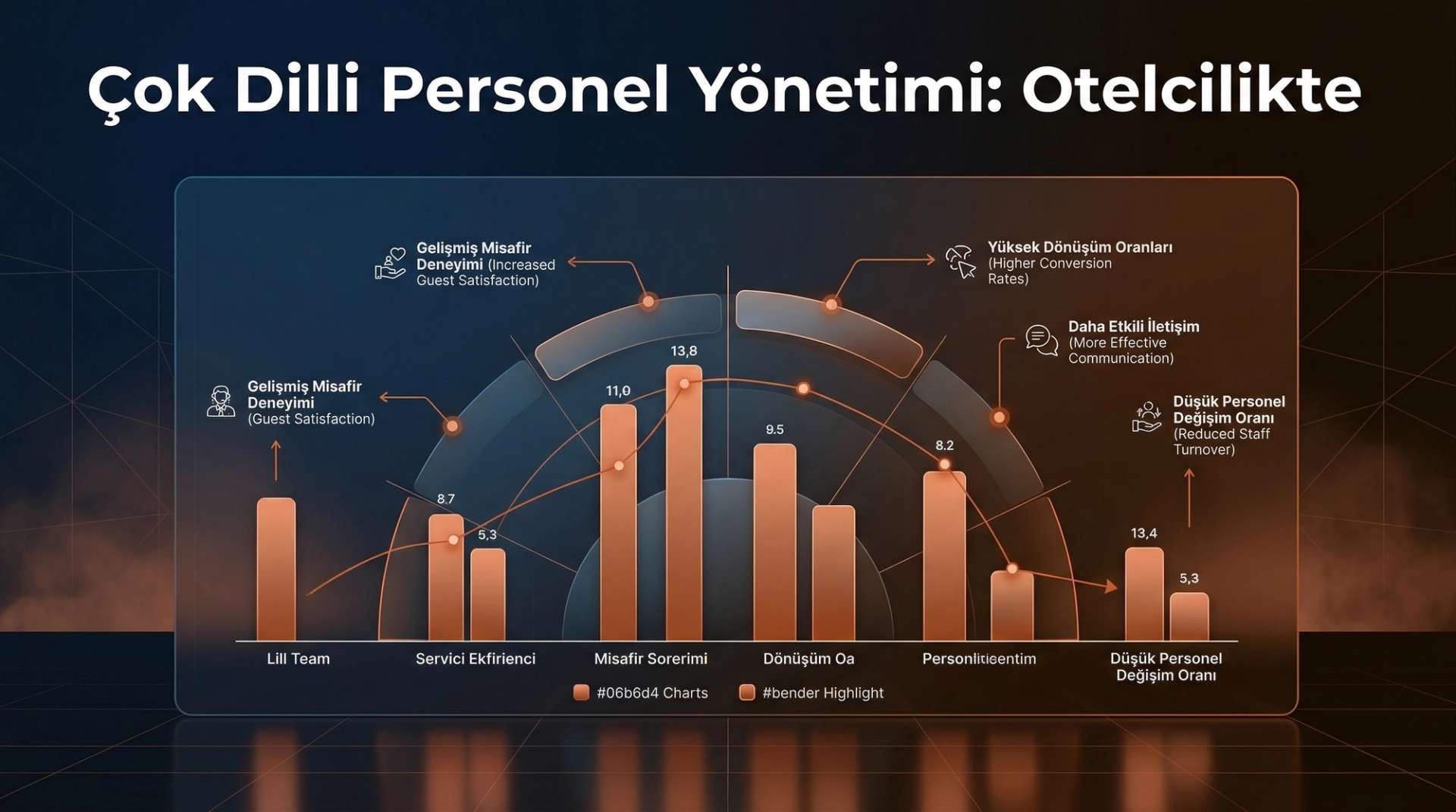
Embed this image on your site
<a href="https://otelciro.com/en/news/multilingual-hotel-staff-communication-coordination-2026-guide">
  <img src="https://cdn.sanity.io/images/1la98t0z/production/36f57e8139f174074e143c4978c4b57f69d2815e-2752x1536.jpg" alt="Multilingual Staff Management Infographic" width="800" />
</a>
<p>Source: <a href="https://otelciro.com">OtelCiro</a> — AI Hotel Revenue Management</p>
Errors arising from internal communication constitute 28% of the problems experienced in hotel operations. A misunderstood room service order, an incorrectly conveyed guest request, or a security procedure not fully comprehended—all can stem from a language barrier. According to one study, the impact of communication mishaps on guest satisfaction in multilingual environments corresponds to an annual 8-12% revenue loss.
Technology-supported multilingual management strategies are the most effective way to overcome these barriers.
Related reading: Employee Engagement Survey: Hospitality Industry Applications
Language Strategy in Internal Communication
Internal communication in a hotel encompasses critical operational information flow, from inter-departmental coordination to shift handovers. A systematic language strategy is essential for this flow to function smoothly in a multilingual environment.
Defining a Common Business Language
Most international hotels adopt English as their common business language (lingua franca). However, expecting all staff to be fluent in English is not realistic. An effective approach is to differentiate language expectations based on communication layers:
Layer 1 — Strategic Communication:
- Department manager meetings, general manager announcements
- Language: Turkish + English (bilingual)
Layer 2 — Operational Communication:
- Shift handovers, inter-departmental coordination
- Language: Common business language + visuals and symbols
Layer 3 — Daily Communication:
- Intra-team conversations, quick information sharing
- Language: Staff's native language + basic common language terms
Standard Operational Terms
Creating a multilingual standard term list for each department reduces communication errors by 45%:
| Turkish | English | German | Russian |
|---|---|---|---|
| Oda hazır | Room ready | Zimmer bereit | Номер готов |
| Check-out yapıldı | Checked out | Ausgecheckt | Выселен |
| Acil tamir | Urgent repair | Dringende Reparatur | Срочный ремонт |
| Misafir şikayeti | Guest complaint | Gästebeschwerde | Жалоба гостя |
| VIP geliyor | VIP arriving | VIP Ankunft | VIP прибывает |
These terms should be visibly displayed in all internal communication systems, mobile applications, and physical boards.
AI-Powered Translation and Language Tools
Artificial intelligence offers tools that revolutionize hotel staff communication.
Instant Translation Systems
OtelCiro's voice assistant technology provides instant translation support for staff communication:
- Text translation: Automatic translation in the internal messaging system
- Voice translation: Instant voice translation during walkie-talkie and phone calls
- Visual translation: Instant camera translation of signs, labels, and instructions
- Contextual translation: Translation in the correct context, specialized for hospitality terminology
Unlike general translation tools, AI translation systems are customized for hospitality terminology. While a general translator might translate "double room" as "çift oda," a hospitality AI correctly renders it as "iki kişilik oda" (room for two people).
Multilingual Training Content
Presenting training materials in the staff's native language increases learning efficiency by 60%. AI automatically translates training content into all necessary languages:
- SOP (Standard Operating Procedures) translation
- Video training subtitling
- Multilingual versions of quizzes and exam questions
- Multilingual visual cards for emergency procedures
Guest Communication Support
AI language support also plays a critical role in direct staff-guest communication:
- Instant translation application for reception staff
- Elimination of language barriers in room service orders
- Multilingual information access for concierge services
- Cultural sensitivity warnings in complaint management
Related reading: Front Office Training: Realistic Scenarios with VR Simulation
Cross-Cultural Management
The language problem is not solved merely by word translation. Cultural differences directly impact communication styles, perceptions of hierarchy, and approaches to conflict management.
Cultural Awareness Training
To manage a multicultural team, managers need to gain awareness in the following areas:
- Communication style: Direct (German, Dutch) vs. indirect (Japanese, Korean) communication cultures
- Perception of hierarchy: Expectation of flat organization vs. strong hierarchy expectation
- Receiving feedback: Cultures of open criticism vs. "saving face" cultures
- Perception of time: Punctual cultures vs. flexible time cultures
- Personal space: Differences in norms for physical proximity
Conflict Management
Conflicts arising from cultural differences can severely disrupt team harmony if not managed correctly. For effective conflict management:
- Cultural mediator: Having a coordinator who understands different cultures on each shift
- Open communication channels: Anonymous feedback mechanism for issues that cannot be expressed due to language barriers
- Team-building activities: Social activities that strengthen cross-cultural interaction
- Religious and cultural calendar: Tracking all staff's important holidays and observances
Technology Infrastructure and Integration
A technology infrastructure that supports multilingual staff management is fundamental to operational efficiency.
Internal Communication Platform
A multilingual internal communication platform designed for hotel staff should include the following features:
- Automatic translation: Displaying messages in the recipient's preferred language
- Visual communication: Icon, emoji, and photo-based communication options instead of text
- Voice messages: Voice message support for staff with writing difficulties
- Channel-based organization: Communication channels based on department, shift, and project
- Emergency mode: Simultaneous emergency notifications in all languages
Digital Task Management
In a multilingual environment, task assignment and tracking must be digital to avoid ambiguity:
- Tasks are presented with visual cards (photo + short text)
- Completion confirmation is done with a single click
- Problem reporting is supported by photos and voice notes
- Supervisors track all tasks in real-time
Performance Tracking
In a multilingual environment, performance evaluations should address language proficiency as a separate category:
- Tracking language development (beginner level → current level)
- Communication-related error rate
- Language-based analysis of guest satisfaction scores
- Cross-cultural collaboration score
OtelCiro's voice assistant and AI solutions eliminate communication barriers in multilingual hotel management, supporting operational excellence.
Related reading: Employee Wellness Program: Hotel Staff Health
![Europe's Hotel Construction Boom: 2026 Oversupply Risks [Market Analysis]](https://cdn.sanity.io/images/1la98t0z/production/6dfe59137f56aa14bfcba86d9db3cf05ff89f406-2752x1536.jpg?w=1920&q=50&auto=format&fit=max)