![Middle East Luxury Hotel Boom: Dubai & Beyond [2026 Market Analysis]](https://cdn.sanity.io/images/1la98t0z/production/6b5feba95addef0b150c343d6de23ad616027a9b-1200x669.png?w=1920&q=65&auto=format&fit=max)
Key Takeaways
- The Middle East luxury hotel market reached $28.4 billion in revenue in 2026, marking an 85% increase from 2019.
- Dubai remains a global luxury hospitality leader, boasting a $485 ADR and 78% occupancy in the luxury segment.
- Saudi Arabia's Vision 2030 fuels massive projects like NEOM and The Red Sea, targeting 100 million tourists by 2030 and a $32 billion tourism sector by 2026.
- Turkish hoteliers face both competitive pressure and significant opportunities in the Middle East for management services and attracting high-spending Gulf tourists.
- While Middle East investments offer high growth potential, Istanbul presents a strong alternative with competitive cap rates and lower construction costs.
Middle East: The New Hub of Luxury Hospitality
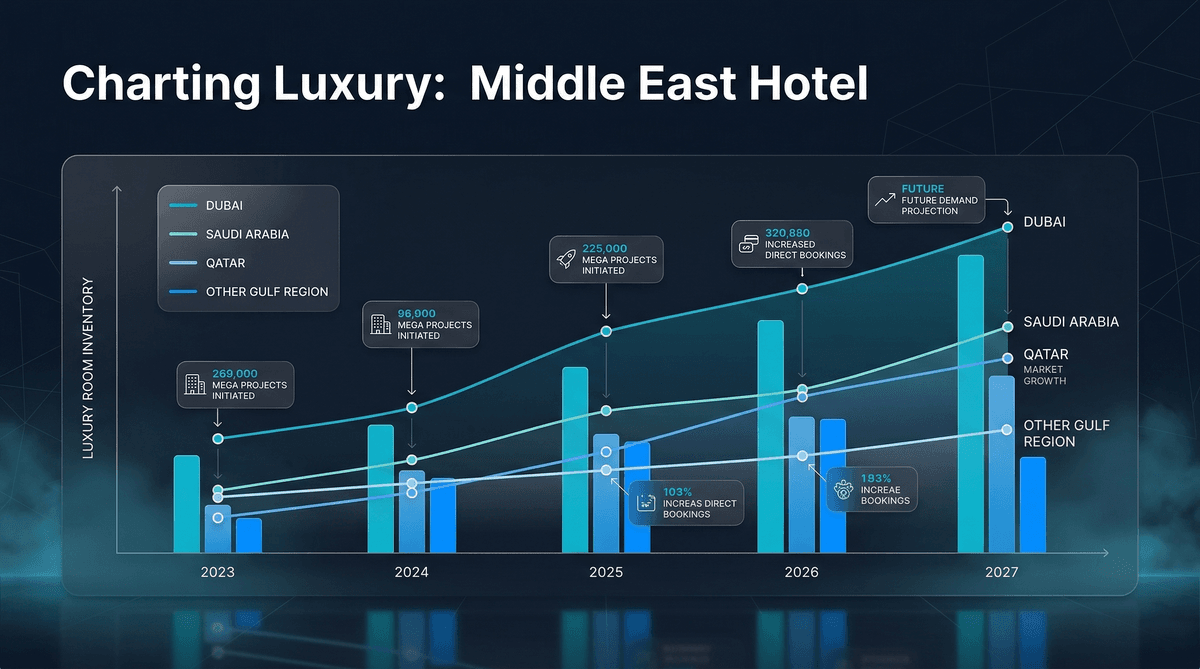
The Middle East region continues to set new records in 2026 as the fastest-growing destination in the global luxury hotel market. Total luxury hotel revenue across the region, particularly in Dubai, Abu Dhabi, Riyadh, and Doha, reached $28.4 billion — an 85% increase over 2019. The Middle East is no longer just an oil-rich geography but an arena where the world's most ambitious tourism visions are brought to life.
For Turkish hoteliers, this growth presents both a competitive threat and a significant opportunity. Turkish management companies and hospitality professionals are taking on an increasingly important role in new projects across the Middle East.
Embed this image on your site
<a href="https://otelciro.com/en/news/middle-east-luxury-hotel-boom-dubai-beyond-2026-market-analysis">
  <img src="https://cdn.sanity.io/images/1la98t0z/production/6b5feba95addef0b150c343d6de23ad616027a9b-1200x669.png" alt="Middle East Luxury Hotel Growth Infographic" width="800" />
</a>
<p>Source: <a href="https://otelciro.com">OtelCiro</a> — AI Hotel Revenue Management</p>
Related reading: Mediterranean Hotel Market Comparison: Spain, Italy, Turkey
Dubai: The Global Capital of Luxury Hospitality
Dubai maintains its position as one of the world's most visited cities, welcoming 21.2 million international tourists in 2026. The city's luxury hotel performance metrics are exceptional:
- Luxury segment ADR: $485 (28% above the global luxury average)
- Luxury segment occupancy: 78%
- Luxury RevPAR: $378
- Total luxury room count: 42,500
- New luxury rooms in pipeline: 8,200 (2026-2028)
Several key factors underpin Dubai's success:
Infrastructure investments: Dubai Airport (DXB) is one of the world's busiest airports with an annual capacity of 92 million passengers. Upon completion of the Al Maktoum International Airport expansion project, capacity will reach 260 million passengers.
Tax advantages: The absence of personal income tax and low corporate tax rates attract both tourists and investors.
12-Month Tourism: Dubai's ideal winter climate complements Europe's summer vacation season. Even the lowest occupancy rate does not fall below 65%.
Mega Events: The lasting legacy of EXPO 2020, combined with a year-round calendar of events like Formula 1, Dubai Shopping Festival, and Global Village.
Dubai's Emerging Trends
Key trends dominating Dubai's luxury hospitality in 2026 include:
- Branded residences: Hotel-branded residential projects are at record levels. Brands like Bulgari, Armani, and Dorchester Collection are developing residential-hotel hybrid projects.
- Ultra-luxury experiences: Underwater hotels (Atlantis), space-themed hotel projects, and artificial island concepts.
- Wellness luxury: The evolution of the traditional definition of luxury from "display of wealth" to "healthy living."
Saudi Arabia: The Grand Scale of Vision
Saudi Arabia's Vision 2030 program involves massive investments aimed at transforming the country into a new global tourism superpower. In 2026, the size of Saudi Arabia's tourism sector reached $32 billion, with a 2030 target of 100 million tourists.
Mega Projects
NEOM/The Line: The world's most ambitious city project. This 170 km long linear city plans a hotel capacity of 9,000 rooms. It will operate entirely on renewable energy and have zero carbon emissions.
The Red Sea Project: Ultra-luxury ecotourism across 50 islands and over 200 km of coastline. As of 2026, 16 resort hotels have opened, with a target of 8,000 rooms by 2030. ADR target: $800+.
AlUla: A cultural and luxury tourism destination developed around a historic UNESCO site, featuring properties by Aman, Banyan Tree, and Jean Nouvel.
Diriyah: The transformation of the historic area near Riyadh into a luxury tourism and cultural hub. It includes 38 hotel and resort projects, totaling 5,600 rooms.
Saudi Arabia's Challenges
This ambitious vision also faces significant challenges:
- Skilled personnel shortage: Finding professionals to manage such vast capacity in a country with limited hospitality experience is difficult.
- Perception challenge: For international tourists, Saudi Arabia is not yet perceived as a vacation destination.
- Seasonality: Temperatures reaching 50°C in summer limit outdoor tourism.
- Supply glut risk: The number of projects in the pipeline could exceed demand, especially in the 2028-2030 period.
Related reading: Hotel Revenue Metrics & KPI Guide: RevPAR, ADR, GOPPAR
Turkey-Middle East Interaction
This growth in the Middle East directly impacts Turkey in several dimensions:
Competition Dimension
Gulf countries directly compete with Turkey, especially during the winter season. Travelers from Northern European markets seeking "winter sun" now see Dubai as a strong alternative. Dubai's winter occupancy is 82%, while Antalya's remains at 42% during the same period.
Opportunity Dimension
Turkish management companies: Demand for Turkish hospitality professionals in new projects across the Middle East is increasing. In 2026, Turkish management teams were involved in 12% of hotel projects in Saudi Arabia.
Attracting Gulf tourists: The number of tourists visiting Turkey from Gulf countries is increasing by 15% annually. This segment represents Turkey's highest-spending tourist group, with an average spend of $1,850 per tourist.
Know-how transfer: Technology adoption and guest experience standards in Dubai and Saudi Arabia offer learning opportunities for Turkish hoteliers, particularly in AI-powered personalization and operational efficiency.
Investment Perspective
A comparative analysis of Middle East hotel investment with Turkey:
| Parameter | Dubai | Riyadh | Istanbul |
|---|---|---|---|
| Construction cost per room ($) | 350,000-600,000 | 280,000-500,000 | 120,000-280,000 |
| ADR ($) | 220 | 155 | 168 |
| Occupancy (%) | 76 | 62 | 74 |
| RevPAR ($) | 167 | 96 | 124 |
| Cap rate (%) | 5-7 | 7-9 | 7-11 |
| Payback period (years) | 10-15 | 8-12 | 7-12 |
Istanbul's capitalisation rate (cap rate) advantage is notable. With lower construction costs and competitive RevPAR, Istanbul offers a strong alternative to the Middle East in terms of risk-return balance.
AI-powered reporting tools provide real-time updates on these comparative metrics, supporting investment decisions.
Conclusion and Outlook
The Middle East luxury hotel market will continue to grow, but the sustainability of this growth remains in question. While Dubai's mature and proven model offers a reliable investment environment, Saudi Arabia's mega-projects carry a high-risk, high-reward profile.
For Turkish hoteliers, the smartest strategy is to view the Middle East as both a competitive threat and a business opportunity. Being active in three dimensions – attracting Gulf tourists, exporting management services, and learning best practices – will strengthen Turkey's position in the global hotel market.
![Europe's Hotel Construction Boom: 2026 Oversupply Risks [Market Analysis]](https://cdn.sanity.io/images/1la98t0z/production/6dfe59137f56aa14bfcba86d9db3cf05ff89f406-2752x1536.jpg?w=1920&q=50&auto=format&fit=max)