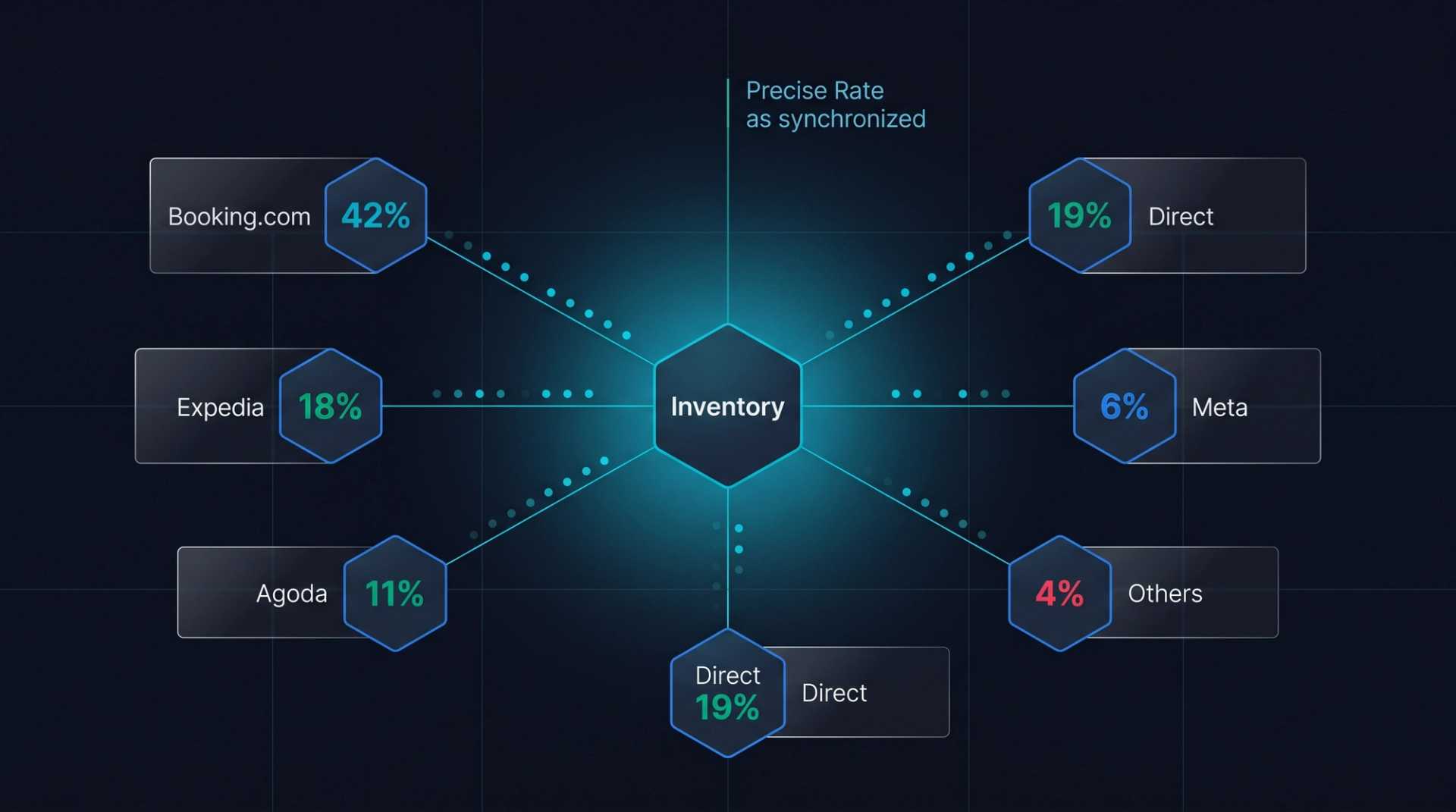
![Mastering Hotel Predictive Analytics [2026 Strategy Guide]](https://cdn.sanity.io/images/1la98t0z/production/26edf16fa2c147a6993fc1241d60559501cec414-1376x768.jpg?w=1920&q=65&auto=format&fit=max)
Key Takeaways
- Predictive analytics shifts focus from "what happened" to "what will happen," enabling proactive, data-driven decision-making in hotels.
- Key applications include accurate demand forecasting, dynamic pricing, pre-empting cancellations, predicting customer churn, and optimizing staff planning.
- Implementing predictive analytics can lead to significant gains, such as a 73% higher decision accuracy and a 9% increase in RevPAR, as shown in case studies.
- High-quality, consistent, and integrated historical data is fundamental for effective predictive models.
- Hotels can evolve from basic statistical forecasting to real-time, AI-driven predictive and prescriptive systems, gaining a substantial competitive edge.
Looking to the Past Isn't Enough — You Need to See the Future
Traditional hotel reporting answers "what happened": last month's occupancy, RevPAR, channel performance. However, strategic decision-making requires an answer to "what will happen." This is precisely where predictive analytics comes into play.
According to research from MIT Sloan Management Review, businesses using predictive analytics achieve 73% higher decision accuracy compared to those that don't. In hospitality, this translates to setting the right price at the right time, forecasting cancellations in advance, and optimizing staff planning.
Predictive analytics is the next evolution of business intelligence.

Embed this image on your site
<a href="https://otelciro.com/en/news/mastering-hotel-predictive-analytics-2026-strategy-guide">
  <img src="https://cdn.sanity.io/images/1la98t0z/production/26edf16fa2c147a6993fc1241d60559501cec414-1376x768.jpg" alt="Hotel predictive analytics use cases" width="800" />
</a>
<p>Source: <a href="https://otelciro.com">OtelCiro</a> — AI Hotel Revenue Management</p>
Related reading: Hotel Management with Smart PMS: Transition from Traditional Systems to AI-Powered Platforms
Related reading: Hotel AI Email Automation: Personalized Communication
Predictive Analytics Use Cases
1. Demand Forecasting
This is the most critical use case. Future occupancy and demand are predicted by analyzing historical data, market trends, and external factors.
Forecast inputs: Historical occupancy, pace data, competitor prices, event calendar, weather, flight prices, Google Trends search volume
Output: Date-based occupancy forecast (with 85% confidence interval)
2. Price Optimization
Based on demand forecasts, it automatically determines the price point that maximizes revenue. This is an AI-powered version of a dynamic pricing strategy.
3. Cancellation Prediction
It estimates the probability of cancellation for each reservation. For reservations with a high cancellation risk:
- An overbooking strategy can be applied
- Pre-arrival communication can prevent cancellations
- Non-refundable rates can be offered
4. Customer Churn Prediction
It predicts which regular guests are unlikely to return. Proactive win-back campaigns are directed at guests at high risk of being lost.
5. Predictive Maintenance
By analyzing IoT sensor data, malfunctions in air conditioning, elevators, or water systems are predicted before they occur. Proactive maintenance eliminates guest complaints and emergency intervention costs.
6. Staff Planning
Based on demand forecasts, it pre-determines how many staff are needed on any given day. This avoids excess staff costs on low-demand days and staff shortages on high-demand days.
Embed this image on your site
<a href="https://otelciro.com/en/news/mastering-hotel-predictive-analytics-2026-strategy-guide">
  <img src="https://cdn.sanity.io/images/1la98t0z/production/9b97fc6f7c09833a7eb10112e6784fd5f5970b20-1200x669.png" alt="Hotel cybersecurity and data protection guide" width="800" />
</a>
<p>Source: <a href="https://otelciro.com">OtelCiro</a> — AI Hotel Revenue Management</p>
Descriptive vs. Predictive vs. Prescriptive Analytics
| Analytics Type | Question | Hotel Example |
|---|---|---|
| Descriptive | What happened? | "Last month's occupancy was 72%" |
| Diagnostic | Why did it happen? | "Convention cancellation caused the occupancy drop" |
| Predictive | What will happen? | "Next month's occupancy will be 68%" |
| Prescriptive | What should we do? | "Reduce prices by 8% and launch an OTA promotion" |
Modern ML-based systems offer all four of these levels together.
Related reading: E-Invoice and Digital Accounting in Hotels: GİB Integration Guide (2026)
Related reading: Hotel API Integration: The Foundation of Modern Hotel Management
Predictive Analytics in Practice
Case Study: Cancellation Prediction Model
A city hotel has an annual cancellation rate of 28%. With predictive analytics:
- The model calculates the cancellation probability for each reservation
- Reservations with 70%+ cancellation probability are identified (~15% of total reservations)
- An automated pre-arrival email is sent to these guests: "We look forward to welcoming you! Free spa pass gift before check-in"
- The cancellation rate drops from 28% to 21% → annual €35,000 additional revenue
Case Study: Dynamic Pricing
A resort hotel, with predictive analytics:
- The model forecasts daily demand up to 90 days in advance
- The optimum price is determined for each day
- Price adjustments are automatically applied
- RevPAR increases by 9% → annual €120,000 additional revenue
Embed this image on your site
<a href="https://otelciro.com/en/news/mastering-hotel-predictive-analytics-2026-strategy-guide">
  <img src="https://cdn.sanity.io/images/1la98t0z/production/94430a233fc50ac1fa33aa6540d2d61c577b51bc-1200x2150.png" alt="Smart PMS hotel management system features" width="800" />
</a>
<p>Source: <a href="https://otelciro.com">OtelCiro</a> — AI Hotel Revenue Management</p>
The Importance of Data Quality
Predictive analytics is directly proportional to the quality of its input data. Low-quality data = low-quality predictions.
Data quality checklist:
- At least 2-3 years of historical data available
- Data is consistent and complete (missing values <5%)
- Abnormal data (pandemic period) is tagged
- External data sources are integrated (events, weather)
- Data freshness is ensured (daily flow)
Predictive Analytics Maturity Levels
| Level | Capability | Technology Requirement |
|---|---|---|
| 1. Basic | Simple forecasting based on historical data | Excel + experience |
| 2. Developing | Statistical models (regression) | BI tools |
| 3. Advanced | ML-based prediction models | AI/ML platform |
| 4. Mature | Real-time prediction + automated action | Integrated AI ecosystem |
Most hotels are currently at Level 1-2. Moving to Level 3-4 provides a concrete competitive advantage.
Related reading: Housekeeping Automation: 7 Steps to Digitalize Hotel Operations
Predictive Analytics with OtelCiro AI Engine
OtelCiro's AI Engine module is equipped with predictive analytics capabilities. It enables you to foresee the future with demand forecasting, price optimization, cancellation prediction, and automated action recommendations.
Discover the power of predictive analytics with OtelCiro AI Engine
Conclusion
Predictive analytics is the technology that makes "proactive management" possible in hospitality. Intervening before problems arise, seizing opportunities ahead of competitors, and utilizing resources most efficiently — all of these are possible with predictive analytics.
Start with your data quality, proceed with basic forecasting models, and gradually transition to an AI-powered predictive system. With each step, your decision quality and revenue performance will increase.
![Europe's Hotel Construction Boom: 2026 Oversupply Risks [Market Analysis]](https://cdn.sanity.io/images/1la98t0z/production/6dfe59137f56aa14bfcba86d9db3cf05ff89f406-2752x1536.jpg?w=1920&q=50&auto=format&fit=max)