![Luxury Train Hotels: Operations and Market Strategy [2026 Guide]](https://cdn.sanity.io/images/1la98t0z/production/689664a2822acbb5aeb364e6ad7f0f166ea9305e-1024x1024.png?w=1920&q=65&auto=format&fit=max)
Key Takeaways
- The global luxury train tourism market is valued at $3.8 billion as of 2025, with an 11.4% annual growth rate.
- Train hotels operate on a high-yield all-inclusive business model, often achieving 88% occupancy rates.
- Successful operations require balancing complex railway logistics with premium hospitality standards, such as keeping noise levels below 45 dB.
- Route design is the primary product, integrating landscape, local gastronomy, and cultural heritage into a seamless experience.
- As a sustainable alternative to aviation, rail travel produces 75-90% fewer carbon emissions, appealing to eco-conscious luxury travelers.
Train Hotels: Luxury Accommodation on Rails
Train travel was the primary mode of long-distance transportation in the pre-aviation era. Today, luxury train hotels are being redefined beyond mere transport as an experience-driven accommodation concept. From the romance of the Orient Express to South Africa's Rovos Rail, Japan's Shiki-shima, and Scotland's Royal Scotsman, train hotels are among the world's most prestigious lodging experiences.
The global luxury train tourism market reached $3.8 billion in 2025 and constitutes one of the most dynamic niche segments in the industry, with an annual growth rate of 11.4%. The rise of the "slow travel" trend in the post-COVID era has increased demand for train hotels by 65%.
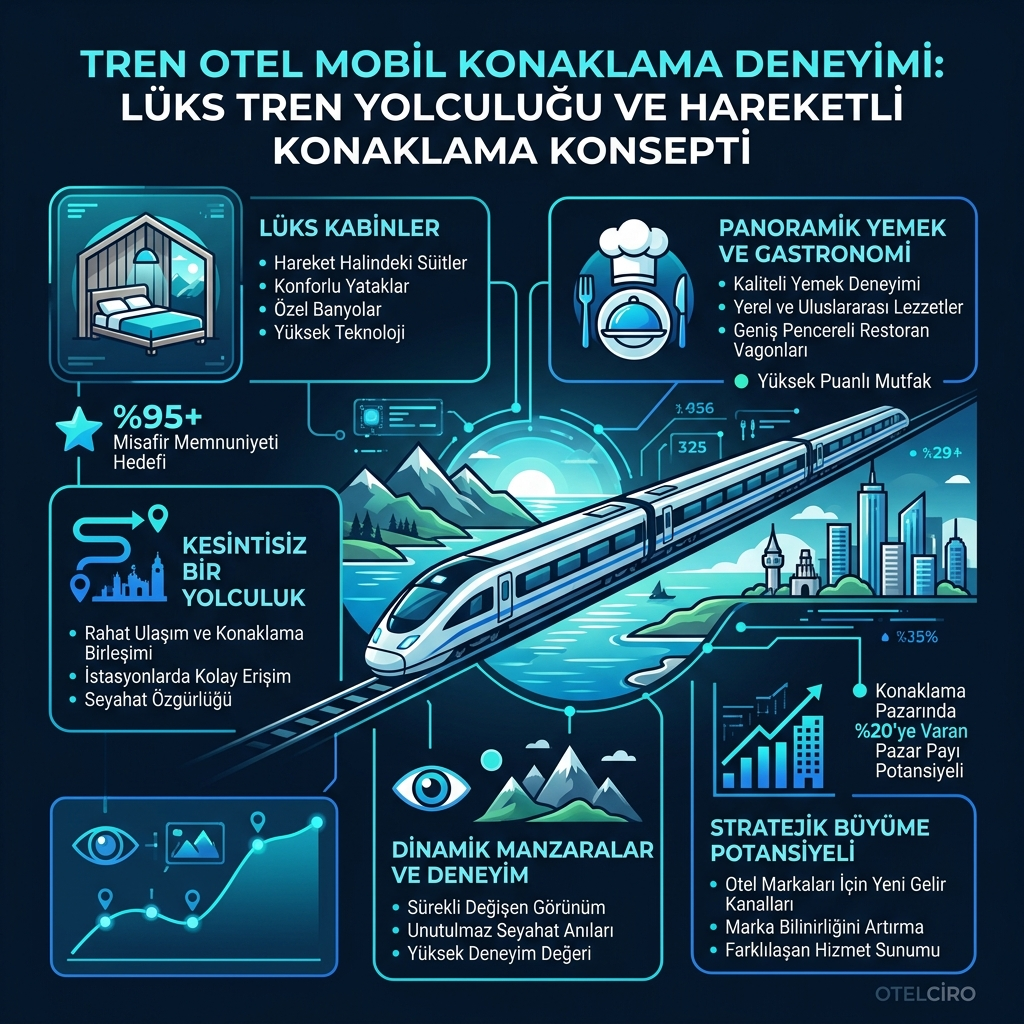
Embed this image on your site
<a href="https://otelciro.com/en/news/luxury-train-hotels-operations-and-market-strategy-2026-guide">
  <img src="https://cdn.sanity.io/images/1la98t0z/production/689664a2822acbb5aeb364e6ad7f0f166ea9305e-1024x1024.png" alt="Train Hotel Concept" width="800" />
</a>
<p>Source: <a href="https://otelciro.com">OtelCiro</a> — AI Hotel Revenue Management</p>
In this article, we examine the operation model, investment requirements, marketing strategies, and potential of the train hotel concept in detail.
Related reading: Bleisure: The Fusion of Business and Leisure Travel 2026
The Train Hotel Business Model
Train hotels utilize a business model distinct from traditional hotels and cruise ships. Offering both accommodation and transportation services results in a complex but high-yield operational model.
Revenue Structure
| Revenue Item | Ratio | Description |
|---|---|---|
| Accommodation (Ticket) | 50% | Within the all-inclusive package price |
| F&B (Food & Beverage) | 20% | Gourmet restaurant car and bar service |
| Tours and Activities | 15% | Stops and experiences along the route |
| Spa and Wellness | 8% | On-board spa services |
| Merchandise and Souvenirs | 7% | Exclusive collection products |
The revenue model for train hotels is generally based on all-inclusive package sales. Guests purchase accommodation, meals, drinks, and all activities for a single price. This model maximizes RevPAR (Revenue Per Available Room) and ensures a seamless guest experience.
Pricing Tiers
- Entry Level (2-3 nights): 2,000-5,000 Euros per person
- Premium (4-7 nights): 5,000-15,000 Euros per person
- Ultra-Luxury (7-14 nights): 15,000-50,000 Euros per person
At these price levels, average occupancy rates stand at 88%, which is higher than most luxury land-based hotels. Demand consistently exceeds supply, with some routes becoming fully booked 6-12 months in advance.
Route Design: The Backbone of the Experience
The quality of the train hotel experience depends largely on route design. A successful route must incorporate the following elements:
Visual Diversity: Different landscapes must be offered throughout the route—mountains, valleys, coasts, agricultural lands, and city skylines.
Cultural Stops: Historic towns, archaeological sites, and local markets along the route provide guests with discovery opportunities.
Gastronomy Integration: Reflecting the local cuisine of each stop in the train's restaurant. Regional wine tastings and farm visits are essential.
Pace Management: A balance between night travel (covering distance while guests sleep) and daytime scenic viewing. An average speed of 60-80 km/h allows guests to savor the scenery.
Iconic Train Hotels of the World
Venice Simplon-Orient-Express: London-Venice route, featuring Art Deco designed carriages. Nightly prices start at 3,000 Euros with a 97% annual occupancy rate.
Rovos Rail (South Africa): Cape Town-Pretoria and Safari routes. 3-15 night programs. Africa's most luxurious train experience.
The Ghan (Australia): A 2,979 km route between Adelaide and Darwin. An experience exploring the Australian outback.
Shiki-shima (Japan): The world's most expensive train hotel. A 4-night route starts at $12,000. Designed with 17 suites reflecting Japanese aesthetics.
Related reading: Global Traveler Profiles: Target Audience Analysis
Operational Challenges
Train hotel management is a complex discipline situated at the intersection of hospitality and railway operations.
Technical Requirements
Carriage Design: Providing luxury hotel standards in a narrow, moving space requires significant engineering skill. A standard train car is 2.6-3.2 meters wide and 23-26 meters long. This space must accommodate a bedroom, bathroom, seating area, and storage.
Vibration and Noise Insulation: Rail-wheel contact generates vibration and noise. Premium insulation systems must reduce indoor noise levels to below 45 dB, which is quieter than a normal conversation.
Water and Energy Management: A moving train is not connected to a grid like a static building. Energy independence is achieved through water tanks, generators, and, in recent years, solar-paneled roof systems.
Meal Preparation: Preparing gourmet meals in a cramped, moving kitchen requires specially trained chefs. Luxury train restaurants often collaborate with Michelin-starred chefs, as food quality is considered the most critical component of the experience.
Railway Coordination
Operating a train hotel requires coordination with other services using the railway infrastructure:
- Track usage permits and slot allocation
- Station access and platform rights
- Safety and signaling system compatibility
- Border crossing procedures for international routes
Train Hotel Potential in Türkiye
Türkiye holds extraordinary potential for the train hotel concept. Its diverse geography, rich history, strong culinary culture, and developing railway infrastructure meet all the core requirements of this concept.
Potential Routes
Istanbul - Ankara (The Historical Silk Road): A route stretching from the Marmara region to Central Anatolia. Cultural and natural richness with stops in Eskişehir, Sakarya, and Bolu. A 2-night program.
Izmir - Denizli - Antalya (Aegean-Mediterranean Route): A route extending from the Aegean coast to the inland regions and the Mediterranean. Pamukkale, ancient cities, and Taurus Mountain views. A 3-night program.
Ankara - Kars (Luxury Version of the Eastern Express): The Eastern Express has become a social media phenomenon, signaling strong demand for a luxury train hotel version of this line. A 3-4 night program with stops in Sivas, Erzincan, Erzurum, and Kars. Activities include the Ruins of Ani and Sarıkamış ski resort.
Istanbul - Edirne - Thessaloniki (The Rumelia Route): An international route to discover Ottoman heritage. Selimiye Mosque, old Istanbul, and Greek culinary experiences. A 2-night program.
Market Size Estimate
The current demand for the Eastern Express demonstrates how strong the appetite for train tourism is in Türkiye. Standard Eastern Express tickets sell out within minutes and can be found on the black market for 10 times their value. A luxury train hotel version could host 5,000-10,000 guests per year at a price range of 3,000-8,000 Euros per person, generating 15-80 million Euros in annual revenue.
Marketing and Brand Strategy
Train hotel marketing is based on the fusion of nostalgia and modernity:
- Cinematic Content: The visual richness of train travel provides ideal material for film-quality promotional videos. The cultural context created by Orient Express films strengthens marketing messages.
- Influencer Programs: Long-format content production with travel, gastronomy, and luxury lifestyle influencers. YouTube documentaries and Instagram Reels campaigns.
- Corporate Segment: For corporate meetings, incentive programs, and VIP guest hosting, train hotel packages offer a far more impressive experience than traditional hotel alternatives.
- Digital Management: Multi-channel sales, dynamic pricing, and CRM management can be executed integrally through modern Sales Platforms.
Related reading: Direct Booking and Booking Engine Strategies
The Sustainability Advantage
Train travel produces 75-90% lower carbon emissions compared to air travel. This environmental advantage provides a powerful marketing message in an era of increasing sustainability awareness.
Modern train hotels can reinforce this advantage by:
- Establishing local supply chains to minimize "food miles."
- Eliminating single-use plastics.
- Offering carbon offset programs.
- Economically supporting communities along the route.
The train hotel concept represents one of the most romantic, sustainable, and profitable niche segments of the hospitality industry. Türkiye’s rich geography, deep history, and developing railway infrastructure provide an ideal foundation for realizing this concept. The wave of demand created by the Eastern Express serves as a strong market signal for luxury train hotel investment, and a significant window of opportunity is open for early-moving investors.
![Europe's Hotel Construction Boom: 2026 Oversupply Risks [Market Analysis]](https://cdn.sanity.io/images/1la98t0z/production/6dfe59137f56aa14bfcba86d9db3cf05ff89f406-2752x1536.jpg?w=1920&q=50&auto=format&fit=max)