
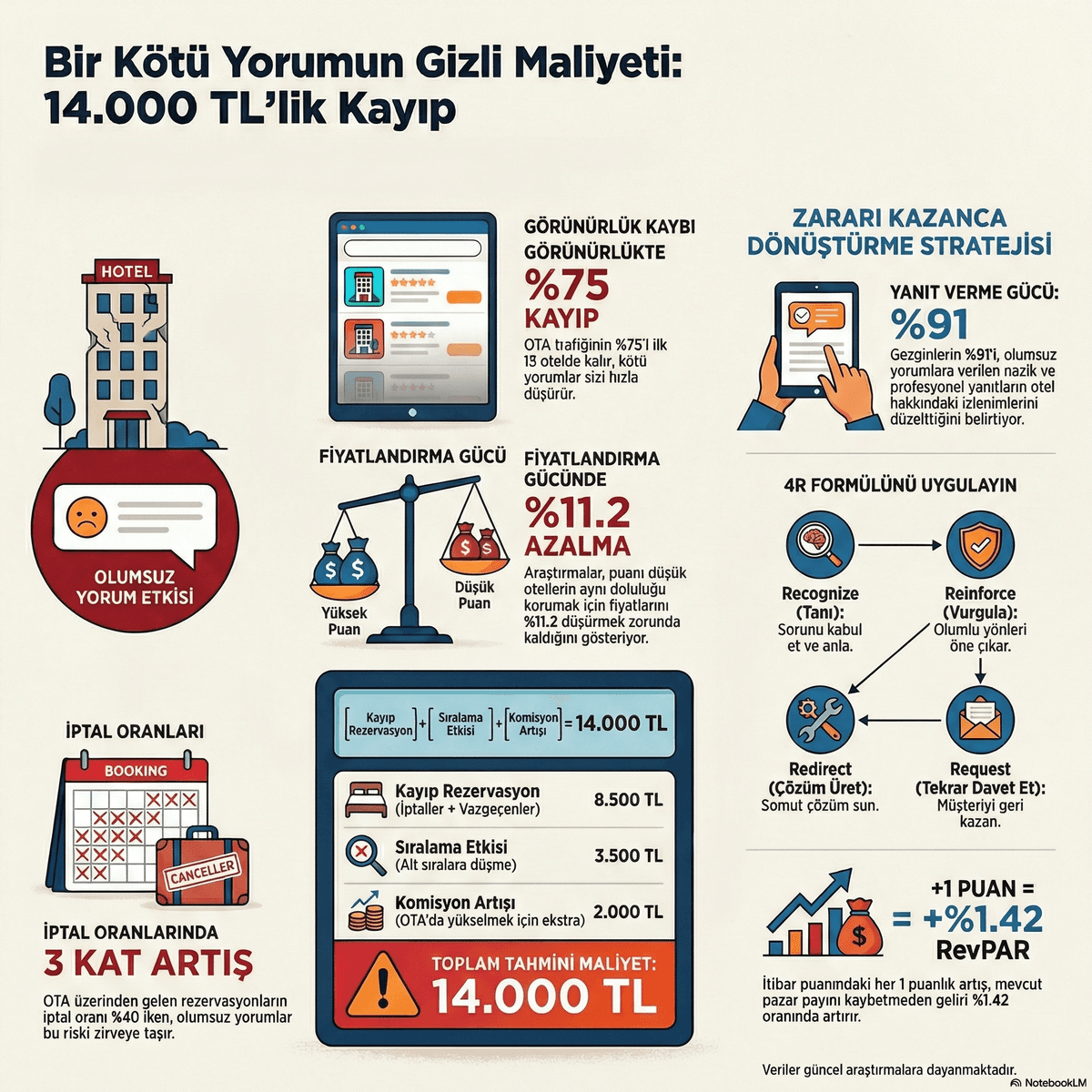
One Review, a Small Fortune
Most hoteliers dismiss bad reviews with a shrug — "it happens." But the domino effect triggered by a single negative review can cause far greater financial damage than you might expect. Research shows that a bad review can cost your hotel approximately 14,000 TL per month.
Where does that figure come from? Let us break it down layer by layer.
Related reading: How Many Hours a Year Does Your Hotel Run Empty? The True Cost of Unsold Rooms
The Three-Layer Cost of a Bad Review
1. Visibility Loss: 8,500 TL
OTA platforms and Google push high-scoring hotels to the top of search results. When your score drops, visibility declines dramatically — research indicates up to 75% visibility loss.
Invisibility translates directly into lost bookings. For a 50-room hotel, this equates to approximately 8,500 TL in monthly revenue.
2. Ranking and Pricing Power Impact: 3,500 TL
A lower score affects not just your ranking but your pricing power. Data shows that every 0.1-point decline reduces pricing capacity by 11.2%. A hotel that drops from 8.5 to 8.4 is forced to sell the same room at an 11% lower price.
The monthly cost of this price pressure is approximately 3,500 TL.
3. Rising Cancellation Rates and Commission Burden: 2,000 TL
Hotels with low scores can see cancellation rates increase by up to 3x. More cancellations lead to both direct revenue loss and disadvantages in OTA commission calculations. This indirect cost amounts to approximately 2,000 TL per month.
Total monthly loss: 8,500 + 3,500 + 2,000 = 14,000 TL
Embed this image on your site
<a href="https://otelciro.com/en/news/kotu-yorum-maliyeti">
  <img src="https://cdn.sanity.io/images/1la98t0z/production/c0edb393f0dd45ca1363f938dbc43e2d65427273-1200x670.png" alt="TRevPAR total revenue management calculation" width="800" />
</a>
<p>Source: <a href="https://otelciro.com">OtelCiro</a> — AI Hotel Revenue Management</p>
The 4R Formula: Turning a Bad Review into an Opportunity
Preventing every bad review is impossible. Managing them effectively is not. The 4R Formula provides a structured approach:
Recognize
Acknowledge the guest's complaint. An opening like "You are right — this experience fell below our standards" makes the guest feel heard and validates their concern.
Reinforce
Highlight the standards your hotel normally delivers. A statement such as "Under normal circumstances, our rooms are cleaned twice daily and pass quality control" reassures prospective guests.
Redirect
Steer the conversation toward resolution. Messaging like "To permanently resolve this issue, our team has implemented a new procedure" demonstrates a proactive approach.
Request
Express your desire to host the guest again. An invitation such as "We would love the opportunity to show you the difference on your next visit" positively influences both the reviewer and any prospective guest reading the exchange.
Related reading: Dynamic vs. Static Pricing: How the Taylor Swift Effect Can Skyrocket Your Revenue
The Financial Impact of Review Scores
According to Cornell University's hospitality research:
- +1 point increase = 1.42% RevPAR increase
- +1 point increase = 0.89% ADR (Average Daily Rate) increase
- Below 8.0 = significant decline in OTA rankings
- 9.0+ = premium pricing capacity
For a 50-room hotel with an average rate of 1,500 TL, a 1-point improvement can generate over 400,000 TL in additional annual revenue.
Embed this image on your site
<a href="https://otelciro.com/en/news/kotu-yorum-maliyeti">
  <img src="https://cdn.sanity.io/images/1la98t0z/production/bbd5fe1bd7958fd95861b71905cdb9701e352e80-1200x669.png" alt="NRevPAR (Net Revenue) calculation method" width="800" />
</a>
<p>Source: <a href="https://otelciro.com">OtelCiro</a> — AI Hotel Revenue Management</p>
A Proactive Review Management Strategy
The most effective way to reduce bad reviews is to resolve issues while the guest is still in-house:
- Post-check-in message: "Are you happy with your room? Is there anything we can help with?"
- Mid-stay survey: Use a digital survey to measure satisfaction in real time
- Pre-checkout intervention: Identify unhappy guests and offer solutions before they leave
- Post-checkout: Request reviews from satisfied guests
Keeping your review score consistently high is also critical for avoiding Booking.com's hidden penalties. Understanding the ROI of reputation management makes the business case for this investment clear.
Related reading: 65% of Travelers Accept Dynamic Pricing: Transparency Builds Trust
Frequently Asked Questions
How many positive reviews does it take to offset one bad review?
Research suggests that neutralizing the impact of a single negative review requires at least 10-12 positive reviews. This is why proactively requesting reviews from satisfied guests is so critical.
What can be done about fake negative reviews?
You can file a complaint with platforms like Booking.com and Google. Reviews that violate platform policies (not based on a real stay, spam in nature) can be removed after review. However, the process may take time.
Should I lower my price if my review score is low?
Cutting prices is a short-term fix that erodes profit margins. Instead, analyze your Booking.com Extranet metrics to identify the root causes behind low scores and make operational improvements. As your score rises, your pricing power will follow.
Conclusion
Bad reviews are inevitable — but they are manageable. Responding professionally with the 4R formula, implementing proactive guest satisfaction management, and continuously tracking score trends will protect your hotel from the 14,000 TL monthly loss.
OtelCiro's reputation management module monitors all your platform reviews from a single dashboard, sends automated alerts, and generates response recommendations. Request a free demo to analyze your hotel's review performance.


![Hotel Upselling: AI-Driven Revenue Growth [2026]](https://cdn.sanity.io/images/1la98t0z/production/9850350573fc466b95b1490c7f689e8ac39c4f11-1200x669.png?w=1920&q=50&auto=format&fit=max)