![Hotel Web Accessibility: A WCAG Compliance Guide [2026 Guide]](https://cdn.sanity.io/images/1la98t0z/production/986fe29c90bd6e6ea3f0ceb99e14c7a7ae83ca42-1024x1024.png?w=1920&q=65&auto=format&fit=max)
Key Takeaways
- Digital accessibility affects 1.3 billion people, yet 96% of hotel websites currently fail WCAG standards.
- Accessible hotel websites can experience a 12-18% increase in annual online bookings.
- Achieving WCAG AA compliance is the critical industry standard for both legal protection and user experience.
- Key conversion points, such as booking engines, must be optimized for keyboard navigation and screen readers to prevent guest drop-off.
- New regulations, including the European Accessibility Act (EAA), make digital compliance a legal requirement for most properties.
Digital Accessibility: A Reality Hotels Cannot Ignore
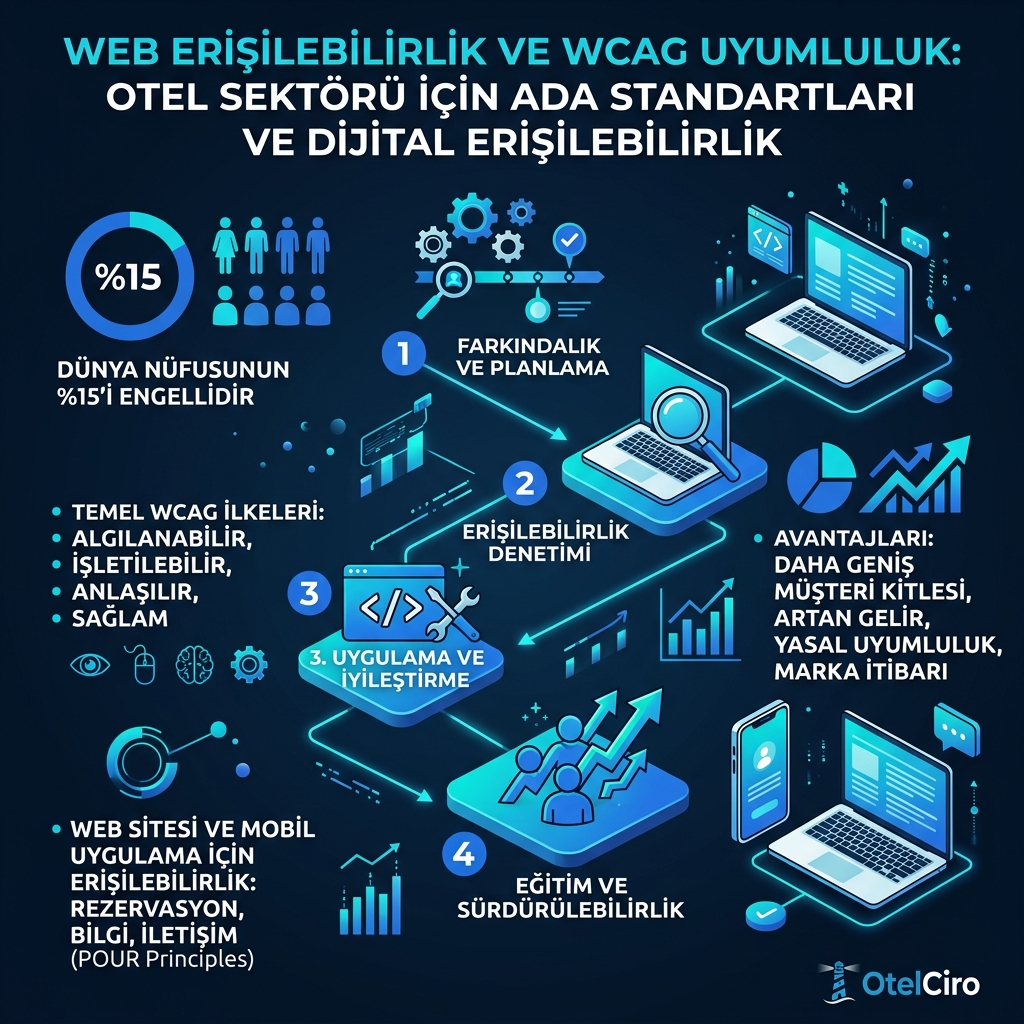
According to World Health Organization data, 16% of the global population—approximately 1.3 billion people—live with some form of disability. The vast majority of this demographic actively uses digital channels when traveling. However, WebAIM’s 2025 analysis reveals that 96% of hotel websites contain at least one WCAG compliance error.
This is not just an ethical issue; it represents a significant loss of revenue. Potential guests experiencing accessibility hurdles cannot complete their reservations and instead turn to competing hotels. Research by the American Hotel & Lodging Association shows that hotels with accessible websites receive 12-18% more online bookings annually.
Embed this image on your site
<a href="https://otelciro.com/en/news/hotel-web-accessibility-a-wcag-compliance-guide-2026-guide">
  <img src="https://cdn.sanity.io/images/1la98t0z/production/986fe29c90bd6e6ea3f0ceb99e14c7a7ae83ca42-1024x1024.png" alt="WCAG Compliance Hotel Web Accessibility Infographic" width="800" />
</a>
<p>Source: <a href="https://otelciro.com">OtelCiro</a> — AI Hotel Revenue Management</p>
Related reading: Hotel Website UX Design: User Experience Optimization
What is WCAG and Why Does It Matter for Hotels?
The Web Content Accessibility Guidelines (WCAG) is the international standard developed by the W3C to ensure web content is accessible to individuals with disabilities. WCAG 2.2—the current version—is built on four core principles:
Perceivable: Content must be perceivable by all users. This includes text alternatives for visual content, subtitles for videos, and audio descriptions.
Operable: The website must be navigable not just by mouse, but also via keyboard and assistive technologies. All interactive elements must be keyboard-accessible.
Understandable: Content must be clear and easy to follow. Forms must have distinct labels, and error messages should provide helpful guidance.
Robust: Content must work reliably across different browsers, devices, and assistive technologies.
WCAG offers three levels of compliance: A (basic), AA (the target standard), and AAA (the highest). For hotel websites, Level AA should be the minimum target from both a legal and commercial perspective.
Common Accessibility Errors on Hotel Websites
The most frequent WCAG violations found on hotel websites and their solutions include:
Low color contrast: 86% of hotel websites have insufficient text-to-background contrast. The WCAG AA standard requires a minimum contrast ratio of 4.5:1 for normal text and 3:1 for large text. This is a common issue for luxury hotel sites using light gray text on dark themes.
Missing alt text: 72% of hotel photos lack alt text (alternative text). Visually impaired guests using screen readers cannot understand the content of room photos. Add descriptive alt text to every image, such as: "Deluxe double room with sea view."
Keyboard navigation issues: Booking forms, date pickers, and gallery sliders are often only usable with a mouse. Ensure all interactive elements can be reached and activated using the Tab key.
Lack of form labeling: Check-in/check-out dates, guest counts, and room types are often labeled only with placeholder text. Assistive technologies cannot read placeholders; add visible and semantic labels to every form field.
Broken heading hierarchy: Skipping from H1 to H2 or jumping straight to H4 prevents screen reader users from understanding the page structure. Maintain a sequential heading hierarchy.
Accessibility in the Booking Process
The booking flow is the most critical conversion point on a hotel website, and accessibility issues here lead directly to lost revenue.
Date picker: Traditional calendar widgets are often inaccessible. Use date pickers supported by ARIA labels that are keyboard-navigable and screen-reader compatible. Alternatively, provide a manual text entry option for dates.
Room comparison tables: Complex tables can be incomprehensible for screen readers. Use table headers (th) correctly and define row-column relationships with the scope attribute.
Payment form: Credit card fields and personal data areas must be accessible. Enable the autocomplete feature, display error messages next to the relevant form field, and announce dynamic updates using ARIA-live regions.
Progress indicator: In a multi-step booking process, indicate the user's current step and how many steps remain, both visually and via text.
An accessible booking process provides a better experience for all users, not just those with disabilities. According to research by the Baymard Institute, accessibility improvements lead to a 23% lower form abandonment rate across all user segments.
Related reading: Improving Your Booking.com Property Page Score
Legal Requirements and Compliance Risks
Digital accessibility is now a legal mandate in many countries:
European Union: The European Accessibility Act (EAA) came into full effect in 2025. All hospitality businesses operating within the EU or serving EU citizens must have websites compliant with WCAG 2.1 AA standards.
United States: Under the Americans with Disabilities Act (ADA), hotel websites are considered "places of public accommodation." In 2024, digital accessibility lawsuits in the hospitality sector increased by 34%.
Turkey: Law No. 5378 on Persons with Disabilities and related regulations mandate digital accessibility for public services. While strict enforcement in the private tourism sector is still evolving, the EU alignment process is expanding these obligations.
Legal non-compliance carries risks beyond financial penalties, including reputational damage and negative press. A proactive accessibility strategy reduces legal risk while providing a competitive advantage.
WCAG Compliance Roadmap: Step-by-Step Implementation
Follow a systematic approach to bring your hotel website up to WCAG AA standards:
Step 1 — Audit your current status: Identify existing accessibility issues using automated tools (axe DevTools, WAVE, Lighthouse). Automated tools can find about 30-40% of problems; the rest require manual testing.
Step 2 — Prioritization: Rank found issues by impact. Errors in the booking flow take precedence over errors on informational pages.
Step 3 — Technical fixes: Add ARIA labels, fix color contrasts, improve keyboard navigation, and write alt text. Test every fix with both automated tools and assistive technology.
Step 4 — Content improvement: Simplify complex sentences, make link text descriptive (use "view room types" instead of "click here"), and add captions and transcripts to multimedia content.
Step 5 — Continuous monitoring: Accessibility is not a one-time project but a continuous process. Repeat accessibility tests whenever new content is added or the design is updated.
OtelCiro’s digital sales ecosystem facilitates compliance for hotel websites by offering WCAG-compatible templates and accessibility checklists.
Investing in digital accessibility is rewarding from both an ethical and commercial standpoint. For hoteliers looking to reach a wider audience, increase conversion rates, and minimize legal risks, WCAG compliance is no longer an option—it is a necessity.
![Europe's Hotel Construction Boom: 2026 Oversupply Risks [Market Analysis]](https://cdn.sanity.io/images/1la98t0z/production/6dfe59137f56aa14bfcba86d9db3cf05ff89f406-2752x1536.jpg?w=1920&q=50&auto=format&fit=max)