![Hotel Staff Performance: Fair & Effective Systems [2026 Guide]](https://cdn.sanity.io/images/1la98t0z/production/b61518f3e2591c960ebb1e0a0ced1af44ae0ce4f-1200x669.png?w=1920&q=65&auto=format&fit=max)
Key Takeaways
- Challenges & Fairness: Traditional performance reviews often fall short in hotels; 72% of staff find current systems unfair, leading to increased turnover.
- Department-Specific KPIs: Implement tailored Key Performance Indicators (KPIs) for each department (Front Office, Housekeeping, F&B, Sales & Marketing) for accurate and relevant evaluation.
- 360-Degree Feedback: Utilize multi-source feedback, including manager, guest, peer, inter-departmental, and self-evaluations, for a comprehensive performance view.
- AI Integration: Leverage AI for automated data collection, detection and correction of human biases, and the creation of personalized employee development plans.
- Reward & Recognition: Link performance evaluations to a tiered reward structure and tangible financial incentives to boost motivation, engagement, and retention.
Challenges of Performance Evaluation in Hospitality
Performance evaluation in the hospitality sector fundamentally differs from an office environment. Shift work, multi-departmental interactions, subjective guest feedback, and seasonal workload fluctuations all contribute to the inadequacy of standard evaluation tools.
Embed this image on your site
<a href="https://otelciro.com/en/news/hotel-staff-performance-fair-effective-systems-2026-guide">
  <img src="https://cdn.sanity.io/images/1la98t0z/production/b61518f3e2591c960ebb1e0a0ced1af44ae0ce4f-1200x669.png" alt="Performance Evaluation System Infographic" width="800" />
</a>
<p>Source: <a href="https://otelciro.com">OtelCiro</a> — AI Hotel Revenue Management</p>
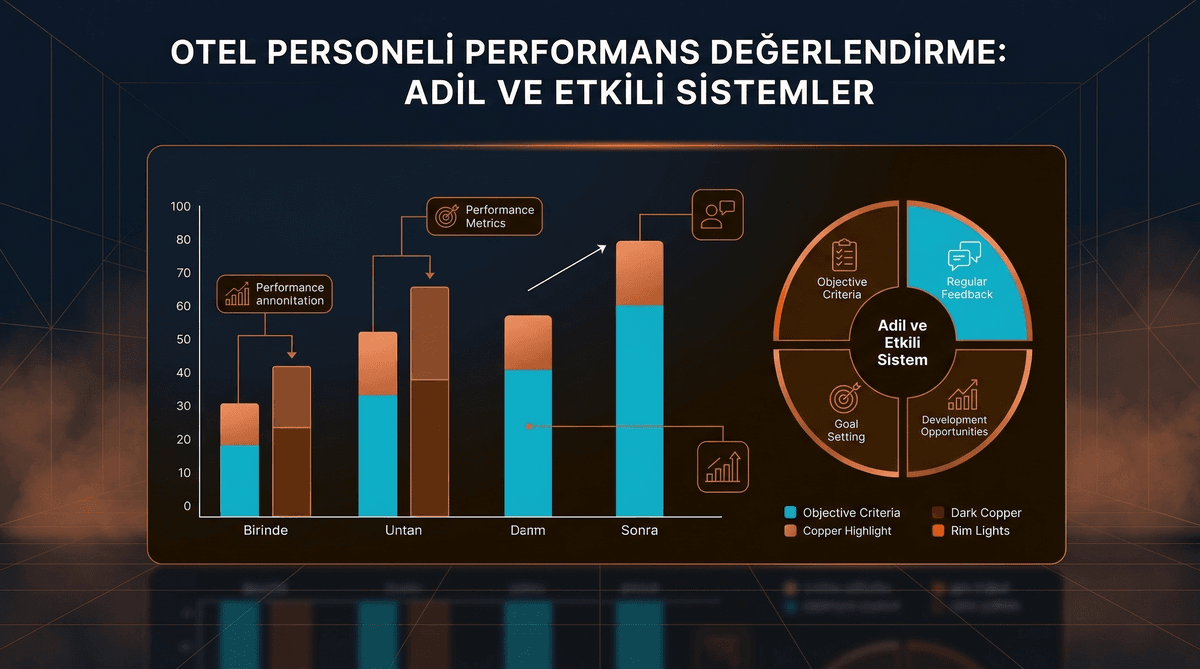
Industry research reveals concerning results: 72% of hotel employees state they "find the current performance evaluation system unfair." This perception directly leads to decreased motivation, loss of engagement, and ultimately, an increase in staff turnover. Employees who find the evaluation system "fair" are 50% less likely to leave.
An effective performance evaluation system must be development-oriented, incorporating both objective metrics and subjective assessments, and differentiated on a department-by-department basis.
Related reading: Employee Engagement Survey: Hospitality Sector Practices
Department-Specific KPI Setting
Each hotel department has distinct performance indicators inherent to the nature of its work. A single KPI set cannot be applied to all departments.
Front Office KPIs
- Check-in time: Average transaction time (target: under 3 minutes)
- Upselling success rate: Room upgrade offer-acceptance rate (target: 25%+)
- Guest satisfaction score: Department-specific survey results (target: 4.5/5)
- Problem resolution speed: Complaint resolution time (target: 15 minutes)
- Cross-selling: Volume of additional service sales (spa, restaurant, tour)
Housekeeping KPIs
- Room cleaning time: Adherence to standard time by room type
- Quality control score: Inspection results (target: 95%+)
- Recleaning rate: Percentage of rooms not meeting standards (target: under 3%)
- Loss/damage rate: Breakage and loss attributable to staff
- Guest complaint rate: Rate of cleaning-related complaints per room
F&B KPIs
- Service time: Order taking to food presentation time (target: 20 minutes)
- Spend per person: Contribution to average check increase
- Food cost adherence: Compliance with recipe standards (target: 28-32%)
- Hygiene inspection score: HACCP compliance score (target: 98%+)
- Guest feedback score: F&B specific satisfaction (target: 4.3/5)
Sales & Marketing KPIs
- Direct booking rate: Percentage of non-OTA bookings (target: 35%+)
- Lead conversion rate: Inquiry-to-booking conversion
- Group sales target: Monthly group room-night target
- RevPAR contribution: Impact of individual sales performance on revenue
- Customer relationship management: Repeat guest rate
OtelCiro's reporting module tracks all department KPIs in real-time, establishing a data-driven foundation for performance evaluation.
360-Degree Feedback System
One-sided managerial evaluations fall short in a multi-stakeholder environment like hospitality. 360-degree feedback allows performance to be assessed from various angles.
Evaluation Sources
Manager evaluation (30%): Direct manager's assessment using a structured form. Focuses on technical competence, work discipline, and development potential.
Guest feedback (25%): Person-specific analysis of online reviews, survey results, and direct complaints. AI automatically matches feedback containing staff names or descriptions from comment texts to the relevant employee.
Peer evaluation (20%): Anonymous assessment by 3-5 colleagues from the same department. Focuses on collaboration, reliability, and team contribution.
Inter-departmental evaluation (15%): Assessment by representatives of other departments with whom the employee interacts. For example, Front Office staff evaluated by the Housekeeping team on communication and coordination.
Self-evaluation (10%): The employee's assessment of their own performance. Comparison with manager evaluation measures the level of self-awareness.
Evaluation Frequency
| Evaluation Type | Frequency | Format |
|---|---|---|
| Daily operational feedback | Every day | Quick score via mobile app |
| Weekly one-on-one meeting | Weekly | 15-minute structured discussion |
| Monthly performance summary | Monthly | KPI dashboard report |
| Quarterly comprehensive evaluation | Every 3 months | Full 360-degree evaluation |
| Annual career discussion | Annually | Development plan and career path update |
Related reading: Career Path in Hospitality: Development Map
AI-Powered Evaluation and Development Plan
Artificial intelligence brings objectivity, continuity, and personalization to performance evaluation.
Automated Data Collection
AI collects and analyzes performance data without human intervention:
- PMS data: Check-in times, upselling successes, transaction error rates
- Quality control data: Room inspection results, hygiene scores
- Guest feedback: Online reviews, survey results, complaint records
- Operational data: Absenteeism, tardiness, overtime acceptance rate
- Training data: Attendance rate, exam results, certificate completion
This automated data collection reduces reliance on managers' subjective judgments, increasing evaluation fairness by 45%.
Bias Detection and Correction
AI detects and warns against common biases found in human evaluators:
- Halo effect: A single strong trait positively influencing the entire evaluation
- Recency bias: Recent performance overshadowing the entire period
- Centrality bias: Tendency to give all scores close to the average
- Personal affinity: Tendency to give high scores to favored employees
When AI detects these patterns, it sends an alert to the evaluator, suggesting a review of the scoring.
Personalized Development Plan
The most critical outcome of performance evaluation is a personalized development plan for each employee. AI analyzes the following data to generate automated development recommendations:
- Strengths: Superior areas identified from performance data
- Areas for development: Specific competencies where performance is low
- Career goal: The employee's stated career advancement objective
- Training history: Previously completed and uncompleted training
- Benchmark: Profile of high-performing employees in the same position
For example, for a Front Office employee with a low upselling success rate, AI might create the following development plan:
- VR-based upselling simulation training (2 weeks)
- Shadowing a high-performing colleague (1 week)
- Practice with a target of 5 upselling attempts per week
- Performance measurement and plan update after 30 days
Reward and Recognition System
For performance evaluation to be a motivator, it must be supported by reward and recognition mechanisms.
Tiered Reward Structure
- Instant recognition: Digital badge and thank-you message on the same day a guest commendation is received
- Weekly star: Best performing employee from each department weekly
- Monthly award: Department-based performance bonus (5-10% of salary)
- Quarterly recognition: Hotel-wide "employee of the quarter" award and special privileges
- Annual award: Training budget, vacation gifts, or promotion for top-performing employees
Financial Performance Link
Performance evaluation should be linked to tangible financial results:
- Upselling revenue → individual bonus
- Department occupancy/revenue target → team bonus
- Guest satisfaction score increase → entire team award
- Food cost improvement → kitchen team bonus
This link ensures that performance evaluation yields real results rather than remaining "on paper."
Digitalize your performance evaluation processes and create a data-driven, fair evaluation culture with OtelCiro's reporting and analytics solutions.
Related reading: Hotel Staff Retention Strategies: AI-Powered Solutions
![Europe's Hotel Construction Boom: 2026 Oversupply Risks [Market Analysis]](https://cdn.sanity.io/images/1la98t0z/production/6dfe59137f56aa14bfcba86d9db3cf05ff89f406-2752x1536.jpg?w=1920&q=50&auto=format&fit=max)