Key Takeaways
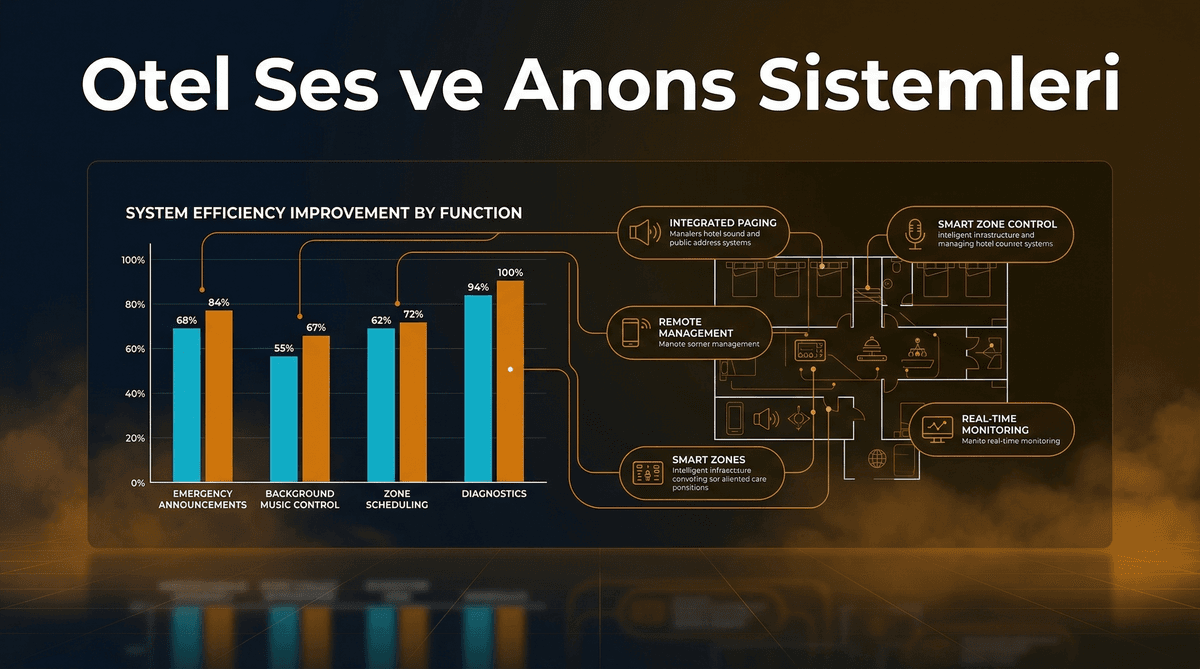
- Sound profoundly impacts the guest experience, with appropriate background music increasing guest spending by 9-15% and overall satisfaction by 12%, while noise complaints account for 14% of negative reviews.
- A modern hotel sound system is a sophisticated infrastructure requiring multi-zone planning, precise acoustic design, seamless emergency announcement integration, and strategic music programming.
- Music programming is a data-driven strategy, not merely "DJing," where elements like tempo and genre directly influence guest behavior, from extending restaurant stays to increasing beverage consumption.
- Emergency announcement systems are critical safety infrastructure, mandatory in certain hotels under Turkish regulations (TS EN 54-16, fire codes), and must ensure high intelligibility and appropriate sound levels for effective evacuation.
- IP-based digital sound systems, though sometimes having a higher initial cost, offer greater flexibility, easier management, and a 15-20% lower Total Cost of Ownership (TCO) over 5 years compared to traditional 100V systems.
Sound: The Hotel's Invisible Design Layer
Sound is one of the most underestimated yet impactful components of the hotel experience. Research shows that appropriate background music increases guest spending by 9-15%, extends restaurant stay duration by 20%, and boosts overall satisfaction perception by 12%. In contrast, noise complaints constitute 14% of negative review reasons on TripAdvisor.
In 2026, a hotel sound system is far more than a simple speaker network. Zone-based sound control, acoustic design, emergency announcement integration, and music programming—all require professional planning. The right sound strategy enriches the guest experience while meeting safety requirements.
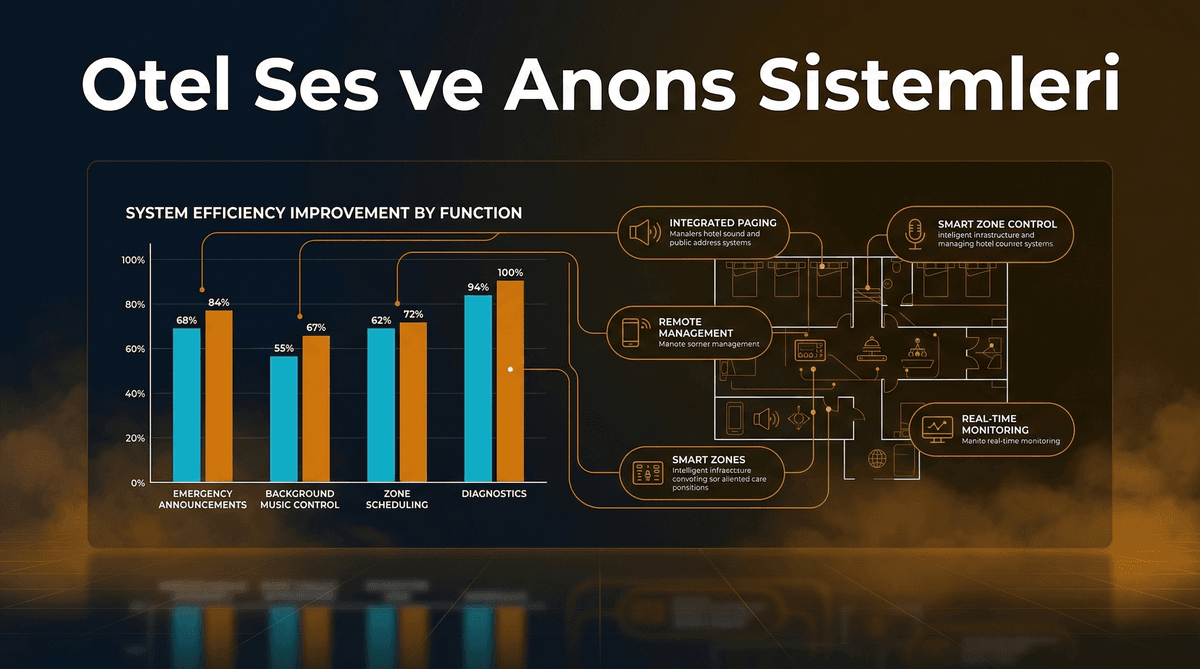
Embed this image on your site
<a href="https://otelciro.com/en/news/hotel-sound-systems-announcements-a-2026-guide">
  <img src="https://cdn.sanity.io/images/1la98t0z/production/e613321c7e77e716ba5cea5f4391f74173b32e63-1200x669.png" alt="Hotel Sound System and Announcement Infrastructure" width="800" />
</a>
<p>Source: <a href="https://otelciro.com">OtelCiro</a> — AI Hotel Revenue Management</p>
Related reading: Hotel IoT and Smart Room Technologies
Sound System Components and Infrastructure Design
A hotel sound system consists of multiple sub-systems working in an integrated manner.
Core System Components
| Component | Function | Criticality |
|---|---|---|
| Central control unit | Sound management for all zones | Very High |
| Amplifiers | Signal amplification | High |
| Speakers | Sound distribution (ceiling, wall, outdoor) | High |
| Mixers | Blending various audio sources | Medium |
| Music sources | Streaming, local storage, microphone | Medium |
| Cabling | Audio signal transmission | High |
| Zone controllers | Area-specific volume adjustment | High |
| Emergency interface | Fire/earthquake announcement integration | Very High |
Zone Planning
Every hotel's sound system should be divided into zones according to usage areas. Each zone has different sound requirements:
| Zone | Sound Type | Target Level (dB) | Speaker Type |
|---|---|---|---|
| Lobby | Ambient music | 45-55 dB | Ceiling recessed |
| Restaurant — morning | Light acoustic | 50-55 dB | Ceiling recessed |
| Restaurant — evening | Lounge/jazz | 55-60 dB | Ceiling + wall |
| Bar/Lounge | High energy | 65-75 dB | Wall + speaker |
| Spa/Wellness | Nature sounds, ambient | 35-45 dB | Ceiling recessed (waterproof) |
| Pool area | Tropical/chill | 55-65 dB | Outdoor |
| Corridor | Very light ambient | 35-40 dB | Ceiling recessed |
| Meeting room | Presentation/speech | 55-70 dB | Ceiling + wall |
| Fitness | High energy | 65-75 dB | Wall |
| Park/Garden | Light ambient | 40-50 dB | Rock/plant speaker |
Acoustic isolation is critical to prevent sound leakage between zones. Particularly in transitions between restaurant-lobby and bar-corridor, the sound level difference should not exceed 15 dB.
Music Programming Strategy
Correct music selection determines 60% of the atmosphere. Music programming is not "DJing" — it's a strategic decision based on scientific data.
Music and Behavior Relationship
Research proves that music directly influences guest behavior:
- Tempo: Slow tempo (60-80 BPM) extends restaurant stay by 20%; fast tempo (120+ BPM) increases turnover in fast-casual outlets.
- Genre: Classical music increases preference for wine and premium menus by 24%.
- Sound level: High volume increases drink consumption by 26% (bar); low volume improves dining experience (fine dining).
- Familiarity: Overly familiar songs distract; unfamiliar but pleasant melodies create a background effect.
Daily Music Flow
| Time Slot | Tempo | Genre Suggestion | Energy Level |
|---|---|---|---|
| 06:00-09:00 | 70-90 BPM | Acoustic, light jazz, bossa nova | Low-Medium |
| 09:00-12:00 | 80-100 BPM | Lounge, soft pop, instrumental | Medium |
| 12:00-15:00 | 90-110 BPM | Contemporary jazz, world music | Medium-High |
| 15:00-18:00 | 80-100 BPM | Chill-out, nu-jazz, ambient | Medium |
| 18:00-21:00 | 100-120 BPM | Deep house, lounge, cocktail music | High |
| 21:00-00:00 | 110-130 BPM | Lounge house, nu-disco, funk | High |
| 00:00-06:00 | 60-80 BPM | Ambient, minimal, downtempo | Low |
Music Licensing and Royalties
Broadcasting music in hotel common areas requires royalty payments. In Turkey, licenses must be obtained through MESAM and MSG. Unlicensed music broadcasting carries a high risk of penalties.
License alternatives:
- Commercial music service providers: Mood Media, Soundtrack Your Brand, Rockbot — monthly subscription, including legal compliance.
- Royalty-free music libraries: Low initial cost but limited variety.
- Live music: 2-3 nights per week live performance for the lobby and bar — high perceived value.
Commercial music service providers prepare playlists suitable for the hotel's concept by professional music curators and guarantee legal compliance. Monthly costs range from 2,000-8,000 TL.
Emergency Announcement System
Beyond being a daily comfort tool, the sound system is a life-saving safety infrastructure. According to current fire regulations in Turkey, audible warning and evacuation announcement systems are mandatory in hotels of certain sizes.
Legal Requirements
- TS EN 54-16: Voice alarm system standard, mandatory integration with fire detection.
- Regulation on Fire Protection of Buildings: General alarm and phased evacuation announcement system.
- Sound level: Emergency announcements must be at least 15 dB above ambient noise.
- Intelligibility: The STI (Speech Transmission Index) value must be a minimum of 0.50.
Emergency Announcement Design
Phased alarm system:
| Phase | Trigger | Content | Scope |
|---|---|---|---|
| Phase 1 — Alert | Detection system | Tonal signal + brief information | Relevant floor/zone |
| Phase 2 — Alarm | After verification | Evacuation instructions + guidance | Affected zone + neighboring areas |
| Phase 3 — General Evacuation | Crisis team decision | Full evacuation announcement | Entire building |
Announcement text features:
- Calm, clear, and slow speaking tone.
- First Turkish, then English (German and Russian can also be added in resort hotels).
- Concrete direction: "Exit the building using the nearest exit."
- Emphasis on prohibition of elevator use.
- Broadcast in a repeating loop.
Related reading: Hotel Emergency Communication Plan
Acoustic Design and Noise Control
No matter how high-quality the sound system is, if the acoustic environment is poor, the result will not be satisfactory. Acoustic design directly determines the effectiveness of the sound system.
Room Acoustics
Noise control in hotel rooms affects guest sleep quality:
- Wall sound insulation: STC (Sound Transmission Class) minimum 50 (55+ in luxury hotels).
- Door sound insulation: STC minimum 35, automatic threshold seal.
- Window sound insulation: STC minimum 35 (40+ in city centers).
- Plumbing noise: NC (Noise Criteria) should be below 30.
- HVAC noise: NC 25-30 (in-room air conditioning unit sound).
Common Area Acoustics
- Lobby: Reverberation time (RT60) 0.8-1.2 seconds — intelligible speech + pleasant ambiance.
- Restaurant: RT60 0.6-0.8 seconds — comfortable table conversation.
- Meeting room: RT60 0.5-0.7 seconds — clear speech intelligibility.
- Spa: RT60 1.0-1.5 seconds — sense of spatial tranquility.
Reverberation can be controlled with acoustic panels, ceiling coverings, and carpet/textile surfaces. Restaurant noise levels should not exceed 70 dB — above this, guest complaints increase by 300%.
Technology and Integration
In 2026, hotel sound systems are being established with IP-based digital network architecture. Compared to traditional 100V line systems, they are more flexible, manageable, and cost-effective.
Advantages of Digital Sound Systems
- Audio over IP (AoIP): Audio transmission over existing data network with Dante or AES67 protocol.
- Central management software: Control all zones from a single screen, scheduling, level adjustment.
- Automatic scheduling: Manage daily music flow with automated programs.
- BMS integration: Automatic sound system on/off based on room occupancy information.
- Mobile control: Authorized personnel can control zone audio from a smartphone.
Cost Comparison
Sound system investment for a 200-room city hotel:
| System Type | Investment Cost | Annual Operating Cost | Flexibility |
|---|---|---|---|
| Traditional 100V | 180,000-250,000 TL | 15,000 TL | Low |
| IP-based Digital | 250,000-350,000 TL | 8,000 TL | High |
| Hybrid (100V + IP) | 220,000-300,000 TL | 12,000 TL | Medium |
Although an IP-based system has a higher initial cost, it offers advantages in the long run with flexibility and lower operating costs. The total cost of ownership (TCO) over 5 years is 15-20% lower.
Maintenance and Service Plan
A sound system requires regular maintenance. In neglected systems, sound quality gradually degrades, and the risk of malfunction increases.
Maintenance schedule:
| Maintenance Task | Frequency | Responsibility |
|---|---|---|
| Speaker function test | Weekly | Technical team |
| Sound level calibration | Monthly | Technical team |
| Amplifier thermal control | Monthly | Technical team |
| Cable connection check | Quarterly | Expert service |
| Emergency announcement test | Quarterly | Security + technical |
| System software update | Semi-annually | Expert service |
| Comprehensive system audit | Annually | Expert service |
Automate the sound system maintenance schedule and track malfunction reports as digital work orders with an operational management platform.
Conclusion
A hotel sound system is a powerful tool that subtly determines the quality of the guest experience. Correct music programming increases spending, effective acoustic design enhances comfort, and reliable announcement infrastructure saves lives.
Priority steps:
- Map out your current sound system zones and measure sound levels.
- Check your music licensing status — rectify immediately if there's a legal risk.
- Create a daily music flow program (according to time and area).
- Test your emergency announcement system and verify its compliance with legal requirements.
- Integrate sound system management into a digital maintenance plan with the OtelCiro operations platform.
When sound is managed correctly, it is the hotel's most effective and lowest-cost atmospheric tool.
![Europe's Hotel Construction Boom: 2026 Oversupply Risks [Market Analysis]](https://cdn.sanity.io/images/1la98t0z/production/6dfe59137f56aa14bfcba86d9db3cf05ff89f406-2752x1536.jpg?w=1920&q=50&auto=format&fit=max)