![Hotel Pre-Arrival Strategy: Boost CX & Revenue [2026 Guide]](https://cdn.sanity.io/images/1la98t0z/production/3912fe58bfb581aed12b4808ed726fd3bd12a924-1200x669.png?w=1920&q=65&auto=format&fit=max)
Key Takeaways
- Pre-arrival communication shapes 40% of guest perception and significantly boosts satisfaction (15-20%) and upsell revenue (25-35%).
- A timed communication flow, from reservation confirmation to pre-arrival and arrival-day messages, is crucial for effective engagement.
- Personalization based on guest segments and data can increase message open rates from 5-8% to 35-45%.
- The pre-arrival phase is the most effective time for upselling, with conversion rates 2-3 times higher than at check-in.
- Leveraging automation platforms, WhatsApp Business API, and chatbots is essential for scaling the strategy and managing guest expectations proactively.
The Experience That Begins Before Check-in
The guest experience doesn't begin at check-in. Research reveals that 40% of a guest's perception of a hotel is shaped by pre-stay communication. A welcome message, transportation information, or a query about a special request makes the guest feel valued and anticipated even before they step into the hotel.
However, 65% of hotels in Turkey do not implement pre-stay communication or only send a standard reservation confirmation. This represents a significant loss in terms of both expectation management and upsell opportunities.
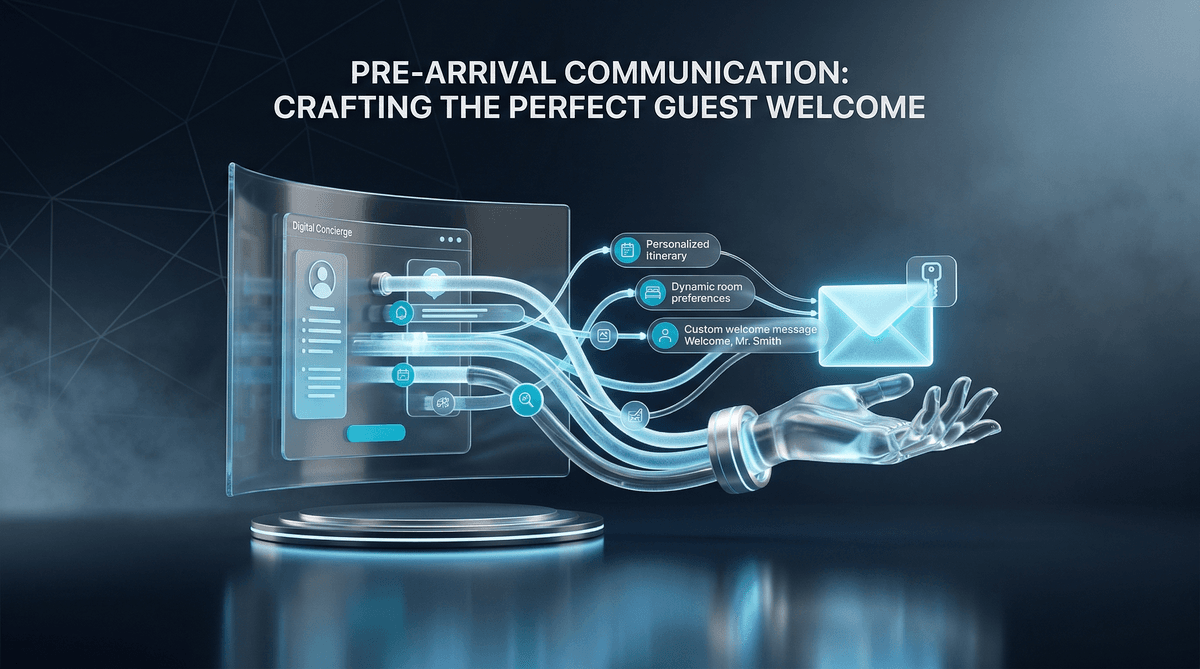
Embed this image on your site
<a href="https://otelciro.com/en/news/hotel-pre-arrival-strategy-boost-cx-revenue-2026-guide">
  <img src="https://cdn.sanity.io/images/1la98t0z/production/3912fe58bfb581aed12b4808ed726fd3bd12a924-1200x669.png" alt="Pre-Arrival Communication Infographic" width="800" />
</a>
<p>Source: <a href="https://otelciro.com">OtelCiro</a> — AI Hotel Revenue Management</p>
Hotels that implement a pre-arrival communication strategy achieve a 15-20% increase in guest satisfaction scores, a 25-35% increase in upsell revenue, and a 40% reduction in check-in time. In this article, we will examine step-by-step how to establish an effective pre-arrival communication strategy.
Related reading: Guest Expectation Management: Rapid Response Strategy
Pre-Arrival Communication Timeline
Effective pre-arrival communication consists not of a single message, but of a communication flow spread over time. Each stage has a different purpose and content.
Reservation confirmation (T+0, instant): The confirmation message sent immediately after the reservation is completed is the first step in building trust. It should include:
- Reservation details (date, room type, price)
- Cancellation and modification policy
- Your hotel's contact information
- An invitation to "contact us if you have any questions"
Early information (T-14 days): A message sent two weeks in advance is ideal for setting expectations and upselling:
- Recommendations for local events and activities
- Weather forecast and clothing suggestions
- Room upgrade opportunity: "Would you like to upgrade to our Suite room? With a 30% discount!"
- Special package offers (spa, restaurant, tour)
Detailed welcome (T-3 days): A comprehensive information message sent three days in advance:
- Transportation guide (airport transfer, parking information, public transport)
- Check-in time and online check-in option
- Special request form: "Would you like us to know your preferences in advance?"
- Hotel amenities and restaurant operating hours
- Wi-Fi connection information
Final touch (T-1 day / same day): A short, warm message sent on the day of arrival:
- "We are excited to host you tomorrow/today!"
- Inquiry about estimated arrival time
- Opportunity for last-minute requests or questions
- WhatsApp or live chat link
Personalization Strategies
Generic pre-arrival messages receive 5-8% open rates, while personalized messages achieve 35-45% open rates. Personalization is the most powerful element that multiplies the impact of pre-arrival communication.
Segment-based personalization:
- Business traveler: Meeting room information, business center hours, express check-in/check-out, restaurant-bar hours, and late-night venues
- Leisure couple: Romantic restaurant suggestions, spa packages, local exploration routes, sunset viewing spots
- Family: Children's activity program, baby crib/high chair confirmation, family menu, pool and playground information
- Returning guest: Emphasis on "Welcome back!", personal touches remembering previous preferences, loyalty points information
Personalization from data sources:
- Reservation source (OTA, direct, corporate) determines the tone of the message
- If the purpose of stay is known (business, leisure, wedding), content is adapted accordingly
- Language preference and country information enable cultural adaptation
- Previous stay data provides personal touches for repeat guests
With the OtelGPT AI assistant, you can automatically personalize pre-arrival messages according to guest profiles and fully automate the communication flow.
Related reading: Guest Experience Map: Creating a Customer Journey Map
Pre-Arrival Upsell Strategy
The pre-arrival stage is the most productive period for upselling. The guest is excited, open to making decisions, and their perception of price is more flexible than at the time of stay. The pre-arrival upsell conversion rate is 2-3 times higher than at check-in.
Effective upsell offers:
Room upgrade: The most popular and highest-yield upsell. Offer to upgrade from a standard room to a superior or suite. Offering the price at a 40-60% discount from the normal price difference increases the conversion rate. The format "Upgrade to our sea-view suite room for just +800 TL" is effective.
Experience packages:
- Romantic package: Champagne + chocolate + rose petals + late check-out (400-600 TL)
- Wellness package: Spa access + in-room aromatherapy + healthy minibar (500-800 TL)
- Discovery package: City tour + local culinary experience + transportation (600-1,000 TL)
Practical services:
- Airport transfer (15% commission revenue)
- Early check-in / late check-out (200-500 TL)
- Special minibar selection (alcoholic/non-alcoholic premium options)
- Guaranteed parking (a valuable offer in busy areas)
Upsell message writing rules:
- Use value-oriented language: "Elevate your experience for just +X TL"
- Create a sense of scarcity: "This offer is only valid pre-stay"
- Use visuals: Show real room photos for room upgrade offers
- One-click purchase: Provide a direct purchase link within the message
Special Request Collection and Expectation Management
One of the most strategic functions of pre-arrival communication is to collect guests' special requests before their stay. This ensures operational readiness and strengthens expectation management.
Information to be collected:
- Arrival information: Estimated arrival time, transportation method, transfer needs
- Room preferences: High/low floor, quiet room, view preference, pillow selection
- Special occasions: Birthday, anniversary, honeymoon – this information creates personalization opportunities
- Dietary requirements: Allergies, vegetarian/vegan, halal, gluten intolerance
- Children's information: Age, baby crib needs, high chair
- Accessibility: Disabled access, request for a room near the elevator
Digital form design: The special request form should be short and user-friendly. Forms that can be quickly filled out with dropdown menus and checkboxes have a 60% higher completion rate than free-text fields.
Setting expectations: Pre-arrival communication is the most effective tool for expectation management. If there's a renovation at the hotel, the pool is under maintenance, or a restaurant is temporarily closed, sharing this information before the stay prevents disappointment. Proactive information leads to a 70% lower dissatisfaction rate compared to reactive complaint management.
Technology Infrastructure and Automation
To make a pre-arrival communication strategy scalable, the right technology infrastructure is essential. Manual email sending might work for a 20-room guesthouse, but for a 100+ room hotel, automation is mandatory.
E-mail automation platform: A PMS-integrated email automation system triggers an automatic communication flow for every new reservation. It should support segment-based templates, personalization variables (name, date, room type), and A/B testing.
WhatsApp Business API: 78% of guests in Turkey use WhatsApp. With the WhatsApp Business API, automatic pre-arrival messages, interactive buttons (yes/no, service selection), and media sharing (room photos, map) are possible.
Chatbot integration: An AI chatbot that responds 24/7 to guests' questions in pre-arrival messages reduces staff workload while increasing response speed. 75% of frequently asked questions can be resolved by a chatbot.
CRM and guest profile management: Recording every pre-arrival interaction (open, click, upsell purchase, special request) in the guest profile enables more targeted communication for future stays.
Success Metrics and Optimization
To measure and continuously improve the performance of your pre-arrival communication strategy, it is necessary to track the right KPIs.
Key metrics:
- E-mail open rate: Target: 35%+ (industry average 20%)
- Click-through rate: Target: 12%+ (industry average 5%)
- Upsell conversion rate: Target: 8-15% (purchase rate of pre-arrival upsell offers)
- Upsell revenue: Average pre-arrival upsell revenue per guest
- Special request collection rate: Target: 40%+ of guests should have specified at least one preference
- Online check-in rate: Target: 30%+ (a key metric for reducing check-in time)
- Satisfaction impact: Overall satisfaction score of guests who received pre-arrival communication vs. those who did not
A/B testing suggestions:
- Subject line variations (personalized vs. general)
- Send time (morning vs. evening, weekday vs. weekend)
- Message length (short/summary vs. detailed)
- Upsell offer format (price-focused vs. experience-focused)
- Channel comparison (e-mail vs. WhatsApp vs. SMS)
A pre-arrival communication strategy is a powerful tool that starts your hotel's guest experience days before check-in. With the right timing, personalization, and automation, you can both increase guest satisfaction and create a significant upsell revenue channel.
![Europe's Hotel Construction Boom: 2026 Oversupply Risks [Market Analysis]](https://cdn.sanity.io/images/1la98t0z/production/6dfe59137f56aa14bfcba86d9db3cf05ff89f406-2752x1536.jpg?w=1920&q=50&auto=format&fit=max)