![Hotel Power Resilience: 2026 UPS & Generator Strategy [Guide]](https://cdn.sanity.io/images/1la98t0z/production/1d5ecc9059f3e44eb7adbaca256f3ee7d43c8dc3-1200x669.png?w=1920&q=65&auto=format&fit=max)
Key Takeaways
- Uninterrupted power is fundamental for guest comfort, safety, and critical hotel operations, as outages lasting 1.5 to 4.2 hours were recorded in Turkey in 2025.
- Accurate generator capacity planning (critical, comfort, and peak loads plus a 20% buffer) and a robust maintenance schedule are essential to prevent breakdowns.
- UPS systems provide crucial bridge power during the 5-15 second transition until generators activate, with online UPS being mandatory for critical IT infrastructure.
- Implementing IoT-driven digital monitoring for generators and UPS units offers real-time insights, automated alarms, and remote access, reducing unplanned failure costs by up to 60%.
- Effective fuel management and consideration of hybrid energy solutions (solar + generator + UPS) can significantly reduce operational costs and enhance long-term energy security.
Uninterrupted Power in Hotels: Why Is It So Critical?
One of a hotel's biggest promises is to offer comfort to its guests. The air conditioning in the room, elevators, security cameras, PMS software, kitchen equipment, and lighting – all run on electricity. A power outage doesn't just mean a dark lobby; it means elevators stopping, key card doors locking, the cold chain breaking, and digital payment systems going offline.
In Turkey, the average duration of power outages recorded in 2025 varied between 1.5 and 4.2 hours depending on the region. For a hotel, being without power for this period risks not only guest satisfaction but also food safety and even legal obligations. According to TÜROB data, 34% of hotels in Turkey still lack adequate energy backup infrastructure.
Embed this image on your site
<a href="https://otelciro.com/en/news/hotel-power-resilience-2026-ups-generator-strategy-guide">
  <img src="https://cdn.sanity.io/images/1la98t0z/production/1d5ecc9059f3e44eb7adbaca256f3ee7d43c8dc3-1200x669.png" alt="Generator and UPS Energy Backup Infographic" width="800" />
</a>
<p>Source: <a href="https://otelciro.com">OtelCiro</a> — AI Hotel Revenue Management</p>
Related reading: Hotel IoT and Smart Room Technologies
Generator System: The Hotel's Main Power Insurance
How to Plan Capacity?
The most critical mistake in generator selection is choosing a capacity below the total energy requirement. Three main factors must be considered when determining hotel generator capacity:
- Critical load analysis: Elevators, fire alarm systems, emergency lighting, security cameras, and PMS servers – these are priority systems that must not be interrupted.
- Comfort load: Air conditioning, general lighting, kitchen equipment, and laundry – these directly impact the guest experience.
- Peak load calculation: The total power requirement should be calculated for a scenario where all systems operate simultaneously. Generator capacity should be at least 20% above this value.
For a medium-sized hotel (100-200 rooms), a 250-500 kVA diesel generator is usually sufficient. However, if the frequency of regional power outages is high, a redundant (N+1) structure with two generators should be preferred.
Maintenance Program and Periodic Checks
80% of generator failures are due to insufficient maintenance. An effective maintenance program should include the following elements:
- Weekly: Engine oil and coolant level checks, battery voltage measurement, 15-minute loaded operation test.
- Monthly: Air and fuel filter checks, leak inspection, automatic transfer switch (ATS) test.
- Annually: Engine oil and all filter changes, injector calibration, complete cooling system inspection, load bank test.
Digital maintenance tracking systems automate these processes, ensuring timely maintenance. Predictive maintenance, supported by sensor data, offers intervention before a fault occurs.
Related reading: Automation in Hotel Operations: Digitizing Business Processes
UPS System: Bridge Power for Critical Seconds
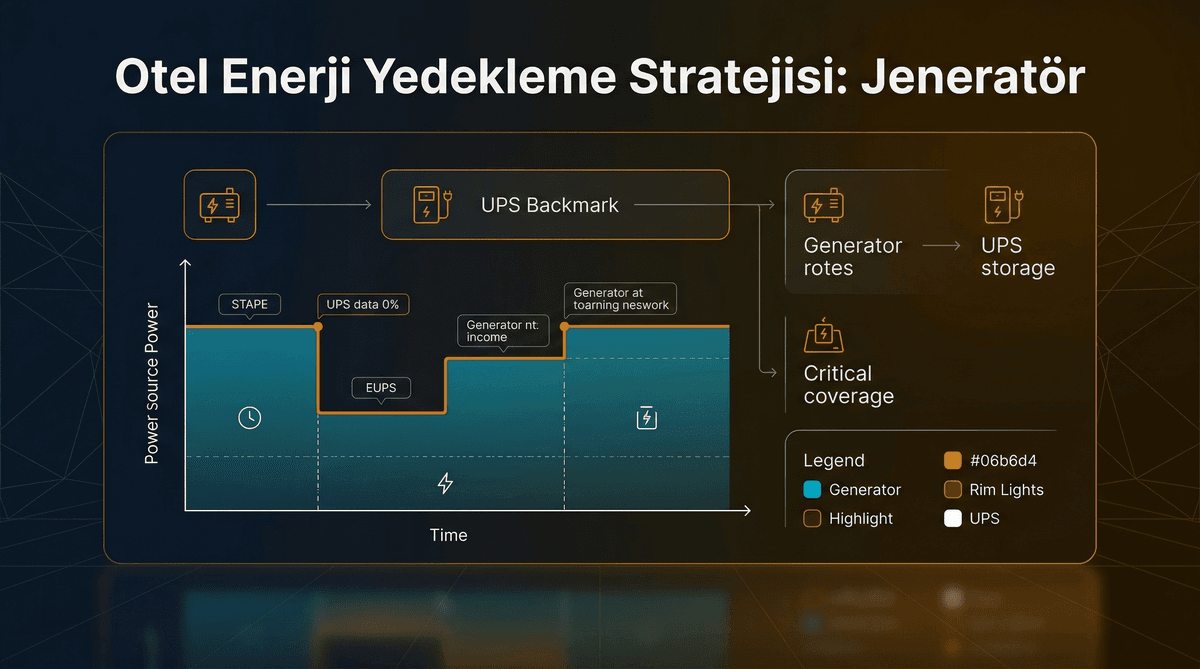
The 5-15 seconds that pass until the generator kicks in can lead to critical consequences without a UPS (Uninterruptible Power Supply). The PMS server could crash, security cameras might stop recording, and key card entry systems could lock, preventing guests from accessing their rooms.
Online UPS vs. Line-Interactive UPS
| Feature | Online UPS | Line-Interactive UPS |
|---|---|---|
| Switching time | 0 ms | 2-4 ms |
| Efficiency | 90-94% | 95-98% |
| Cost | High | Medium |
| Protection level | Highest | Standard |
| Recommended use | Server room, PMS | Reception, safe |
67% of hotels prefer online UPS for critical IT infrastructures. Zero-interruption (online) UPS is mandatory for server rooms, fire alarm panels, and security systems.
UPS Battery Management
Batteries are the most critical component determining UPS performance. Batteries typically have a lifespan of 3-5 years, but ambient temperature dramatically affects this period. Every 10°C increase in temperature shortens battery life by 50%. Therefore, the area where the UPS is located should be kept between 20-25°C.
Battery status should be checked quarterly with internal resistance measurements, and weak cells should be replaced before they affect the entire group.
Automation and Digital Monitoring Solutions
In modern energy backup management, digitalization is no longer an option but a necessity. Generator and UPS systems equipped with IoT sensors offer the following advantages:
- Real-time monitoring: Fuel level, engine temperature, battery status, and load distribution are tracked instantly.
- Automatic alarms: Instant notifications are sent to the technical team when critical thresholds are exceeded.
- Remote access: The technical manager can view all parameters via a mobile app, even if not at the hotel.
- Reporting: Monthly and annual energy consumption, outage durations, and maintenance history are digitally reported.
Such a digital monitoring system typically has a return on investment within 12-18 months, as it can reduce unplanned failure costs by up to 60%.
With OtelCiro's operations management module, generator maintenance schedules, UPS alarm notifications, and energy consumption reports can be managed from a single panel.
Fuel Management and Cost Control
For a hotel operating a diesel generator, fuel cost constitutes 40-60% of the energy backup budget. Effective fuel management involves the following steps:
- Stock tracking: Minimum fuel levels should be determined, and automatic order triggers should be set up. General rule: at least 72 hours of backup fuel should be kept.
- Consumption analysis: Hourly fuel consumption should be recorded to detect abnormal increases. Consumption more than 15% above normal indicates engine inefficiency.
- Supplier management: Working with multiple fuel suppliers provides both price advantage and supply security.
- Hybrid solutions: A combination of solar panels + generator + UPS can reduce fuel costs by 25-35% in the long run.
Conclusion: Energy Security is Guest Security
Hotel energy backup strategy goes beyond a technical topic; it directly impacts guest experience and business continuity. Correct sizing, regular maintenance, and integration with digital monitoring of generator and UPS systems – these three pillars reduce the impact of power outages on the guest experience to a near-zero level.
Neglecting energy infrastructure on the path to digitalization is like skipping the foundation of a building. For hotels seeking a competitive advantage in 2026, integrating energy backup systems with smart operations platforms is now a necessity.
![Europe's Hotel Construction Boom: 2026 Oversupply Risks [Market Analysis]](https://cdn.sanity.io/images/1la98t0z/production/6dfe59137f56aa14bfcba86d9db3cf05ff89f406-2752x1536.jpg?w=1920&q=50&auto=format&fit=max)