![Hotel PMS Selection: Your 2026 Smart Guide [Strategy]](https://cdn.sanity.io/images/1la98t0z/production/eb5beab8c7e3cc214f1ce9ee2a369d3c97d19a8e-1376x768.jpg?w=1920&q=65&auto=format&fit=max)
Key Takeaways
- A Property Management System (PMS) is your hotel's digital backbone; a wrong choice can cost 3-7% of annual revenue.
- By 2026, the hotel software market is dominated by AI-native, cloud-based, and mobile-first solutions, making older on-premise systems obsolete.
- Critical features for a modern PMS include cloud-native architecture, advanced AI for dynamic pricing and forecasting, integrated channel management, and robust guest experience tools.
- Turkish hotels require specific compliance features like integration with the Identity Notification System (KBS), e-invoice/e-archive systems (GİB), tourism fund calculations, and multi-currency support with real-time exchange rates.
- Prioritize systems with open APIs for ecosystem integration, strong data security (KVKK/GDPR, PCI DSS), 24/7 local language support, and a comprehensive understanding of the total cost of ownership (TCO) for a 3-5 year investment.
Why Hotel Software Selection is So Critical
A Property Management System (PMS) is more than just software; it's the digital backbone of your hotel. From reservations to check-out, revenue management to guest experience, every operational process flows through this system. A wrong software choice can lead to years of inefficiency, missed revenue opportunities, and increased operational costs.
As of 2026, the hotel software market is undergoing a radical transformation with artificial intelligence integration, cloud technologies, and mobile-first design. Selection criteria from five years ago are no longer valid. In this guide, we detail how to choose the best hotel PMS for today's conditions, what features to look for, and specific requirements for Turkish hospitality.
The Cost of Choosing the Wrong System
Industry research shows that choosing the wrong PMS costs hotels 3-7% of their annual revenue. For a 100-room hotel, this could mean an annual loss of 250,000-600,000 TL. Losses arise from the following areas:
- Operational inefficiency: Staff hours lost due to manual processes
- Revenue loss: Inability to perform dynamic pricing, channel management deficiencies
- Guest dissatisfaction: Slow check-ins, incorrect bills, communication breakdowns
- Integration issues: Different systems unable to communicate with each other
- Data loss: Missed strategic opportunities due to inadequate reporting
Related reading: Hotel Management with Smart PMS: Transitioning from Traditional Systems to AI-Powered Platforms
Related reading: Housekeeping Automation: 7 Steps to Digitizing Hotel Operations
The Evolution of Hotel Management Systems: 2020 to 2026
The world of hotel software has experienced a dramatic transformation in the last six years:
| Period | Technology | Approach |
|---|---|---|
| Pre-2020 | On-premise server | Module-based, siloed structure |
| 2020-2022 | Hybrid cloud | API integrations began |
| 2023-2024 | Full cloud (cloud-native) | Integrated ecosystems |
| 2025-2026 | AI-native cloud | AI-centric, predictive |
Understanding this evolution is critical when selecting a hotel management system in 2026. Investments in older generation software only provide short-term cost savings; in the medium to long term, they create a competitive disadvantage.
Embed this image on your site
<a href="https://otelciro.com/en/news/hotel-pms-selection-your-2026-smart-guide-strategy">
  <img src="https://cdn.sanity.io/images/1la98t0z/production/46982eee55bf4225dd55170e11b536c3dcd9b3f4-1200x669.png" alt="Modern hotel API integration ecosystem" width="800" />
</a>
<p>Source: <a href="https://otelciro.com">OtelCiro</a> — AI Hotel Revenue Management</p>
10 Critical Features You Must Evaluate
1. Cloud-Native Architecture
The era of on-premise server systems is over. In 2026, a hotel software must be cloud-based. Let's examine why:
Cloud advantages:
- Access from anywhere, on any device
- Automatic updates and security patches
- Zero hardware investment and maintenance costs
- Flexible scalability (from 1 hotel to 100 hotels)
- Built-in disaster recovery
- 99.9%+ uptime guarantee
On-premise system risks:
- Server failure = hotel operations halt
- Waiting time for technical teams for updates
- High initial investment (hardware + license)
- Restricted remote access
- Delayed security updates
OtelCiro's Smart PMS solution offers all these advantages with its cloud-native architecture, guaranteeing low latency thanks to its data centers in Türkiye.
2. Artificial Intelligence and Automation Capabilities
In 2026, AI is not a "nice-to-have" feature, but a fundamental requirement. AI capabilities you should evaluate:
- Dynamic pricing: Automatic price optimization based on demand, competition, and market conditions
- Forecasting: Occupancy, revenue, and demand predictions
- Guest segmentation: Automatic guest profiling and personalization
- Chatbot / virtual assistant: 24/7 guest communication
- Autonomous operations: Housekeeping planning, staff scheduling
- Anomaly detection: Detecting unusual pricing or reservation patterns
OtelCiro AI Engine offers all these capabilities on a single platform with machine learning models specifically trained for the hospitality sector. Unlike general-purpose AI, it provides an engine that deeply understands Turkish hospitality dynamics—seasonal patterns, holiday impacts, and exchange rate sensitivity.
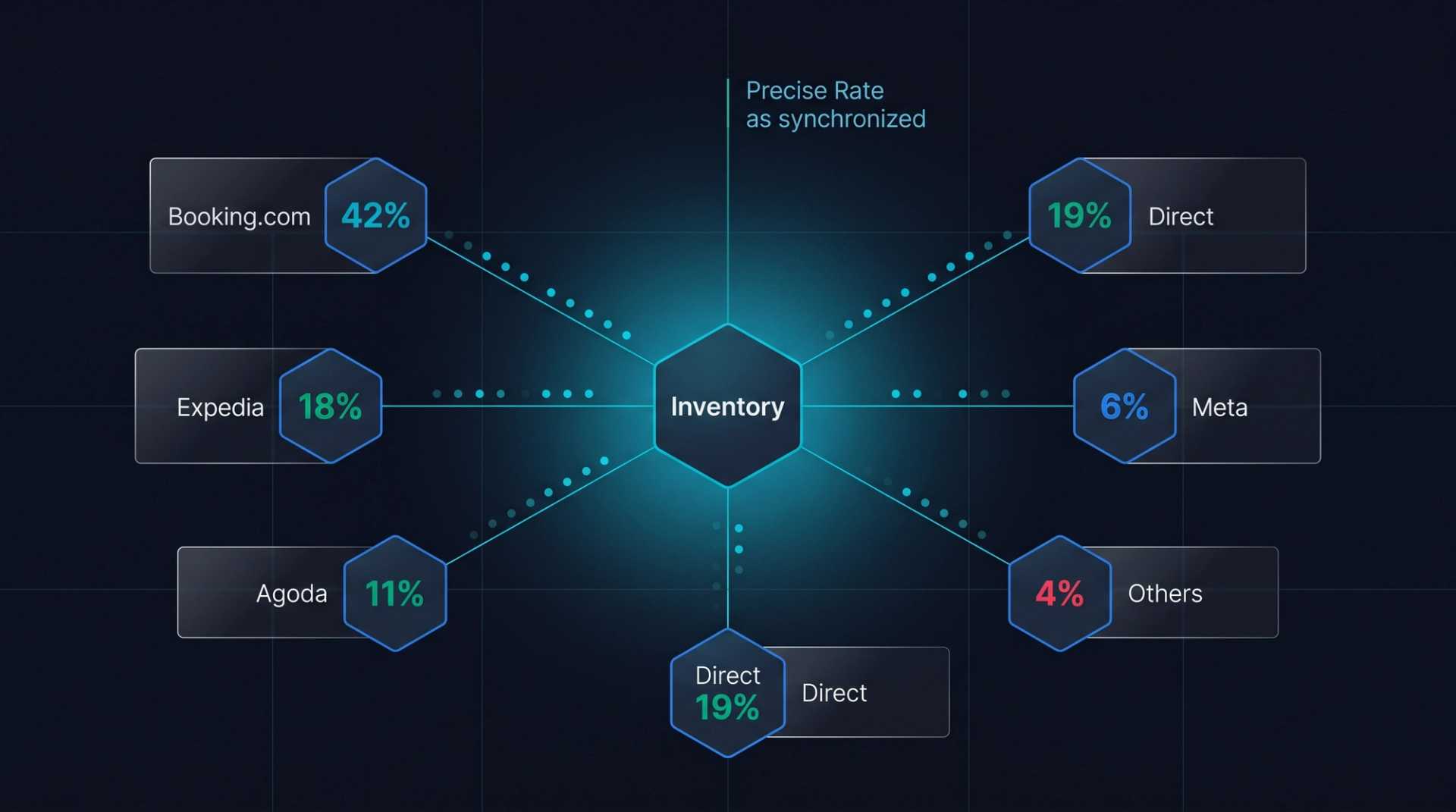
3. Channel Manager Integration
It is essential that your hotel management system offers an internal or integrated channel manager. Check for the following connections:
- Booking.com, Expedia, Agoda, Google Hotels connectivity
- Two-way real-time synchronization
- Rate parity monitoring and alert system
- GDS connectivity (Amadeus, Sabre, Travelport)
- Metasearch integration (Google Hotels, Trivago, Kayak)
For detailed information on channel management, you can refer to our Hotel Channel Management Guide.
4. Revenue Management Tools
A basic PMS merely manages reservations. An advanced system, however, optimizes revenue. Features to look for:
- Dynamic pricing engine: Real-time demand and competitor analysis
- RevPAR optimization: Automatically balancing occupancy and ADR
- Segment-based pricing: Different strategies for corporate, tour, OTA, and direct channels
- Upsell and cross-sell: Room upgrades and additional service recommendations
- What-if scenarios: Simulating the revenue impact of price changes
5. Guest Experience Management
Modern guests expect personalized experiences. Your PMS must support:
- Digital check-in/check-out: Via mobile or kiosk
- Guest profile management: Preferences, past stays, special notes
- Automated communication: Reservation confirmation, pre-arrival information, post-stay surveys
- Loyalty program: Point earning, special offers, VIP status management
- Multi-channel communication: Email, SMS, WhatsApp, app notifications
6. Reporting and Business Intelligence (BI)
The ability to make data-driven decisions is a key factor distinguishing successful hotels from others.
Essential reports:
- Daily Revenue Report (DRR)
- Performance analysis by channel
- ADR and occupancy comparison by segment
- Pace report (year-over-year comparison)
- Gross Operating Profit (GOP) tracking
- Forecast reports
OtelCiro reporting module provides all these reports in real-time and generates AI-powered automatic insights. You can get data-backed answers to questions like "Why did ADR drop this week?"
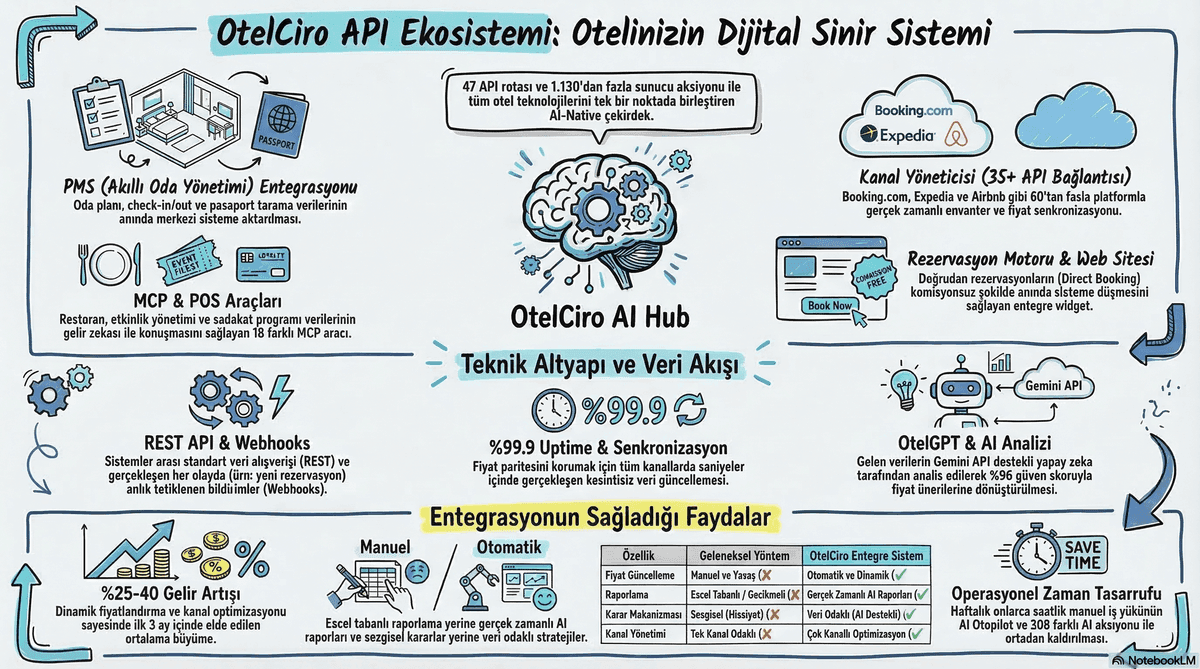
7. Integration Ecosystem
No PMS can do everything on its own. Your system needs to support the following integrations:
- Payment systems: Stripe, iyzico, PayTR, virtual POS
- Accounting software: Luca, Logo, Netsis, Paraşüt
- CRM and marketing: Email automation, social media
- Housekeeping: Room status management, task assignment
- Restaurant POS: F&B integration, folio transfer
- Door locks: Smart lock systems
- Energy management: Room automation systems
Systems with Open API support provide the flexibility to integrate with new technologies that emerge in the future.
8. Mobile Access and Management
Hotel managers don't sit at desks. Mobile access is no longer a luxury, but a necessity:
- Full-featured mobile app (iOS and Android)
- Real-time notifications (new reservation, cancellation, overbooking risk)
- Mobile check-in/check-out management
- Mobile access to dashboards and reports
- Mobile interface for housekeeping task management
9. Multi-Language and Multi-Currency Support
This feature is critical for Turkish hospitality:
- Turkish interface: For comfortable use by the team
- Multi-language guest communication: Automated communication in the guest's preferred language
- Pricing in TL, EUR, USD, GBP, and other currencies
- Automatic exchange rate updates: Real-time tracking of exchange rates (Central Bank of the Republic of Türkiye integration)
- Compliance with Turkish regulations: E-invoice, Identity Notification System (KBS) reporting, tourism fund calculation
10. Security and Data Protection
Compliance with KVKK (Law on Protection of Personal Data) and GDPR is a must-have in 2026:
- Data encryption: AES-256 both in-transit and at-rest
- Role-based access: Each staff member accesses only data within their authorization
- Audit logs: Tracking who, when, and what changed
- Automatic backup: Daily, weekly, and monthly backup policies
- PCI DSS compliance: Secure processing of credit card data
- KVKK/GDPR tools: Data deletion requests, privacy policy management
Related reading: OtelCiro Ecosystem: All Hotel Solutions on One Platform (2026)
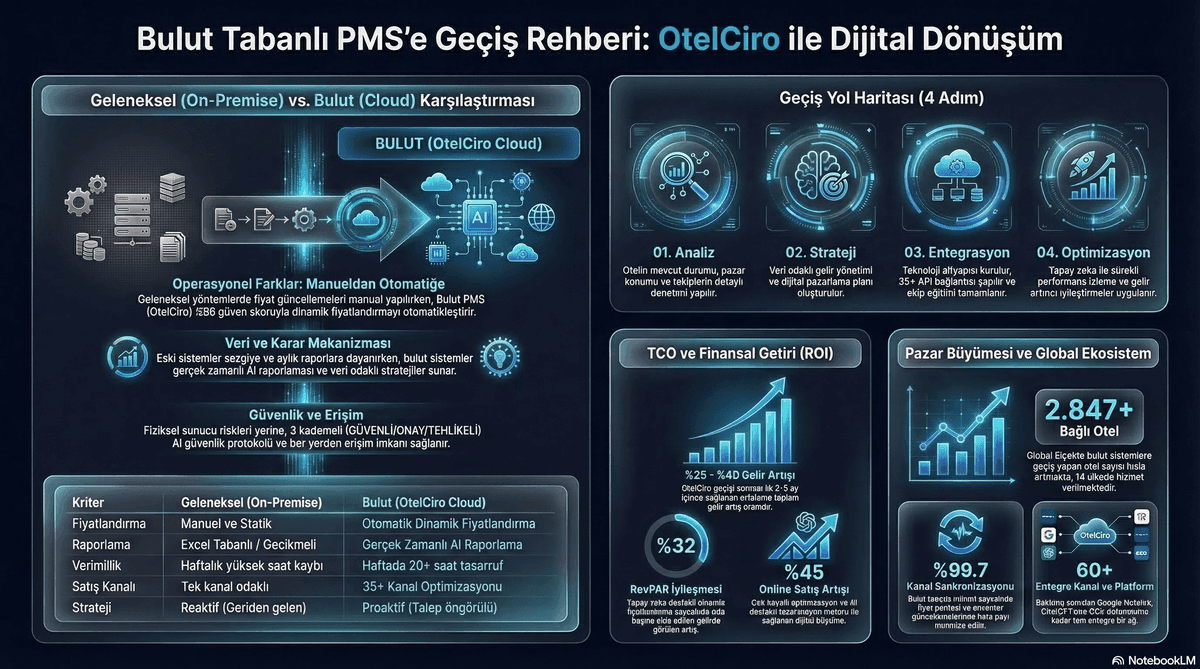
Cloud vs. On-Premise? A 2026 Comparison
The answer to this question in 2026 is almost definitive: Cloud. However, to support your decision-making process, let's provide a detailed comparison:
| Criteria | Cloud | On-Premise |
|---|---|---|
| Initial cost | Low (monthly subscription) | High (license + hardware) |
| Total cost of ownership (5 years) | Medium-low | High |
| Update frequency | Continuous, automatic | 1-2 per year, manual |
| Remote access | Full | Restricted (VPN required) |
| Scalability | Instant | Hardware investment required |
| Disaster recovery | Built-in | Additional investment required |
| AI capabilities | Advanced, continuously updated | Limited |
| Dependency | Internet connection | Local server |
| Data security | Professional data center | Hotel's responsibility |
The only exception: in locations with very inadequate internet infrastructure, a hybrid model (cloud + local cache) might be considered. However, in Türkiye in 2026, this is a very rare scenario.
Embed this image on your site
<a href="https://otelciro.com/en/news/hotel-pms-selection-your-2026-smart-guide-strategy">
  <img src="https://cdn.sanity.io/images/1la98t0z/production/e7bafa9293f887b24a2d4d0d26684221705d0113-1200x669.png" alt="Cloud-based PMS advantages and comparison" width="800" />
</a>
<p>Source: <a href="https://otelciro.com">OtelCiro</a> — AI Hotel Revenue Management</p>
Specific Evaluation Criteria for Turkish Hotels
Issues often not covered in international software comparisons, but vital for Turkish hotels:
Regulatory Compliance
- KBS (Identity Notification System): Automatic guest notification integration with the General Directorate of Security
- E-Invoice/E-Archive: Integration with the Turkish Revenue Administration (GİB)
- Tourism Fund: Automatic calculation of the 2% tourism contribution fee
- Accommodation Tax: Municipality-based accommodation tax management
Exchange Rate Management
Due to Turkish Lira volatility:
- Multi-currency pricing support
- Automatic exchange rate updates (Central Bank of the Republic of Türkiye integration)
- Foreign currency-based revenue reporting
- Exchange rate risk alerts
Seasonal Operations Management
Due to the strong seasonality of Turkish tourism:
- Season opening/closing processes
- Seasonal staff management
- High/low season pricing templates
- Integration with holiday and public holiday calendars
Turkish Support and Training
- 24/7 Turkish technical support
- Turkish user manuals and video tutorials
- Support team proficient in Turkish hospitality terminology
- Local training and onboarding services
Hotel Software Evaluation Checklist
A comprehensive checklist you can use in your system selection process:
Core Functionality:
- Reservation management (individual, group, corporate)
- Check-in / check-out processes
- Room type and inventory management
- Rate and pricing management
- Folio and billing
- Guest profile management
- Housekeeping module
Revenue Management:
- Dynamic pricing engine
- Channel manager (internal or integrated)
- Booking engine (website reservation engine)
- RevPAR and KPI tracking
- Competitor rate monitoring
Technology:
- Cloud-native architecture
- Artificial intelligence capabilities
- Open API
- Mobile application
- Multi-language and multi-currency
Compliance:
- KBS integration
- E-invoice integration
- KVKK/GDPR compliance
- PCI DSS compliance
- Tourism fund calculation
Support:
- 24/7 Turkish support
- Training program
- SLA guarantee (99.9%+ uptime)
- Data migration support
- Regular update schedule
Hotel Software Trends in 2026
Natural Language Interfaces
Traditional menu and form-based interfaces are being replaced by natural language interactions. Being able to manage the system with questions like "How many deluxe rooms do we have vacant for tomorrow?" is one of the most important trends of 2026. OtelGPT is a pioneer of this vision, serving as an AI assistant specifically trained for hospitality.
Composable Hotel Tech
Instead of a single monolithic software, a "composable" architecture where the best individual components are brought together via API is gaining prominence. This approach makes it possible to create a technology stack customized to the hotel's specific needs.
Predictive Operations
In 2026, the most advanced hotel software not only reports the past but also predicts the future: which day will experience staff shortages, which guests are prone to complain, which room type will see increased demand.
Sustainability Tracking
Tracking energy consumption, carbon footprint, and waste management is now becoming a standard component of PMS systems. As ESG reporting becomes mandatory in the hospitality sector, systems that automatically collect this data offer a significant advantage.
How to Make the Right Decision?
Selecting hotel software is an investment decision for at least 3-5 years. Here are our recommendations for managing this process quickly but correctly:
- Conduct a needs analysis: List your current problems and priorities.
- Request a demo: Evaluate at least 3-4 different systems with a live demo.
- Check references: Ask about the experiences of hotels operating in the same segment and region.
- Calculate total cost: Include not only license/subscription but also installation, training, integration, and data migration costs.
- Review contract terms: Exit clauses, data portability, SLA guarantees.
- Request a pilot implementation: If possible, test the system in a real environment with a 1-2 month pilot period.
Related reading: E-Invoice and Digital Accounting in Hotels: GİB Integration Guide (2026)
Conclusion: Software Selection is Strategy Selection
Choosing a hotel management system is much more than purchasing software—it is a strategic decision that determines your hotel's future competitiveness. In 2026, this decision is shaped around AI capabilities, cloud architecture, and the integration ecosystem.
The right system frees your team's time from operational details, allowing them to focus on strategic decisions. The wrong system, on the other hand, causes you to lose a little more time, energy, and revenue every day.
OtelCiro offers an AI-native hotel management ecosystem designed specifically for the needs of Turkish hospitality. With Smart PMS, AI Engine, Sales, and Operations modules, it provides end-to-end digital transformation for your hotel. Review pricing and plans to take the right step for your hotel.
![Europe's Hotel Construction Boom: 2026 Oversupply Risks [Market Analysis]](https://cdn.sanity.io/images/1la98t0z/production/6dfe59137f56aa14bfcba86d9db3cf05ff89f406-2752x1536.jpg?w=1920&q=50&auto=format&fit=max)