![Hotel PMS Explained: The Essential 2026 Guide [Strategy]](https://cdn.sanity.io/images/1la98t0z/production/771995728e35e2ee8cd6cd2a3ddd94e5f1f34ec4-1376x768.jpg?w=1920&q=65&auto=format&fit=max)
Key Takeaways
- A Hotel PMS (Property Management System) is an essential software solution for centralizing and managing all daily operations of a hospitality establishment.
- The global hotel PMS market is projected to reach $5.2 billion by 2026, growing at an annual rate of 8.4%, making PMS a fundamental necessity for hotels.
- Modern PMS solutions offer core modules for reservation, front office, revenue, channel management, and robust reporting, often complemented by POS, CRM, and maintenance modules.
- Cloud-based PMS is now the de facto standard, especially for small to mid-sized hotels, offering lower initial costs, automatic updates, global access, and enhanced scalability compared to on-premise systems.
- AI integration is transforming PMS, enabling smart pricing, predictive analytics (e.g., 92% accuracy for 90-day occupancy forecasts), and automated operations, leading to significant efficiency gains and improved guest experiences.
What is Hotel PMS?
A Hotel PMS (Property Management System) is a software system that enables a hospitality establishment to manage its daily operations from a single hub. In essence, it's a hotel management system that digitizes all operational processes, from reservation tracking to room management, front office operations, and revenue reporting.
As of 2026, the global hotel PMS market has reached a size of $5.2 billion and continues to expand at an annual growth rate of 8.4% (Hospitality Technology, 2026). This rapid digitalization in the industry has made PMS software no longer a luxury, but a fundamental necessity.
So, what exactly does a hotel PMS software do? What modules does it consist of? How is it chosen? In this guide, we examine hotel management systems from A to Z.
Related reading: Hotel Management with Smart PMS: Transitioning from Traditional Systems to AI-Powered Platforms
Related reading: E-Invoicing and Digital Accounting in Hotels: GIB Integration Guide (2026)
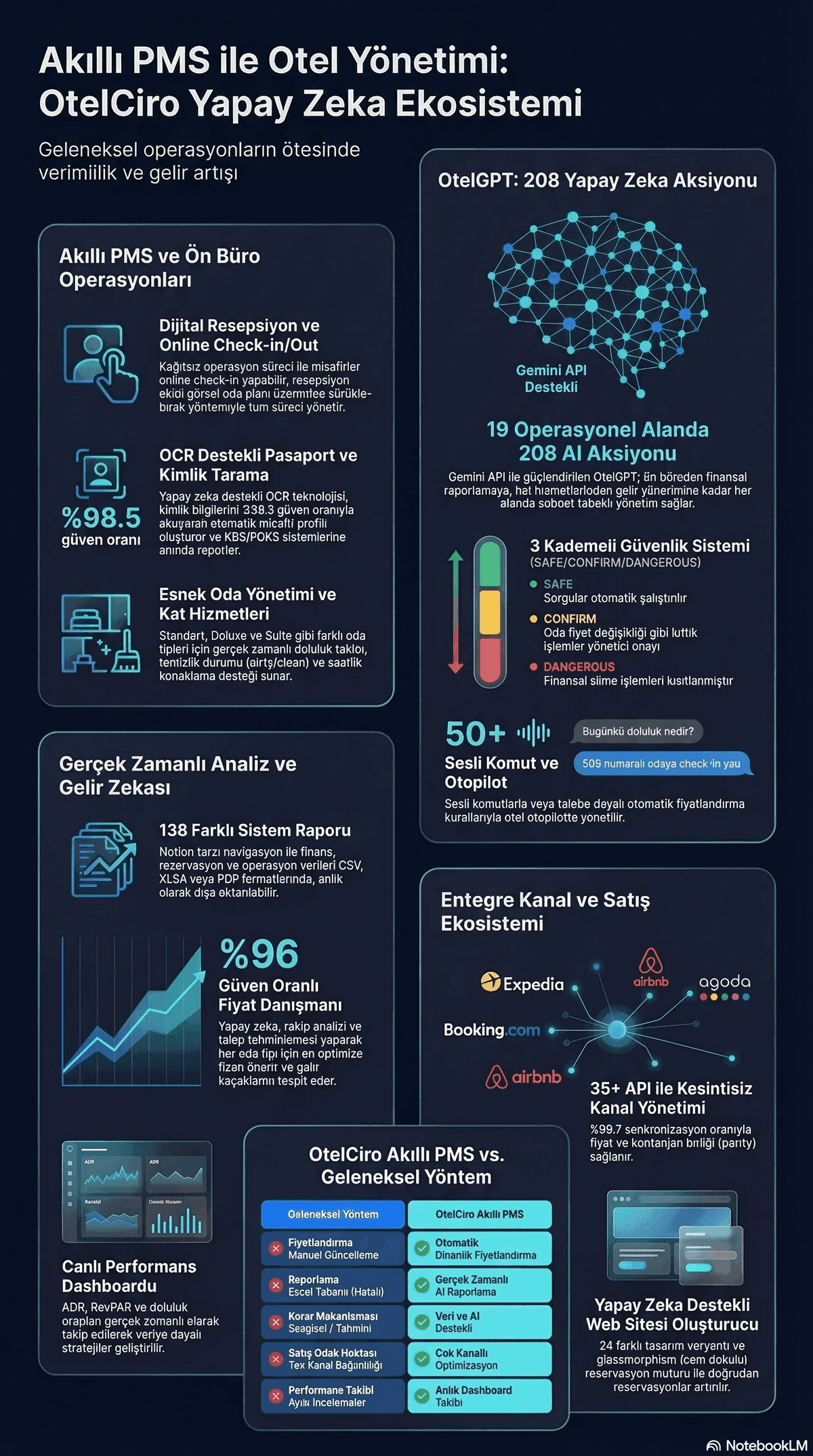
Core Modules of PMS Software
A modern hotel PMS software consists of multiple interconnected modules. Each module manages a different operational area of the hotel.
1. Reservation Management
The reservation module is the heart of the PMS. This module covers:
- Real-time room inventory: Instant occupancy view and availability management
- Multi-channel integration: Consolidation of OTAs, direct website, phone, and walk-in reservations in one place
- Automatic confirmations and notifications: Instant email/SMS reservation confirmation to guests
- Group and allotment management: Bulk room blocking for tour operators and corporate clients
- Cancellation and modification policies: Automated cancellation processes and penalty calculations
An effective smart PMS solution automates all these processes and minimizes human error.
2. Front Office Management
The front office, as the first point of contact for guests, is the most heavily used area of the PMS:
- Check-in / Check-out: Fast check-in/out processes, ID scanning, and police notification integration
- Room Assignment: Automatic room matching based on guest preferences
- Guest profiles: Historical stay data, preferences, and special notes
- Housekeeping coordination: Tracking cleaning status and room readiness notifications
- Message and request management: Recording guest requests
3. Revenue and Pricing Management
The revenue management module of the PMS directly impacts the hotel's profitability:
- Dynamic pricing: Automatic price adjustments based on demand, season, and competitor data
- Rate management: Different rate plans, promotions, and discount codes
- RevPAR tracking: Revenue per available room, ADR, and occupancy rate metrics
- Forecasting: Future demand prediction based on historical data
- Competitor price analysis: Automatic monitoring of market prices
An AI-powered revenue management engine analyzes these metrics in real-time, ensuring the hotel always offers the most optimal price.
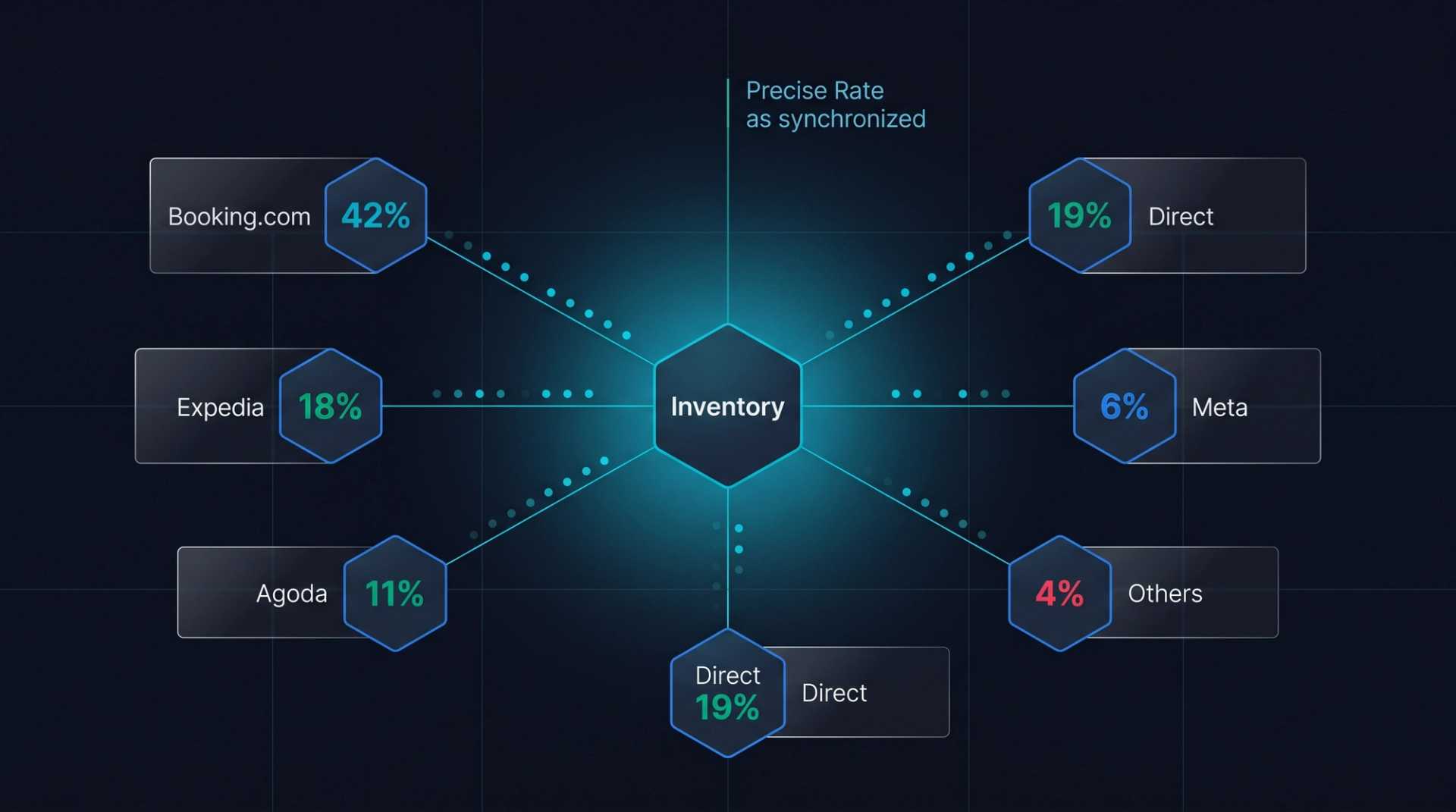
4. Channel Management
Today's hotels use an average of 5-8 different distribution channels. The PMS channel management module provides:
- Two-way integration with OTAs (Booking.com, Expedia, HotelBeds, etc.)
- Price and availability synchronization
- Over-booking protection
- Channel-specific performance analysis
- Commission tracking and cost analysis
Sales and channel management tools transparently report net revenue from each channel.
5. Reporting and Analytics
Strong reporting is the foundation of data-driven decision-making:
- Daily, weekly, monthly performance reports
- Department-specific revenue-expense analysis
- Guest segmentation and behavior analysis
- Competitor benchmarking
- Management dashboards
6. Additional Modules
Comprehensive PMS solutions also include the following modules:
- POS (Point of Sale): Integration of restaurant, bar, spa, etc., departments into the room account
- Accounting: Invoice, collection, and tax management
- CRM: Guest relations and loyalty programs
- Maintenance management: Technical fault reporting and tracking
- Banquet and event: Meeting room and organization management
Embed this image on your site
<a href="https://otelciro.com/en/news/hotel-pms-explained-the-essential-2026-guide-strategy">
  <img src="https://cdn.sanity.io/images/1la98t0z/production/94430a233fc50ac1fa33aa6540d2d61c577b51bc-1200x2150.png" alt="Akıllı PMS otel yönetim sistemi özellikleri" width="800" />
</a>
<p>Source: <a href="https://otelciro.com">OtelCiro</a> — AI Hotel Revenue Management</p>
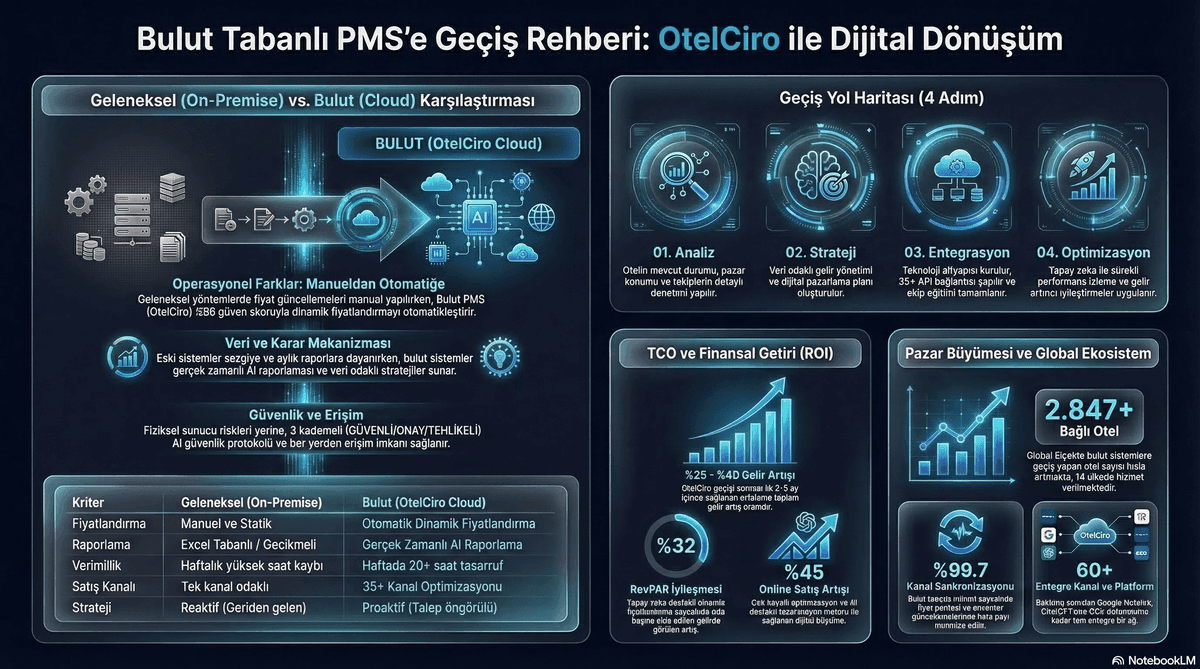
Cloud PMS vs. On-Premise: Which is Right?
In 2026, the most critical decision in hotel PMS selection is whether to choose a cloud-based or on-premise installation.
Cloud-Based PMS Advantages
| Criteria | Cloud PMS | On-Premise Installation |
|---|---|---|
| Initial Cost | Low (monthly subscription) | High (license + hardware) |
| Updates | Automatic | Manual, additional cost |
| Access | Anywhere, any device | Only from hotel network |
| Scalability | Instant | Requires hardware investment |
| Data Security | Professional data center | Hotel's own infrastructure |
| Integration | API-based, easy | Limited, complex |
| Disaster Recovery | Automatic backup | Manual configuration |
Industry data is clear: In 2026, 78% of new PMS installations are cloud-based. This rate was 52% in 2022 and 65% in 2024. Cloud PMS has now become the de facto standard, especially for boutique and mid-sized hotels with 10-200 rooms.
Situations Where On-Premise Installation Still Makes Sense
- Large resorts and chain hotels with 500+ rooms (high customization needs)
- Regions where internet infrastructure is unreliable
- Countries subject to very strict data localization regulations
- Requirement for deep integration with an existing ERP system
Related reading: Hotel Management System Selection: 2026 Comparison Guide
Related reading: Housekeeping Automation: 7 Steps to Digitalize Hotel Operations
Artificial Intelligence and PMS: 2026's Turning Point
Artificial intelligence integration in PMS software is no longer a future promise, but today's reality. The tangible benefits provided by AI-powered PMS:
Smart Pricing
In traditional PMS, price changes are often done manually or based on simple rules (e.g., "if occupancy exceeds 80%, increase price by 15%"). AI-powered systems, however:
- Simultaneously analyze competitor prices, weather forecasts, event calendars, and historical data
- Provide optimal price recommendations for each room type on a minute-by-minute basis
- Continuously improve pricing strategies through A/B testing
- Proactively adjust prices by predicting seasonal transitions in advance
The OtelGPT assistant makes these analytical capabilities accessible through a natural language interface — a hotelier can ask, "What should we do for our Deluxe rooms during the holiday period next week?"
Predictive Analytics
AI analyzes patterns in historical data with a depth that human eyes cannot capture:
- Demand forecasting: Calculates 90-day occupancy projections with 92% accuracy
- Cancellation prediction: Identifies which reservations are highly likely to be canceled
- No-show prediction: Anticipates guests who will not arrive to form an over-booking strategy
- Segment analysis: Detects which guest segments are growing or shrinking
Automated Operations
AI-powered automation dramatically increases operational efficiency:
- Smart room assignment: Automatic room matching based on guest profile, preferences, and historical data
- Housekeeping optimization: Cleaning sequence based on check-out times and new arrival schedules
- Staff scheduling: Shift optimization based on expected occupancy and activity
- Email automation: Personalized pre-arrival, in-stay, and post-stay communication
Embed this image on your site
<a href="https://otelciro.com/en/news/hotel-pms-explained-the-essential-2026-guide-strategy">
  <img src="https://cdn.sanity.io/images/1la98t0z/production/e7bafa9293f887b24a2d4d0d26684221705d0113-1200x669.png" alt="Bulut tabanlı PMS avantajları ve karşılaştırması" width="800" />
</a>
<p>Source: <a href="https://otelciro.com">OtelCiro</a> — AI Hotel Revenue Management</p>
How to Choose the Right Hotel PMS? 10 Critical Questions
Selecting PMS software determines the operational future of a hotel for 5-10 years. Here are 10 critical questions you should ask:
1. Is it Suitable for Your Property's Size?
The needs of a 10-room boutique hotel are fundamentally different from those of a 300-room city hotel. Evaluate the PMS's scalability and pricing model according to your property's size.
2. Is the Integration Capacity Sufficient?
Minimum integration requirements for a modern PMS:
- At least 50+ OTA and channel manager integrations
- Payment gateway (POS) integration
- Accounting software connection
- CRM and email marketing tools
- Police notification system (GIYKIMBIL in Turkey)
3. Does it Offer Mobile Access?
In 2026, 64% of hotel managers access their PMS from mobile devices. A responsive web interface or native app is a must-have.
4. What is the Quality of Training and Support?
The best PMS is unsuccessful if it cannot be used without training. Evaluate:
- Onboarding process and duration
- 24/7 technical support
- Turkish support and documentation (if applicable)
- Video training library
- Live training sessions
5. What are the Data Security Standards?
Guest data security is both a legal requirement (KVKK, GDPR) and a matter of reputation:
- PCI DSS compliance (for credit card data)
- SSL/TLS encryption
- Two-factor authentication
- Regular security audits
- Data backup and disaster recovery plan
6. Is the Reporting Depth Sufficient?
Reports generated by the PMS are the basis for management decisions. Check for:
- Customizable report templates
- Real-time dashboard
- Export options (Excel, PDF, API)
- Benchmark comparison
- Automated report scheduling
7. Does it Have Artificial Intelligence Capabilities?
In 2026, choosing a PMS without AI integration is like setting up a non-mobile-friendly website in 2015. Minimum expectations:
- Dynamic pricing recommendations
- Demand forecasting model
- Automated guest segmentation
- Chatbot or AI assistant support
8. What is the Total Cost of Ownership (TCO)?
Don't just look at license or subscription fees. TCO covers:
- Installation and data migration costs
- Training costs
- Integration development costs
- Support and maintenance fees
- Hardware costs (for on-premise installation)
9. What are its References and Market Share?
Ask about the experiences of hotels of similar size:
- How many active hotels use it?
- How many customers does it have in the Turkish market?
- What is the uptime guarantee?
- Average customer satisfaction score
10. What is its Future Vision and Roadmap?
The PMS provider's technology roadmap affects your next 5 years:
- Frequency of new feature development
- AI and automation investments
- Open API strategy
- Adaptation speed to industry trends
PMS Software Comparison Criteria
A scoring matrix you can use when comparing different PMS solutions:
| Criteria | Weight | Score (1-10) |
|---|---|---|
| Ease of use | %15 | ? |
| Reservation management | %15 | ? |
| Channel manager integration | %12 | ? |
| Revenue management tools | %12 | ? |
| Reporting and analytics | %10 | ? |
| AI and automation | %10 | ? |
| Mobile access | %8 | ? |
| Integration capacity | %8 | ? |
| Support quality | %5 | ? |
| Price-performance | %5 | ? |
You can objectively compare each PMS candidate by scoring them using this matrix.
Hotel PMS Trends in 2026
Trend 1: AI-First PMS
Artificial intelligence is no longer an add-on but is at the core of the PMS architecture. AI-first PMS are systems that learn as they collect data and continuously improve their recommendations.
Trend 2: Headless and API-First Architecture
Modern PMS are moving from monolithic structures to microservices architecture. This allows each module to operate independently, and third-party integrations become much easier.
Trend 3: Guest Experience Focus
The role of PMS is no longer just "operational management" but also personalizing the guest experience. Digital check-in, mobile key, personalized room settings — all are managed through the PMS.
Trend 4: Sustainability Integration
Energy consumption tracking, carbon footprint calculation, and ESG reporting are being added to PMS modules. This feature is becoming mandatory, especially for hotels serving the European market.
Related reading: OtelCiro Ecosystem: All Hotel Solutions on One Platform (2026)
Conclusion: PMS Selection is a Strategic Decision
Choosing hotel PMS software is much more than an IT purchase — it is a strategic decision that defines the operational DNA of your hotel. In 2026, the right PMS is:
- Cloud-based — provides flexibility in access and scalability
- AI-powered — automates data-driven decisions
- Integrated — connected with all distribution channels and operational systems
- User-friendly — minimizes training time and error rates
To discover the most suitable management system for your hotel's needs, we recommend exploring OtelCiro's smart PMS solution and its comprehensive pricing plans.
With the right PMS, your hotel doesn't just operate efficiently — it operates smarter, earns more, and offers unforgettable experiences to its guests.
![Europe's Hotel Construction Boom: 2026 Oversupply Risks [Market Analysis]](https://cdn.sanity.io/images/1la98t0z/production/6dfe59137f56aa14bfcba86d9db3cf05ff89f406-2752x1536.jpg?w=1920&q=50&auto=format&fit=max)