![Hotel Outsourcing: Strategic Decisions & Cost Savings [2026 Guide]](https://cdn.sanity.io/images/1la98t0z/production/c0791a4c585381445e382011f4ea915abb478340-1200x669.png?w=1920&q=65&auto=format&fit=max)
Key Takeaways
- Outsourcing can reduce hotel operational costs by 15-30% and enhance flexibility, but it requires strategic evaluation, not just cost comparison.
- Departments with low guest interaction and functions distant from core competencies (e.g., security, laundry, IT infrastructure) are most suitable for outsourcing.
- A comprehensive cost-benefit analysis, including hidden costs and intangible factors like quality risk and employee loyalty, is crucial before making a decision.
- Successful outsourcing relies heavily on rigorous vendor selection, thorough reference checks, and robust Service Level Agreements (SLAs).
- Consider a hybrid model, blending in-house control with outsourced flexibility for specific functions, to achieve an optimal balance between cost savings and quality.
Outsourcing: Strategic Decision or Cost Reduction?
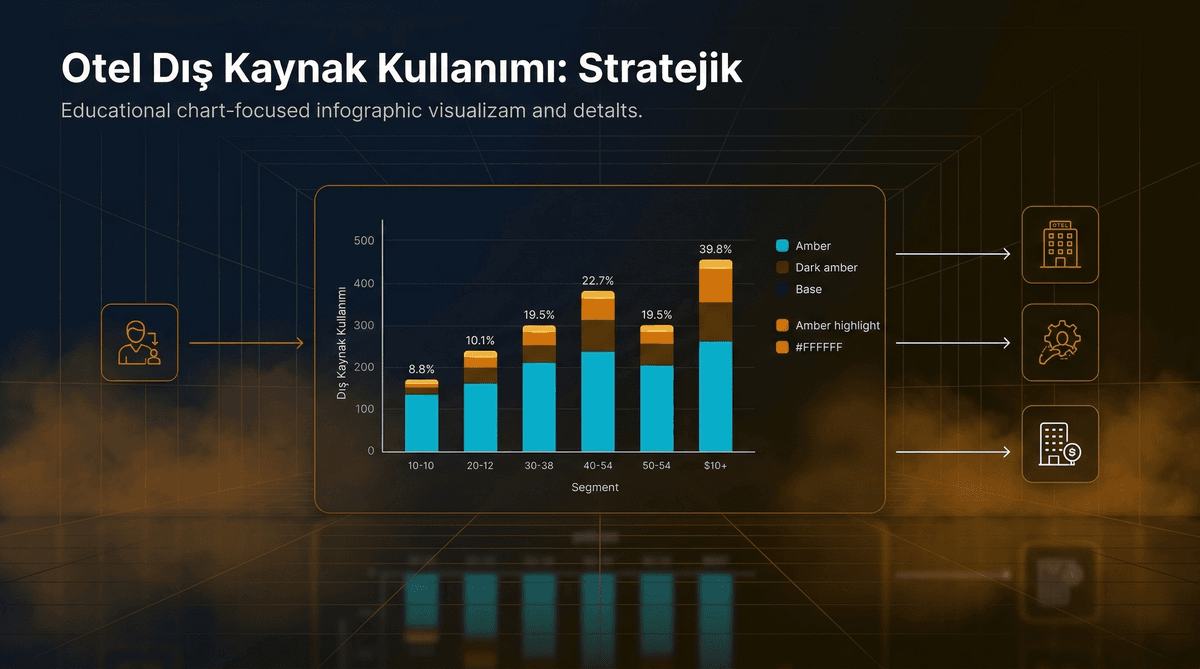
Hotel outsourcing has rapidly expanded in the Turkish hospitality sector over the last decade. According to industry research, 62% of hotels in Turkey will be utilizing outsourcing in at least one department by 2026. However, an outsourcing decision requires strategic evaluation beyond a simple cost comparison.
When implemented correctly, outsourcing can reduce costs by 15-30% and provide operational flexibility. Conversely, poorly executed outsourcing can lead to quality degradation, guest dissatisfaction, and hidden costs. This guide addresses all factors you should consider when making an outsourcing decision.
Embed this image on your site
<a href="https://otelciro.com/en/news/hotel-outsourcing-strategic-decisions-cost-savings-2026-guide">
  <img src="https://cdn.sanity.io/images/1la98t0z/production/c0791a4c585381445e382011f4ea915abb478340-1200x669.png" alt="Hotel Outsourcing Decision Guide" width="800" />
</a>
<p>Source: <a href="https://otelciro.com">OtelCiro</a> — AI Hotel Revenue Management</p>
Related reading: Hotel Automation and Business Processes Guide
Suitable Departments for Outsourcing and Analysis
Not every department is equally suitable for outsourcing. When making a decision, "guest contact intensity" and "distance from core competency" are two primary criteria.
Department-Based Outsourcing Suitability Matrix
| Department | Outsourcing Suitability | Potential Savings | Risk Level | Prevalence (TR) |
|---|---|---|---|---|
| Security | High | %20-30 | Low-Medium | %78 |
| Laundry | High | %25-35 | Low | %65 |
| Garden maintenance | High | %15-25 | Low | %72 |
| IT infrastructure | High | %20-30 | Medium | %55 |
| Housekeeping | Medium | %10-20 | High | %35 |
| Accounting/finance | Medium | %15-25 | Medium | %28 |
| Technical maintenance | Medium-Low | %10-15 | High | %18 |
| Front desk | Low | %5-10 | Very High | %5 |
| F&B service | Low | %5-10 | Very High | %8 |
Key Rule: Departments requiring direct and frequent guest contact carry very high outsourcing risks. Back-office support functions are more suitable for outsourcing.
Cost-Benefit Analysis Framework
Before making an outsourcing decision, a comprehensive cost-benefit analysis must be conducted. A superficial cost comparison can be misleading because if hidden costs are not accounted for, the total cost may increase.
Total Cost Comparison Model
In-house costs:
- Personnel gross salary + SSI employer's share (22.5%)
- Severance and notice pay provision (8.33%/year)
- Annual leave, sick leave, absenteeism costs
- Recruitment and training costs (average 15,000 TL/year per employee)
- Management and supervision time
- Equipment and consumable material costs
- Insurance and occupational safety expenses
Outsourcing costs:
- Service fee (monthly/annual contract)
- Quality control and audit costs
- Coordination and communication time
- Transition period additional costs
- Contract management and legal consulting
- Risk of service quality decline (intangible cost)
Example Calculation: 200-Room Hotel — Housekeeping
| Cost Item | In-house (Annual) | Outsourcing (Annual) |
|---|---|---|
| Personnel cost (25 people) | 3.750.000 TL | — |
| Equipment and chemicals | 280.000 TL | — |
| Training and recruitment | 120.000 TL | — |
| Management cost | 180.000 TL | 60.000 TL |
| Service fee | — | 3.200.000 TL |
| Quality control/audit | 50.000 TL | 120.000 TL |
| Total | 4.380.000 TL | 3.380.000 TL |
| Difference | — | -%23 |
This calculation appears to favor outsourcing at first glance. However, intangible factors such as quality risk, employee loyalty, and flexibility must also be evaluated.
Outsourcing Decision Matrix
A scoring-based decision matrix can be used for the final decision:
| Criterion | Weight | In-house Score (1-5) | Outsourcing Score (1-5) |
|---|---|---|---|
| Cost | %25 | 3 | 4 |
| Quality control | %25 | 5 | 3 |
| Flexibility | %15 | 3 | 4 |
| Guest experience | %20 | 5 | 3 |
| Ease of management | %15 | 2 | 4 |
Fill out this matrix separately for each department. The option with a weighted score above 3.5 should be preferred.
Related reading: Hotel Business Intelligence and Reporting Guide
Vendor Selection and Evaluation
70% of outsourcing success depends on selecting the right vendor.
Vendor Evaluation Criteria
Mandatory criteria (elimination):
- Minimum 5 years of experience in the service sector
- Hospitality references (at least 3 hotels of similar segment)
- Financial strength certificate and bank reference
- No SSI and tax debt certificate
- Occupational safety certifications (ISO 45001 or OHSAS 18001)
Scoring criteria:
- Personnel qualification level and training programs
- Technology infrastructure (reporting, tracking systems)
- Ability to flexibly increase/decrease capacity
- Crisis management capability (contingency plan in case of staff shortage)
- Price/performance ratio
Reference Check
Contact at least 3 current clients of the vendor candidates:
- How is the consistency of service quality?
- What is the staff turnover rate?
- How quickly do they resolve issues?
- How are out-of-contract requests handled?
- Would you choose them again?
Contract Management
The outsourcing contract forms the foundation of the relationship. A weak contract is a source of problems for both parties.
Provisions to Include in the Contract
Service Level Agreement (SLA):
- Clear performance metrics (room cleaning time, customer satisfaction score, complaint rate)
- Measurement method and frequency
- Penalties for SLA breaches
- Bonus/incentive mechanism (for exceeding targets)
Operational provisions:
- Staff count and qualifications
- Working hours and shift schedule
- Shared responsibility for equipment and materials
- Training requirements and certifications
Financial provisions:
- Pricing model (fixed, variable, or hybrid)
- Payment schedule and conditions
- Price increase mechanism (annual CPI-linked)
- Pricing for additional service requests
Exit strategy:
- Contract termination conditions and periods
- Transition period support
- Information and equipment transfer procedure
- Non-compete clauses
Quality Control and Performance Management
The biggest mistake after outsourcing is thinking, "I've handed over the work, it's no longer my problem." Regular quality control is the key to outsourcing success.
Performance Monitoring System
| Metric | Measurement Frequency | Target | Minimum Acceptable |
|---|---|---|---|
| Guest satisfaction score | Monthly | 4.5/5 | 4.0/5 |
| Complaint rate | Weekly | <2% | <5% |
| Staff turnover rate | Monthly | <15%/year | <30%/year |
| SLA compliance rate | Monthly | >95% | >90% |
| Response time | Daily | <15 min | <30 min |
| Audit score | Weekly | >90/100 | >80/100 |
Regular Meetings
- Weekly operational meeting: Current issues, staff status, next week's plan
- Monthly performance review: SLA metrics, trend analysis, improvement suggestions
- Quarterly strategic review: Long-term performance, contract compliance, price revision
Hybrid Model: The Best of Both Worlds
Instead of full outsourcing or full in-house, a hybrid model is an optimal solution for many hotels.
Hybrid model examples:
- Housekeeping: Core team in-house, peak period reinforcement outsourced. This model saves 15% on costs while maintaining quality control.
- Security: Day shifts in-house (high guest contact), night shifts outsourced. 20% savings on total security costs.
- Technical maintenance: Daily maintenance in-house, specialized tasks (elevators, HVAC, generators) outsourced.
- IT: Infrastructure management outsourced, PMS and guest-facing systems coordinated in-house.
Track the performance of both in-house and outsourced teams from a single dashboard with the OtelCiro operations platform.
Risk Management
Outsourcing risks must be proactively managed.
Key risks and precautions:
- Quality degradation: Regular audits, SLA penalties, keeping a backup vendor ready
- Staff turnover: Vendor guarantee of minimum training duration, commitment to experienced staff ratio
- Dependency risk: Avoid reliance on a single vendor, maintain a contingency plan
- Information security: Confidentiality agreement, guest data access restrictions, KVKK compliance audit
- Labor law risk: Seek legal advice against the risk of muvazaa (sham subcontracting)
The subcontracting regulation in force in Turkey since 2014 defines the legal framework for outsourcing relationships. Practices that would create a direct employer-employee relationship should be avoided.
Conclusion
When applied correctly, outsourcing is a powerful tool that optimizes costs and provides operational flexibility. However, it may not be suitable for every department and always requires detailed analysis.
Recommendations for your decision-making process:
- Conduct a cost-benefit analysis, including all hidden costs.
- Fill out the decision matrix separately for each department.
- Evaluate the hybrid model — full outsourcing is not the only option.
- Do not skip reference checks in vendor selection.
- Make outsourcing performance measurable with the OtelCiro operations platform.
![Europe's Hotel Construction Boom: 2026 Oversupply Risks [Market Analysis]](https://cdn.sanity.io/images/1la98t0z/production/6dfe59137f56aa14bfcba86d9db3cf05ff89f406-2752x1536.jpg?w=1920&q=50&auto=format&fit=max)