![Hotel Meta Search Bidding: Google, Trivago, Kayak [2026 Strategy Guide]](https://cdn.sanity.io/images/1la98t0z/production/80038ee38e7ca9198176cdcc9916541b2f21d52b-1200x669.png?w=1920&q=65&auto=format&fit=max)
Key Takeaways
- Meta search platforms like Google Hotel Ads, Trivago, and Kayak are crucial for driving direct bookings, with 47% of hotel searches starting here in 2026.
- Hotels must strategically choose between CPC (Cost Per Click) and CPA (Cost Per Acquisition) bidding models based on their website strength, conversion rates, and risk tolerance.
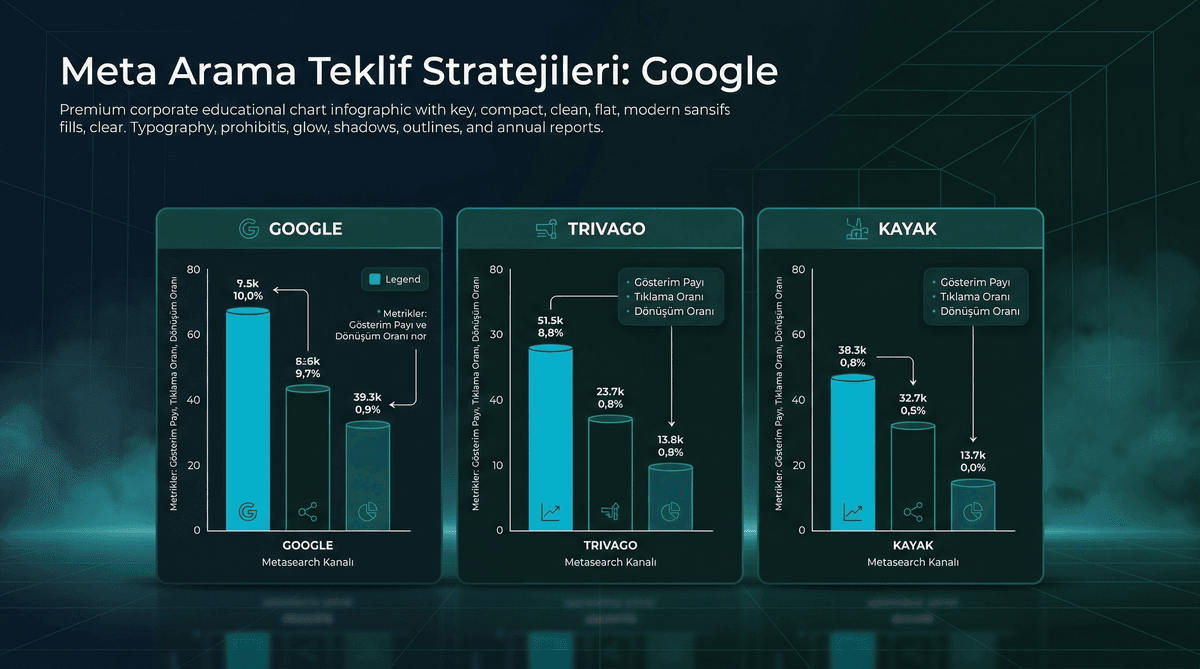
- Tailor bidding strategies to each platform (e.g., Google Hotel Ads can yield 8:1 to 15:1 ROAS, Trivago is strong in Europe, Kayak in North America).
- Consistent ROI measurement and a weekly optimization cycle (including bid adjustments, price parity checks, and conversion tracking) are essential for maximizing returns.
- Avoid common pitfalls such as price inconsistency and inadequate landing pages to gain a competitive advantage and achieve high ROAS.
Meta Search Engines: A Critical Channel for Hotels
Meta search engines are platforms that allow travelers to compare prices from multiple sources. Google Hotel Ads, Trivago, Kayak, TripAdvisor, and Skyscanner are leaders in this category. In 2026, 47% of hotel searches begin on meta search platforms, and this rate is increasing every year.
According to Phocuswright research, hotels investing in the meta search channel have a 28% higher direct booking rate. However, extracting value from this channel requires a precise bidding strategy. A poorly structured campaign will not provide a return on every dollar spent.
In the Turkish market, the percentage of hotels actively using the meta search channel is 22%, significantly behind the European average (41%). This situation presents an opportunity for early-adopting hotels to benefit from low competition and high returns.
Embed this image on your site
<a href="https://otelciro.com/en/news/hotel-meta-search-bidding-google-trivago-kayak-2026-strategy-guide">
  <img src="https://cdn.sanity.io/images/1la98t0z/production/80038ee38e7ca9198176cdcc9916541b2f21d52b-1200x669.png" alt="Meta search bidding strategy and optimization infographic" width="800" />
</a>
<p>Source: <a href="https://otelciro.com">OtelCiro</a> — AI Hotel Revenue Management</p>
Related reading: Google Hotels Visibility Strategies
CPC vs CPA: Choosing a Bidding Model
There are two primary bidding models on meta search platforms. Each has advantages and disadvantages, varying based on the hotel's profile and goals.
CPC (Cost Per Click)
In the CPC model, you pay every time a user clicks on your hotel's price link. The click cost accrues even if a reservation does not occur.
Advantages:
- Lower unit cost (per click 0.30-2.50 USD)
- Easy budget control
- Increased brand awareness (traffic even without reservations)
Disadvantages:
- Conversion risk entirely on the hotel
- High total cost at low conversion rates
- Continuous bid optimization required
Ideal profile: Hotels with high conversion rates (3%+) and robust website and booking engine infrastructure.
CPA (Cost Per Acquisition / Commission Model)
In the CPA model, you pay only for completed reservations. Google Hotel Ads' "Commission" model and Trivago's "CPA" option fall into this category.
Advantages:
- No risk: Pay only for realized reservations
- Fixed commission rate (in the range of 10-15%)
- Low risk of budget overrun
Disadvantages:
- Unit cost higher than CPC
- The platform may prioritize hotels offering higher commissions
- Advantage may narrow when compared to OTA commissions
Ideal profile: Hotels with limited digital marketing experience looking for a low-risk start.
Hybrid Approach
The most successful hotels combine CPC and CPA models based on the platform and season. For example:
- High season: CPC model (low click cost + high conversion)
- Low season: CPA model (risk minimized, guaranteed cost)
- Google Hotel Ads: CPC-heavy
- Trivago: CPA-heavy
Platform-Based Strategy
Each meta search platform has its unique algorithm, audience, and bidding dynamics. Managing all platforms centrally via the OtelCiro sales ecosystem ensures strategic consistency.
Google Hotel Ads
Google leads the meta search market with a 65% share. It provides visibility through Google Maps, Google Search, and Google Travel.
Bidding optimization tips:
- Device-based bid adjustment: 20% higher bids for mobile (mobile conversions are increasing)
- Location-based targeting: Differentiate bids according to source markets
- Date-based strategy: Increase bids 3-7 days before check-in date
- Hotel class impact: CPC performance is 40% higher for 4-5 star hotels
Average ROAS (Return on Ad Spend) for Google Hotel Ads, when properly optimized, ranges between 8:1 and 15:1.
Trivago
Trivago, Europe's largest hotel meta search engine, has 120 million monthly visitors. It is particularly strong in the German, UK, and French markets.
Bidding strategy:
- Use the CPA model with the Trivago Rate Connect program (ideal for starting)
- Photo quality has a 30% weight in the Trivago algorithm
- Price competitiveness: Showing lower prices than OTAs increases click-through rates by 55%
- Review score: Hotels with a score of 8.0+ receive 25% more clicks
Kayak
Kayak is a meta search engine especially strong in the North American market. It is an effective channel for travelers from the US and Canada coming to Turkey.
Key points:
- Bid competition on Kayak is 35% lower than on Google
- Package search feature: Travelers searching for flight + hotel provide higher ADR
- CPC cost: Average 0.20-0.80 USD (half of Google's)
Related reading: Guide to Increasing Revenue with 5 Channel Optimizations
ROI Measurement and Optimization Cycle
Accurately measuring the return on meta search investment is fundamental to continuously improving the strategy.
Basic ROI Formula
Net ROI calculation:
- Gross Revenue: Total reservation revenue from the meta search channel
- Click Cost: Total CPC expenditure
- Transaction Cost: Booking engine and payment processing fees
- Net Profit: Gross Revenue - (Click Cost + Transaction Cost)
- ROAS: Net Profit / Click Cost
Target ROAS: 8:1 (8 TL revenue for every 1 TL spent)
Weekly Optimization Checklist
Successful meta search management requires regular optimization:
- Bid adjustment: Decrease bids in low-ROAS markets, increase in high-performing ones
- Price parity check: Verify that your website price is lower than or equal to OTAs
- Conversion rate tracking: Monitor landing page performance
- Competitor analysis: Check your competitive position
- Budget allocation: Reallocate platform budget based on performance
Common Mistakes and Solutions
The most frequent mistakes made in the meta search channel and ways to avoid them:
- Price inconsistency: If the website price is higher than the OTA, clicks are wasted. Solution: Price parity monitoring automation
- Inadequate landing page: If users are directed to the general homepage after clicking, conversions will plummet. Solution: Deep link with pre-selected dates and room types
- Single-platform focus: Investing only in Google misses low-competition opportunities on other platforms
- Lack of seasonal adjustment: Using the same bidding strategy year-round leads to waste during low season and lost revenue during high season
Conclusion: Gaining a Competitive Edge in Meta Search
Meta search engines are one of the most effective ways for hotels to reduce OTA dependency while increasing direct bookings. With the right bidding model selection, platform-based strategy, and a continuous optimization cycle, it's possible to achieve 8-15x ROAS from this channel.
As a first step, start with Google Hotel Ads using the CPA model, collect your conversion data, and then transition to the CPC model, focusing on bid optimization. Manage all your meta search channels through a centralized system to ensure consistency and efficiency.
![Europe's Hotel Construction Boom: 2026 Oversupply Risks [Market Analysis]](https://cdn.sanity.io/images/1la98t0z/production/6dfe59137f56aa14bfcba86d9db3cf05ff89f406-2752x1536.jpg?w=1920&q=50&auto=format&fit=max)