![Hotel Maintenance Teams: Work Order Management [2026 Guide]](https://cdn.sanity.io/images/1la98t0z/production/7c0253f827732e00b297717bc49688224837d9dc-1200x669.png?w=1920&q=65&auto=format&fit=max)
Key Takeaways
- Boost Efficiency & Guest Satisfaction: Effective hotel technical maintenance is crucial, reducing reactive maintenance costs by 35% and boosting guest satisfaction by 20%.
- Implement Digital Work Order Management: Utilize a CMMS for systematic creation, prioritization, assignment, and tracking of all maintenance tasks from mobile devices.
- Shift to Proactive Maintenance: Transition from reactive to preventive and predictive maintenance to decrease breakdowns by 60% and overall maintenance costs by 35%.
- Leverage Technology for Energy Savings: Integrate IoT sensors and a CMMS for enhanced energy management, offering 20-30% savings on energy costs and instant leak detection.
- Invest in Staff & Monitor KPIs: Prioritize continuous staff training for safety and technical skill development, and regularly monitor key performance indicators for optimal departmental performance.
Technical Maintenance: The Hotel's Heartbeat
The hotel technical maintenance department is the unseen hero of the guest experience. When the air conditioning isn't working, a faucet leaks, or an elevator malfunctions, the guest's first call will be to reception, but it's the technical team that provides the solution. According to JD Power hotel satisfaction research, complaints originating from technical malfunctions reduce the overall satisfaction score by 15-20%.
In 68% of hotels in Turkey, technical maintenance still operates on a "react-to-failure" (reactive maintenance) model. However, hotels transitioning to preventive and predictive maintenance approaches reduce breakdown rates by 60% and maintenance costs by 35%. An effective technical maintenance organization not only reduces costs but also protects the guest experience.
Embed this image on your site
<a href="https://otelciro.com/en/news/hotel-maintenance-teams-work-order-management-2026-guide">
  <img src="https://cdn.sanity.io/images/1la98t0z/production/7c0253f827732e00b297717bc49688224837d9dc-1200x669.png" alt="Technical Maintenance Team Organization" width="800" />
</a>
<p>Source: <a href="https://otelciro.com">OtelCiro</a> — AI Hotel Revenue Management</p>
Related reading: Hotel IoT and Smart Room Technologies
Team Structure and Organization Chart
The size and structure of the technical maintenance team are determined by the hotel's room count, age, and facility complexity.
Recommended Team Size
| Hotel Type | Room Count | Technical Staff | Staff/Room Ratio |
|---|---|---|---|
| Boutique | 30-50 | 2-3 people | 1:15-20 |
| City Mid-Segment | 100-150 | 5-7 people | 1:20-25 |
| City Upper-Segment | 200-300 | 8-12 people | 1:25-30 |
| Resort | 200-400 | 12-18 people | 1:20-25 |
| MICE/Convention | 300-500 | 15-25 people | 1:20-25 |
Areas of Expertise
In mid-sized and large hotels, the team should be structured according to areas of expertise:
- Mechanical/Plumbing: Plumbing, heating, cooling systems, pump, and boiler maintenance
- Electrical: Electrical panels, lighting, generators, UPS systems
- HVAC: Air handling units, chillers, fan-coil units, ventilation
- Building Automation: BMS (Building Management System), energy management, room control
- General Maintenance: Furniture repair, painting, minor construction work, locks/doors
- Pool and Spa (Resort): Water chemicals, filter systems, sauna/Hammam technology
Shift Planning
A 24/7 technical support requires a shift plan:
| Shift | Hours | Minimum Staff | Task Focus |
|---|---|---|---|
| Morning | 07:00-15:00 | 50% team | Preventive maintenance, planned tasks |
| Evening | 15:00-23:00 | 35% team | Guest requests, evening breakdowns |
| Night | 23:00-07:00 | 15% team (min 1-2 people) | Emergency response, night rounds |
Work Order Management System
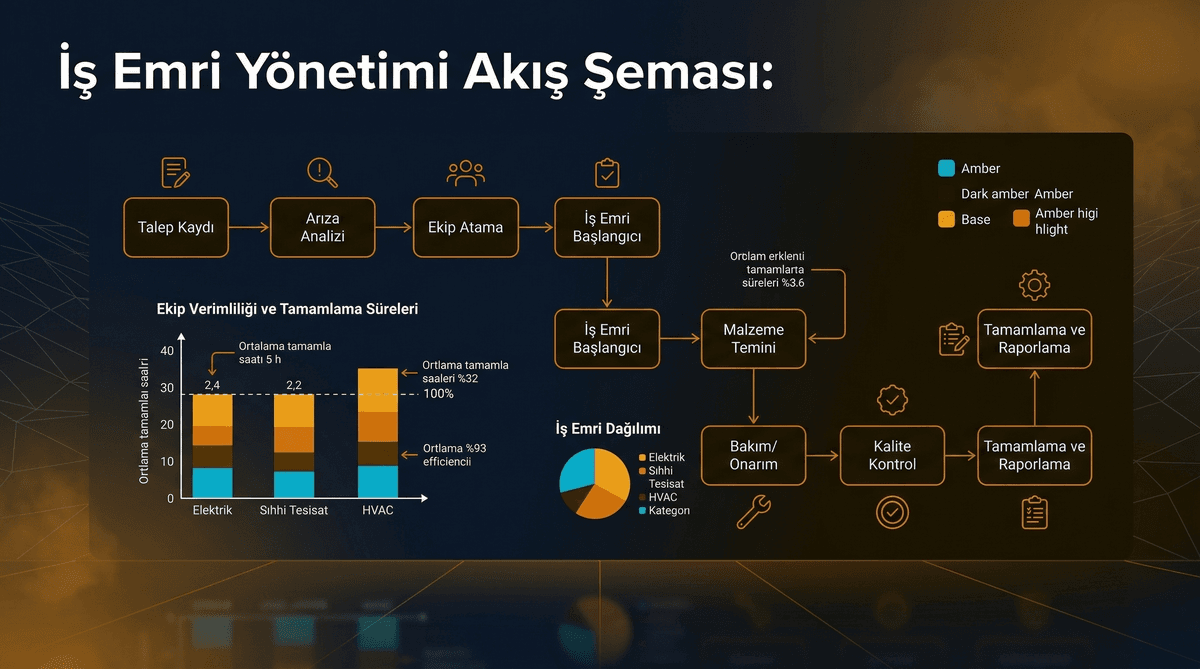
The work order system is the backbone of the technical maintenance department. Without systematic work order management, knowing which breakdowns are open, who is working on what, and the average resolution time is impossible.
Work Order Life Cycle
- Creation: Guest request (via reception), staff notification, automatic detection (sensor), or planned maintenance schedule
- Classification: Category (mechanical, electrical, HVAC, general), priority level, estimated duration
- Assignment: Directing to the appropriate technician or area of expertise
- Execution: Initiating work, material usage, progress updates
- Completion: Work completion, recording materials used, photographic documentation
- Verification: Supervisor or requester approval
- Closure: Work order closure, performance data logging
Prioritization System
| Priority | Definition | Target Response Time | Target Resolution Time | Examples |
|---|---|---|---|---|
| P1 — Emergency | Affecting guest safety or accommodation | 15 minutes | 1 hour | Flooding, power outage, door lock |
| P2 — High | Affecting guest comfort | 30 minutes | 4 hours | AC malfunction, no hot water, broken TV |
| P3 — Normal | Affecting operations | 2 hours | 24 hours | Lighting malfunction, dripping faucet |
| P4 — Low | Aesthetic or planned | 24 hours | 72 hours | Painting, furniture repair, decoration |
| P5 — Planned | Preventive maintenance | According to schedule | According to schedule | Filter replacement, lubrication, calibration |
Any malfunction affecting a guest room should be classified as at least P2. Malfunctions in occupied rooms should automatically be elevated to the next higher priority.
Related reading: Advantages of Cloud-Based PMS for Hotels
Preventive Maintenance Program
Preventive maintenance is a systematic maintenance approach that prevents breakdowns before they occur. According to industry data, every 1 TL spent on preventive maintenance prevents 4-6 TL in reactive maintenance costs.
Preventive Maintenance Schedule
Daily checks:
- Generator run test (no load)
- Boiler and hot water system temperature check
- Pool chemical values measurement
- Elevator visual inspection
- Common area lighting check
Weekly maintenance:
- AC filter check and cleaning
- Pump pressure and vibration check
- Generator loaded run test (30 minutes)
- Emergency exit lighting test
- Fire detection system spot check
Monthly maintenance:
- HVAC system comprehensive maintenance
- Elevator professional maintenance
- Generator oil and filter check
- Water softening system maintenance
- Energy consumption analysis and anomaly detection
Quarterly maintenance:
- Chiller/boiler seasonal maintenance
- Electrical panel thermal imaging
- Fire extinguishing system test
- Roof and facade drainage check
- BMS calibration and update
Annual maintenance:
- Elevator annual inspection
- General electrical installation check
- Boiler periodic inspection
- Pressure vessel inspection
- Annual fire systems test
Preventive Maintenance ROI
Impact of a preventive maintenance program for a 200-room hotel:
| Metric | Before Preventive Maintenance | After Preventive Maintenance | Improvement |
|---|---|---|---|
| Monthly breakdown count | 85 | 35 | -59% |
| Average resolution time | 3.2 hours | 1.4 hours | -56% |
| Annual maintenance cost | 850,000 TL | 550,000 TL | -35% |
| Guest technical complaint rate | 8.5% | 2.8% | -67% |
| Room unavailability due to breakdown (room-nights/year) | 240 room-nights/year | 45 room-nights/year | -81% |
Energy Management
The hotel technical maintenance team is also responsible for the hotel's energy efficiency. Energy costs account for 6-10% of total operating expenses, and proper management can achieve 20-30% savings.
Energy Monitoring Metrics
| Metric | Formula | Benchmark (City Hotel) |
|---|---|---|
| kWh/occupied room-night | Total electricity / Occupied room-nights | 25-40 kWh |
| m3 natural gas/occupied room-night | Total gas / Occupied room-nights | 3-6 m3 |
| Liters water/guest-night | Total water / Guest-nights | 300-500 liters |
| Energy cost/occupied room-night | Total energy expense / Occupied room-nights | 15-30 TL |
Energy Saving Opportunities
- Lighting: 60-70% savings with LED conversion (ROI: 12-18 months)
- HVAC optimization: 20-30% savings with occupancy-based AC control
- Room key card energy switch: 15% savings by cutting power in unoccupied rooms
- BMS optimization: 10-15% additional savings with building automation system settings
- Solar energy: 20-35% reduction in electricity costs with rooftop PV systems
Technology and Digitalization
Modern technical maintenance management cannot be effective without technology. Digitalizing maintenance processes with operational management platforms increases efficiency and traceability.
CMMS (Computerized Maintenance Management System) Components
- Digital work order management: Creation, assignment, tracking, closure — all from a mobile device
- Preventive maintenance schedule: Automatic reminders and task creation
- Asset management: Digital inventory of all equipment, maintenance history, warranty information
- Spare part stock integration: Automatic stock deduction of materials used during maintenance
- Reporting and analytics: Breakdown trends, resolution times, cost analysis, staff performance
IoT Sensor Integration
Transition to predictive maintenance with IoT sensors:
- Vibration sensors: Detect pump and fan failures 2-4 weeks in advance
- Temperature sensors: Detect overheating and electrical faults in advance
- Water meters: Instant detection of hidden water leaks
- Energy monitoring: Automatic reporting of abnormal consumption patterns
In hotels adopting predictive maintenance, the unexpected breakdown rate decreases by 75%.
Staff Development and Training
Continuous training for technical staff is critical for both safety and efficiency.
Mandatory training:
- Occupational safety and working at heights (annual)
- Electrical safety (annual)
- Firefighting and evacuation (biannual)
- Hazardous material handling (annual)
Technical development training:
- New equipment usage (for each new device)
- BMS and automation system update training
- Energy efficiency practices
- HVAC and cooling technologies updates
The breakdown resolution time for certified technicians is 40% shorter than for their uncertified colleagues.
Performance Metrics and KPIs
Technical maintenance performance should be regularly measured and reported:
| KPI | Target | Measurement Frequency |
|---|---|---|
| Average response time (P1) | <15 minutes | Daily |
| Average resolution time (P1-P2) | <2 hours | Weekly |
| Preventive maintenance completion rate | >95% | Monthly |
| Recurring breakdown rate | <5% | Monthly |
| Guest technical complaint rate | <3% | Monthly |
| Energy consumption target compliance | ±5% | Monthly |
| Maintenance cost/room | Within target | Monthly |
Conclusion
Technical maintenance organization directly determines a hotel's reliability and guest experience. Transitioning from reactive to preventive and predictive maintenance reduces costs by 35% while increasing guest satisfaction by 20%.
Priority steps:
- Establish a digital work order system and record all requests
- Create a prioritization system and set response time targets
- Prepare a preventive maintenance schedule and implement it diligently
- Start tracking energy monitoring metrics
- Digitalize all maintenance processes with the OtelCiro operations platform
A well-organized technical maintenance team is one of a hotel's most valuable assets.
![Europe's Hotel Construction Boom: 2026 Oversupply Risks [Market Analysis]](https://cdn.sanity.io/images/1la98t0z/production/6dfe59137f56aa14bfcba86d9db3cf05ff89f406-2752x1536.jpg?w=1920&q=50&auto=format&fit=max)