![Hotel Loyalty Apps: Boost Direct Bookings [2026 Guide]](https://cdn.sanity.io/images/1la98t0z/production/e17d4f8436194a7d6951f30f63a5e050cc67bf79-1200x669.png?w=1920&q=65&auto=format&fit=max)
Key Takeaways
- Combat OTA Dependency: Hotels typically generate 55-70% of revenue from OTAs, incurring 15-25% commissions. Implementing a loyalty app can increase your direct channel share by 10-20 points.
- Essential App Features: A powerful loyalty app requires a comprehensive points system, tiered membership levels, an integrated direct booking engine, digital room keys, and personalized offers.
- Strategic Pricing & Notifications: Offer loyalty members prices 5-15% lower than OTA rates to boost net revenue. Utilize push notifications, which boast a 45-65% open rate, for targeted offers, but limit frequency to a maximum of two per week.
- Technical Implementation: Choose between custom development (3-6 months, 150,000-500,000 TL) or ready-made solutions (4-8 weeks, 30,000-100,000 TL), ensuring seamless PMS integration and strict data security (KVKK/GDPR, PCI DSS).
- Measure & Iterate: Track key performance indicators (KPIs) like app downloads, active users, direct booking conversion, and Lifetime Value (LTV). Aim to onboard 30% of guests and increase direct channel share by 8-12 points in the first year, continuously refining the platform.
The Key to Escaping OTA Dependency: A Loyalty App
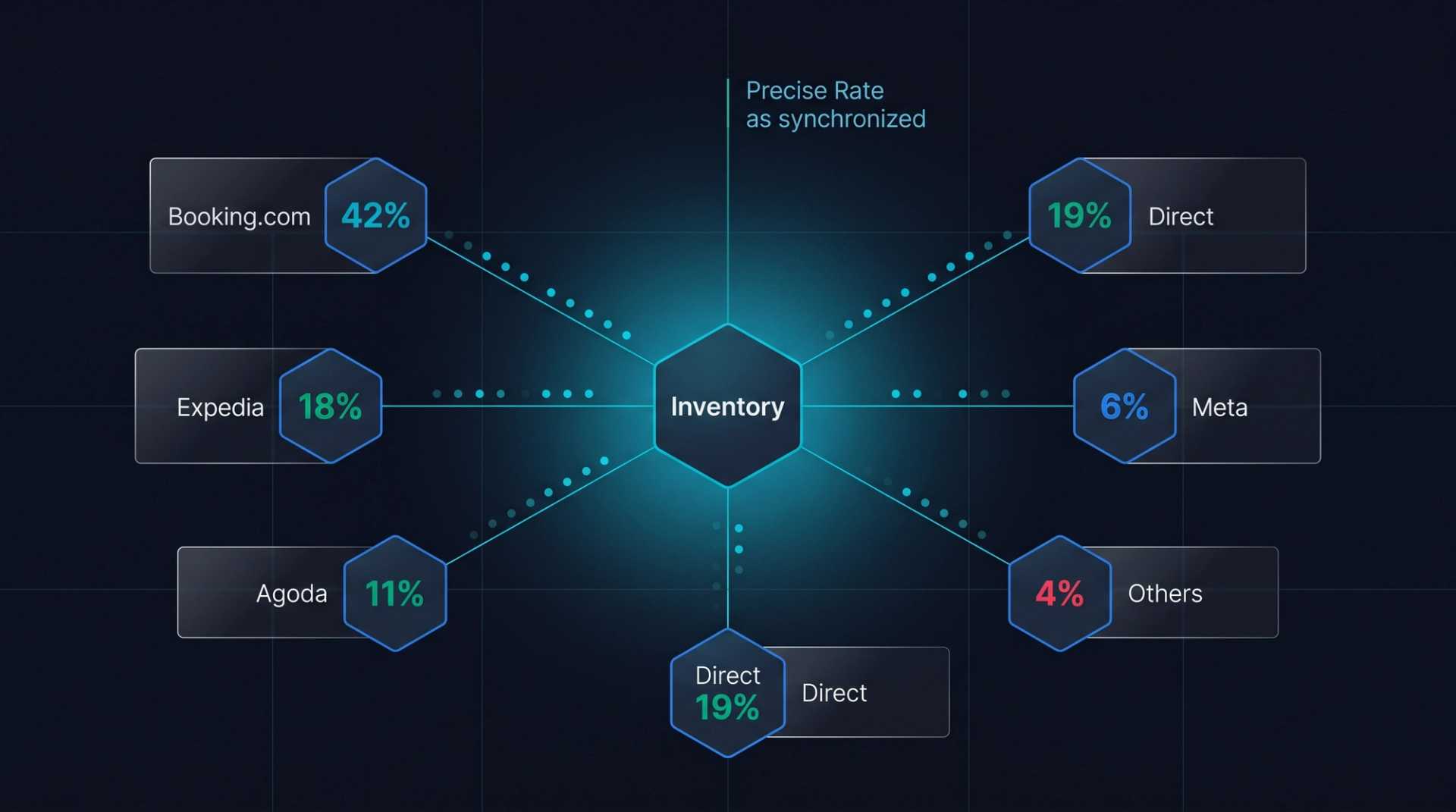
The vast majority of hotels in Turkey generate 55-70% of their total revenue from OTA channels. Considering a 15-25% commission cut from each reservation, this translates to a significant loss in profitability. While completely breaking away from OTAs isn't a realistic strategy, it is possible to reduce this dependency by increasing direct channel share. The most powerful tool for this is your own hotel loyalty application.
Large chain hotels (Marriott Bonvoy, Hilton Honors, IHG One Rewards) have successfully increased their direct channel share to over 50% with their loyalty programs. Marriott's Bonvoy program boasts 196 million members, and these members account for 58% of total direct channel reservations. A standalone boutique hotel or small chain cannot achieve this scale, but with a well-designed mobile loyalty application, increasing direct channel share by 10-20 percentage points is an entirely realistic goal.
The core value proposition of a loyalty app is this: to provide guests with a concrete reason to make their next stay directly with you, rather than through an OTA. This reason could be points accumulation, special pricing, room upgrades, early check-in, or simply a personalized experience—the important thing is that it must be more appealing than the alternatives.
Core Loyalty App Features
An effective hotel loyalty app should not merely be a tool for collecting points; it must be a digital experience platform that encompasses the guest's entire stay journey.
Points system: Earn points on every expenditure. Points should be earned from rooms, restaurants, spas, minibars, and all additional services. Standard rule: 1 point for every 10 TL spent. Points can be used for discounts on future stays, free nights, room upgrades, or services.
Membership tiers: A tiered structure such as Bronze, Silver, Gold, and Platinum. Each level offers increasing privileges. Criteria for advancing levels: annual number of stays or spending amount. Platinum members receive premium benefits like late check-out, lounge access, and free spa services.
Direct booking engine: One-step booking directly within the app. Fast payment with saved card information. Additional point bonuses for reservations made through the app—a tangible incentive to choose the app over an OTA.
Digital room key: Mobile check-in and a digital key. Guests can go directly to their room without waiting at the front desk. This feature holds significant value, especially for business travelers, and increases app download motivation by 60%.
Personalized offers: Personalized campaigns based on the guest's past stay data. Targeted offers like "You loved the sea-view room on your last stay—get 20% off on your next visit" yield 3 times higher conversion rates compared to generic campaigns.
Related reading: Increase Direct Bookings with a Booking Engine
Push Notification Strategy
Push notifications are the loyalty app's most powerful marketing tool. While email marketing open rates are 20-25%, push notification open rates range between 45-65%. However, abusing this power can also increase the app uninstall rate—a strategy is essential.
Notification types and timing:
- Price drop notification: Instant notification when the price drops for a date range the guest previously viewed. High conversion rate.
- Early bird booking: Early bird campaign 60-90 days before the season opens. E.g., "25% early bird discount exclusive to loyalty members."
- Birthday and special occasions: Personalized offers for the guest's birthday, wedding anniversary, or other special days. E.g., "Celebrate your birthday with us—complimentary cake and room upgrade."
- Pre-check-in: Reminder 3 days before the stay date, invitation for online check-in, and upselling offers (room upgrade, transfer, restaurant reservation).
- Post-check-out: Thank you message, request for review, and an early offer for the next stay.
Frequency rule: A maximum of 2 notifications per week. More than this will annoy users and increase the app uninstall rate. Ensure every notification offers real value—do not send notifications without a promotion.
Special Pricing Strategy: Cheaper Than OTAs
The most potent weapon of a loyalty app is offering special member pricing below OTA rates. Major OTAs, including Booking.com, do not apply rate parity rules to member prices within hotel loyalty programs—this is a legal and compliant strategy.
Pricing structure: Offer app members a price 5-15% lower than the OTA price. For example, a room costing 1,000 TL on an OTA could be 870 TL for app members. The guest receives a discount and earns points. The hotel, in turn, gives a small discount instead of a commission, increasing its net revenue.
Comparison: 1,000 TL room
- Booking.com: 1,000 TL × 18% commission = 820 TL net revenue
- Loyalty app: 870 TL × 2% payment infrastructure fee = 852 TL net revenue
The hotel earns 32 TL more from the direct channel—and the guest saves 130 TL. A win-win for both parties.
"Best Price Guarantee" badge: Provide a "You won't find this price anywhere else" guarantee within the app. This guarantee eliminates the guest's need to compare prices and increases the conversion rate by 25%.
Technical Infrastructure and Development
There are two main approaches to developing a loyalty app: custom development and ready-made solutions.
Custom development: Developing an app for iOS and Android from a single codebase using React Native or Flutter. Offers full control and customization. Development time is 3-6 months, with costs ranging from 150,000-500,000 TL. Suitable for large chains and hotels with high budgets.
Ready-made solutions: Solutions from Revinate, Cendyn, Pebblesoft, or local Turkish providers. Can be implemented in a shorter time (4-8 weeks) and at a lower cost (30,000-100,000 TL). PMS integration is provided through ready-made modules. Ideal for small and medium-sized hotels.
PMS integration: Two-way API integration with the PMS system is essential for the app to function in real time. Inventory, prices, guest profiles, and point information must be synchronized instantly.
Data security: A data processing infrastructure compliant with KVKK and GDPR is mandatory. Personal data must be stored encrypted. Payment information must be processed on a PCI DSS compliant infrastructure. Explicit consent mechanisms and the right to data erasure should be offered within the app.
With OtelCiro's sales ecosystem, you can integrate your loyalty app with your other distribution channels to manage the entire guest journey from a single platform.
Success Metrics and Sustainable Growth
To measure the success of your loyalty app, track the following KPIs: number of app downloads, active user rate (MAU), reservation rate via the app, average points earned and used, Lifetime Value (LTV) per member, churn rate, and change in direct channel share.
First-year goals for a successful loyalty app should be: 30% of total guests downloading the app, 20% of those who download making reservations through the app, and an 8-12 percentage point increase in direct channel share.
A loyalty app is not a one-time project but a continuously evolving platform. Regular updates, new feature additions, A/B tests, and improvements based on user feedback—this process never ends. However, a properly established loyalty app transforms into your hotel's most valuable digital asset and forms the cornerstone of your journey to independence from OTA reliance.
![Europe's Hotel Construction Boom: 2026 Oversupply Risks [Market Analysis]](https://cdn.sanity.io/images/1la98t0z/production/6dfe59137f56aa14bfcba86d9db3cf05ff89f406-2752x1536.jpg?w=1920&q=50&auto=format&fit=max)