![Hotel Linen Lifecycle Management: Costs & Quality [2026 Guide]](https://cdn.sanity.io/images/1la98t0z/production/5a8edd36160820b56cf645194e5781e0471049d2-1200x669.png?w=1920&q=65&auto=format&fit=max)
Key Takeaways
- Linen operations are silent cost drivers, representing 3-5% of total operating costs, equating to TL 600,000-1,500,000 annually for a 200-room hotel.
- Systematic linen lifecycle management can reduce costs by 15-25% while consistently maintaining high quality and guest satisfaction.
- Strategic decisions like in-house versus outsourced laundry (in-house often more economical for 150+ rooms) and proper washing procedures significantly impact linen lifespan and operational efficiency.
- Implementing technology such as RFID for wash count tracking can significantly decrease linen loss (by up to 60%) and improve renewal budgeting accuracy.
- Adopting sustainability practices, including guest towel reuse programs and multi-tier linen reuse strategies, can save substantial water and energy, while reducing textile waste by up to 80%.
Linen Management: The Hotel's Silent Cost Giants
Hotel linen operations — sheets, towels, napkins, tablecloths, and staff uniforms — account for 3-5% of total operating costs. While this figure may seem small, for a 200-room hotel, it translates to an annual expenditure between TL 600,000-1,500,000. Effective linen lifecycle management optimizes this cost while maintaining guest experience quality.
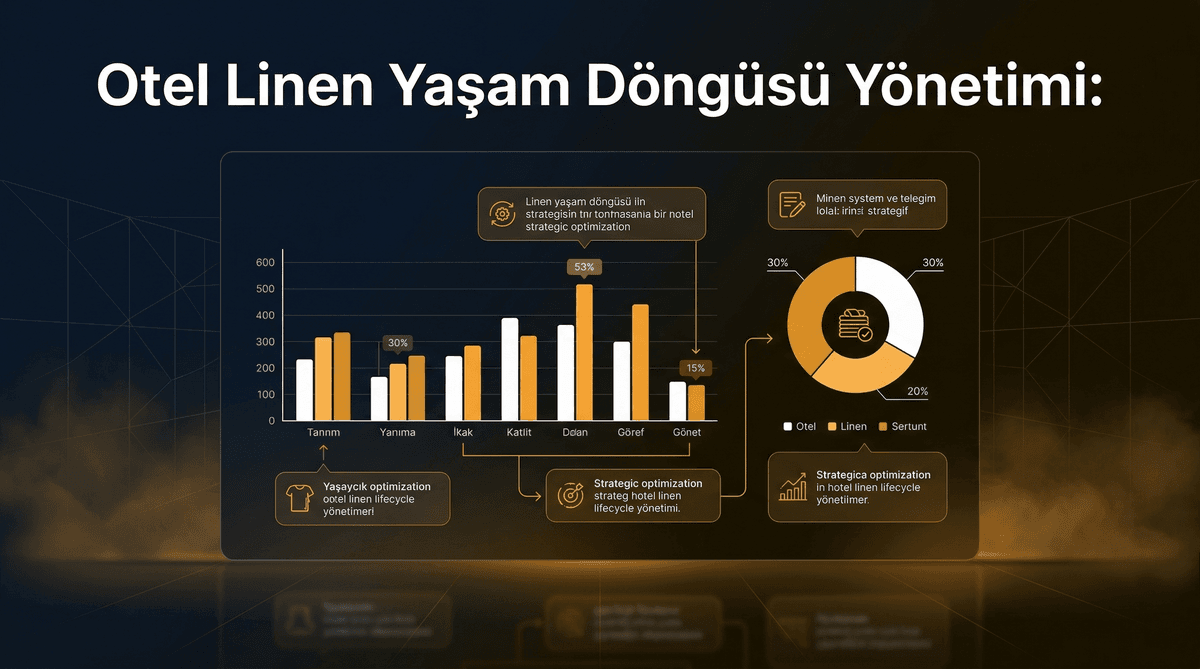
According to industry data, 55% of hotels adopt a "wait until it looks worn" approach to linen replacement decisions. This reactive strategy leads to both guest complaints and cash flow pressure from bulk replacements. Systematic lifecycle management, however, can reduce linen costs by 15-25% while consistently maintaining high quality.
Embed this image on your site
<a href="https://otelciro.com/en/news/hotel-linen-lifecycle-management-costs-quality-2026-guide">
  <img src="https://cdn.sanity.io/images/1la98t0z/production/5a8edd36160820b56cf645194e5781e0471049d2-1200x669.png" alt="Otel Çamaşır ve Linen Yaşam Döngüsü" width="800" />
</a>
<p>Source: <a href="https://otelciro.com">OtelCiro</a> — AI Hotel Revenue Management</p>
Related reading: Hotel Automation and Business Process Guide
Linen Types and Expected Lifespans
Each linen category has different quality standards, wear rates, and lifespans.
Lifespan Table
| Linen Type | Expected Wash Cycles | Expected Lifespan | Replacement Cost (per piece) |
|---|---|---|---|
| Sheet (percale, 200TC) | 200-250 washes | 18-24 months | 120-250 TL |
| Sheet (sateen, 300TC+) | 150-200 washes | 12-18 months | 250-500 TL |
| Bath towel (500-600 g/m2) | 250-300 washes | 18-24 months | 80-180 TL |
| Hand towel | 300-350 washes | 24-30 months | 30-60 TL |
| Bath mat | 200-250 washes | 12-18 months | 40-80 TL |
| Bathrobe | 150-200 washes | 18-24 months | 200-500 TL |
| Pillowcase | 250-300 washes | 18-24 months | 40-80 TL |
| Duvet cover | 200-250 washes | 18-24 months | 180-400 TL |
| Restaurant tablecloth | 200-250 washes | 12-18 months | 100-300 TL |
| Napkin (fabric) | 300-400 washes | 18-24 months | 20-50 TL |
These lifespans are valid under correct washing conditions. Incorrect temperature, excessive detergent, or mechanical damage can shorten these periods by 30-50%.
Stock Level Calculation
Hotel linen stock is managed using "par level" (cycle level). Standard hotel practice recommends 3 par:
- 1 par: In use (on bed/table)
- 1 par: In wash/dry/iron cycle
- 1 par: Clean and ready in storage
For a 200-room hotel, sheet stock: 200 rooms x 2 sheets/room x 3 par = 1,200 sheets. Actual stock should include a 10% safety margin to cover wear and renewal cycles, totaling 1,320 sheets.
Laundry Operation: In-house vs. Outsourcing
Laundry operation is one of the hotel's most critical "make or buy" decisions.
Comparison Table
| Criterion | In-house Laundry | Outsourced Laundry |
|---|---|---|
| Cost per kilogram | 3-6 TL/kg | 5-10 TL/kg |
| Initial investment | 500,000-2,000,000 TL | None |
| Space requirement | 100-300 m2 | None |
| Staff requirement | 4-12 people | None (excluding coordinator) |
| Quality control | Full control | Limited control |
| Linen lifespan | Longer (15-25%) | Shorter (aggressive washing) |
| Flexibility | Responds to immediate needs | Dependent on delivery schedules |
| Turnaround time | 4-8 hours | 24-48 hours |
| Water/energy usage | On hotel bill | Included (service fee) |
General rule: For hotels with over 150 rooms, in-house laundry is generally more economical. For hotels with fewer than 150 rooms, outsourcing may be preferred. A hybrid model (in-house for room linen, outsourcing for restaurant and public area linen) is also a common approach.
In-house Laundry Efficiency Metrics
| Metric | Target | Benchmark |
|---|---|---|
| Kg/staff/hour | 25-35 kg | Industry average: 20 kg |
| Water consumption/kg | 8-12 liters | Old machines: 20+ liters |
| Energy consumption/kg | 0.8-1.2 kWh | Old machines: 2+ kWh |
| Chemical cost/kg | 0.4-0.8 TL | Over-dosage: 1.5+ TL |
| Linen damage rate | <1% | Poor practice: 3-5% |
Washing Procedures and Quality Control
Washing quality directly impacts linen lifespan and guest satisfaction.
Washing Programs
An optimized washing program should be applied for each linen type:
| Linen Type | Temperature | Detergent Dosage | Mechanical Action | Duration |
|---|---|---|---|---|
| White sheet | 70-75°C | Standard + bleach | Medium | 45-55 min |
| Colored sheet | 50-60°C | Standard (no bleach) | Low-medium | 40-50 min |
| Towel | 60-70°C | Standard + softener | Medium | 40-50 min |
| Bathrobe | 50-60°C | Standard + softener | Low | 35-45 min |
| Tablecloth | 60-70°C | Standard + stain remover | Medium-high | 45-55 min |
| Staff uniform | 50-60°C | Standard | Medium | 35-45 min |
Critical rules:
- Excessive heat damages fiber structure — do not exceed 75°C for sheets, 70°C for towels.
- Excessive detergent leaves residue and can cause skin irritation.
- Increased mechanical action (wash cycle speed) accelerates wear.
- Chlorine-based bleaches shorten linen lifespan by 20% — prefer oxygen-based.
Stain Management
Intervention protocol based on stain types:
- Blood stain: Pre-treat with cold water, enzyme-based detergent; never hot water (coagulates protein).
- Coffee/tea: Immediate pre-treatment, alkaline detergent, 60°C wash.
- Oil/grease: Pre-treatment (stain remover spray), alkaline detergent, 65-70°C wash.
- Makeup: Pre-treatment (solvent-based), standard wash.
- Mold: Long soak with oxygen-based bleach, 75°C wash.
Intervening within the first 30 minutes of a stain occurrence increases the success rate to 85%.
Related reading: Hotel Standard Operating Procedures (SOPs) for Cleaning
Lifecycle Tracking and Renewal Plan
Linen lifecycle tracking ensures data-driven renewal decisions.
Wash Count Tracking Methods
- RFID tagging: Automatic wash counting with an RFID chip sewn into each linen piece. High investment cost (3-8 TL per piece) but the most accurate method.
- Barcode system: Lower cost but requires manual scanning for each wash.
- Batch tracking: Group-based tracking — monitoring linens purchased at the same time as a batch. The simplest method but cannot track individual items.
- Date stamping: Tracking age by stamping the entry date on the linen edge.
Hotels implementing RFID systems report a 60% reduction in linen loss and 90% accuracy in lifespan predictions.
Quality Degradation Indicators
Physical signs that indicate linen needs replacement:
| Indicator | Description | Action |
|---|---|---|
| Loss of whiteness | Grey/yellow tinge (Whiteness Index <70) | Try bleaching, replace if unsuccessful |
| Tear/hole | Tear greater than 1 cm, unraveling | Replace immediately |
| Thinning | Light passes through when stretched with fingers | Replace within 3 months |
| Loss of absorbency | Towel doesn't absorb water (softener buildup) | Try vinegar wash, replace if unsuccessful |
| Permanent stain | Stain that doesn't come out after washing | Replace |
| Seam unraveling | Stitching coming undone, fraying | Repair or replace |
Renewal Budget Planning
The renewal budget should be planned according to the age profile of the linen inventory:
| Year | Renewal Rate | Estimated Budget for 200-Room Hotel |
|---|---|---|
| 1st year (new) | 5-10% (damage/loss) | 80,000-150,000 TL |
| 2nd year | 20-25% | 250,000-400,000 TL |
| 3rd year | 25-30% | 300,000-500,000 TL |
| 4th year | 20-25% | 250,000-400,000 TL |
| 5th year | 15-20% + start of bulk renewal | 500,000-800,000 TL |
Planning the renewal budget according to the lifecycle, rather than distributing it equally across years, helps preserve cash flow.
Sustainability and Environment
Linen operations are a significant component of a hotel's environmental footprint.
Water and Energy Savings
- Guest laundry preference program: Reduce wash cycles by 30% with a "reuse your towel" program. This program saves 500,000-800,000 liters of water annually for a 200-room hotel.
- Full capacity washing: Running machines half-full consumes 40% more water/energy.
- Greywater recycling: Final rinse water can be reused for pre-wash cycles.
- Heat recovery: Pre-heating fresh water with the heat from waste hot water.
Second Life Strategy
Linens that no longer meet guest room standards can be used in different areas:
- Tier 1 → Tier 2: Room sheet → staff dormitory/storage cover
- Tier 2 → Tier 3: Second-tier linen → cleaning cloth/dust rag
- Tier 3 → Recycling: End-of-life linen → textile recycling facility
This tiered approach reduces linen waste by 80% and positively contributes to sustainability reports.
Technology and Digital Management
Digitalizing linen management with operational management platforms strengthens cost and quality control.
Components of a digital linen management system:
- RFID inventory tracking: Real-time stock visibility, loss detection.
- Automated wash count recording: Lifespan prediction and renewal alerts.
- Quality assessment module: Digital condition scoring, photo records.
- Cost reporting: Department and linen type-based cost analysis.
- Supplier integration: Automated ordering and delivery tracking.
Hotels implementing RFID-based linen management reduce linen loss from 3% to 0.5%, translating to an annual saving of TL 80,000-120,000 for a 200-room hotel.
Conclusion
Linen lifecycle management is a low-profile yet high-impact area for operational improvement. Through systematic tracking, correct washing procedures, and planned renewal, you can reduce your linen costs by 20% while enhancing guest satisfaction.
Steps you can start today:
- Audit your current linen inventory and assess age/condition.
- Standardize washing procedures by linen type.
- Calculate par levels and address stock deficiencies.
- Launch a guest laundry preference program (for water saving).
- Implement a digital linen tracking system with the OtelCiro operations platform.
Quality linen is the tangible face of the guest experience — its management should be a strategic priority.
![Europe's Hotel Construction Boom: 2026 Oversupply Risks [Market Analysis]](https://cdn.sanity.io/images/1la98t0z/production/6dfe59137f56aa14bfcba86d9db3cf05ff89f406-2752x1536.jpg?w=1920&q=50&auto=format&fit=max)