![Hotel KVKK Compliance: Guest Data Privacy & Protection [2026 Guide]](https://cdn.sanity.io/images/1la98t0z/production/b26a3de9989d9bca1e6d456bdf9ed38b5937705b-2048x2048.png?w=1920&q=65&auto=format&fit=max)
Key Takeaways
- Hotels process vast amounts of personal guest data (an average of 24 different data points per stay), placing them in the high-risk data controller category under KVKK.
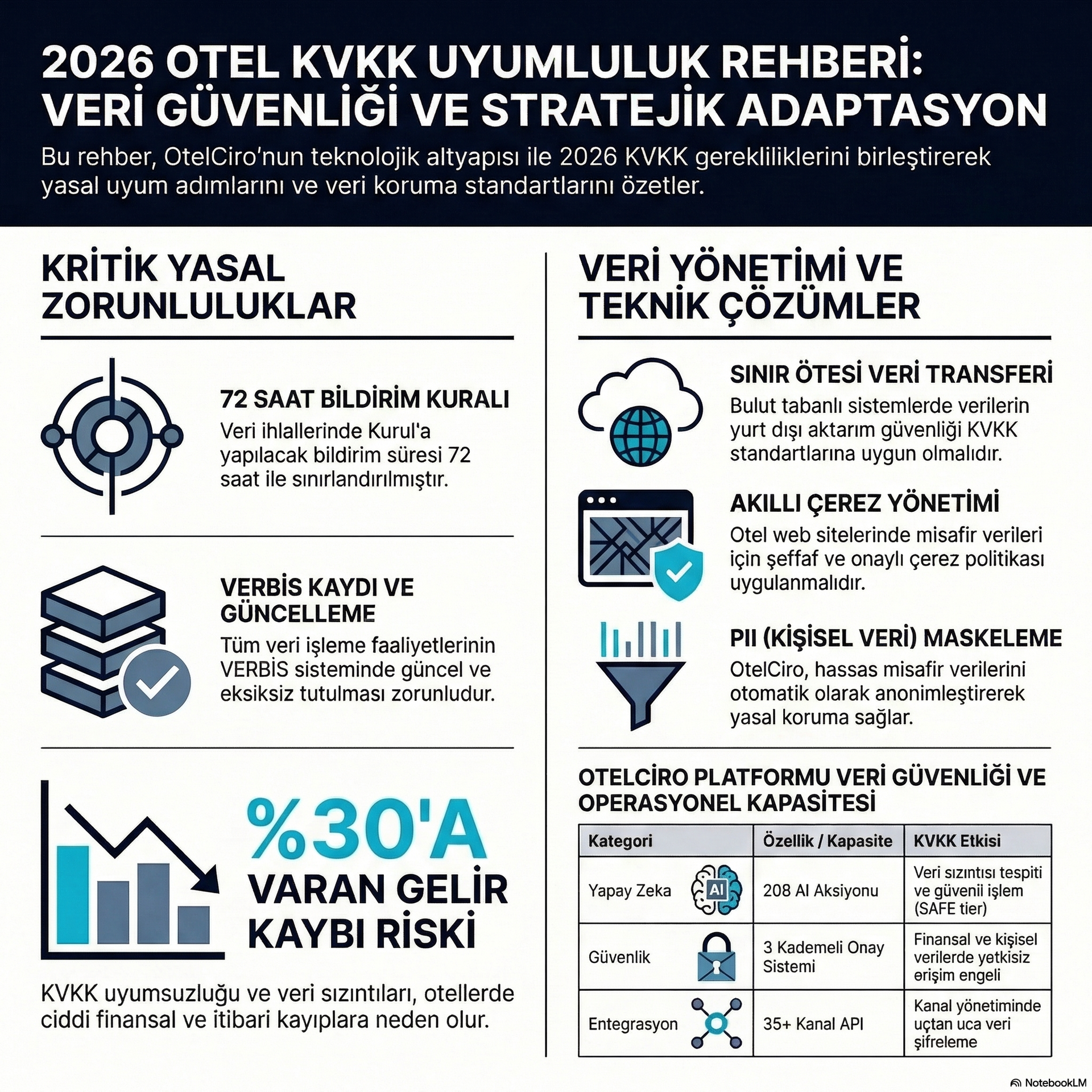
- KVKK non-compliance carries significant penalties, including administrative fines of up to 9,013,213 TL (or 4% of annual turnover for large chains), and severe reputational damage.
- Comprehensive compliance requires mandatory VERBİS registration, transparent illumination texts and explicit consent management for guests, and strict data retention and destruction policies.
- International hotel chains must navigate dual KVKK and GDPR compliance, often requiring Binding Corporate Rules (BCR) and careful consideration of data localization.
- Common KVKK errors include retaining passport photocopies, sending unconsented marketing emails, neglecting to delete old guest data, and failing to secure third-party data sharing agreements.
The Personal Data Problem in Hospitality: Why Is It So Critical?
During a single guest stay, a hotel collects an average of 24 different personal data points: name, Turkish ID number, passport information, credit card number, phone, email, vehicle license plate, Wi-Fi connection logs, room preferences, allergy information, and much more. According to Deloitte's 2025 Hospitality Sector Data Research, a mid-sized hotel processes over 500,000 personal data records annually.
This volume places hotels in the category of high-risk data controllers under Turkey's Law on the Protection of Personal Data No. 6698 (KVKK). According to the 2025 activity report of the Personal Data Protection Authority (PDP Authority), complaints directed at the hospitality sector increased by 47% compared to the previous year. The total amount of administrative fines imposed exceeded 78 million TL.
KVKK non-compliance is no longer just a legal risk; it's an operational and reputational risk. If not managed properly, a single guest complaint can expose your hotel to millions of Turkish Liras in fines.
Embed this image on your site
<a href="https://otelciro.com/en/news/hotel-kvkk-compliance-guest-data-privacy-protection-2026-guide">
  <img src="https://cdn.sanity.io/images/1la98t0z/production/b26a3de9989d9bca1e6d456bdf9ed38b5937705b-2048x2048.png" alt="KVKK data protection hotel guest privacy compliance guide" width="800" />
</a>
<p>Source: <a href="https://otelciro.com">OtelCiro</a> — AI Hotel Revenue Management</p>
Categories of Personal Data Collected by Hotels
Systematically classifying the personal data processed by hotels under KVKK is the first step in the compliance process.
Identity and Contact Data
- Turkish ID number and national identity card information
- Passport information (foreign guests)
- First name, last name, date of birth, nationality
- Phone number, email address
- Mailing address
This data is collected under legal obligation for the Ministry of Interior's GİKS (General Administrative Registry System) notification. However, KVKK requires this mandatory collection process to be carried out in accordance with specific rules.
Financial Data
- Credit card number, expiration date, CVV
- Billing information (tax ID number, address)
- Payment history, refund records
- Company agreement details
Credit card data is also subject to PCI-DSS. Managing KVKK and PCI-DSS requirements together creates a dual layer of compliance responsibility for hotels.
Digital Trace Data
- Wi-Fi connection logs: Obligation to retain for 2 years under Internet Law No. 5651
- Website cookies and analytics data
- Mobile application usage data
- Email open and click data
- Security camera recordings (may fall under biometric data)
Special Categories of Personal Data
Under Article 6 of KVKK, special categories of data require extra protection:
- Health information: Allergy notifications, dietary requirements, disabled guest information
- Biometric data: Facial recognition check-in, fingerprint access systems
- Religion/denomination information: Indirect inference risk via halal meal requests
Related reading: Hotel Cybersecurity: Guest Data Protection and PCI-DSS
KVKK Compliance Requirements: Hotel-Specific Details
1. Data Controller Registration (VERBİS)
Hotels with over 50 employees annually or with an annual financial balance sheet total exceeding 100 million TL are obligated to register with VERBİS. During registration, the following must be declared:
- Categories of processed data
- Purposes of data processing
- Data retention periods
- Information on international data transfers
- Security measures taken
2. Obligation to Inform (Illumination)
Guests must be informed with a KVKK illumination text during check-in. This text must include:
- Which data is collected
- For what purpose the data is processed
- To whom the data may be transferred
- The guest's rights (access, correction, deletion)
- Contact information of the data controller
Practical application: Directing to the illumination text via a QR code on a check-in tablet or form both enhances the guest experience and fulfills the legal obligation.
3. Explicit Consent Management
Explicit consent is required for data processing activities outside of legal obligations:
| Data Processing Activity | Legal Basis | Is Explicit Consent Required? |
|---|---|---|
| GİKS notification | Legal obligation | No |
| Payment by credit card | Contract performance | No |
| Marketing emails | Legitimate interest/consent | Yes |
| Loyalty program registration | Explicit consent | Yes |
| Facial recognition check-in | Explicit consent | Yes |
| Wi-Fi log retention | Legal obligation (Law 5651) | No |
| Guest preference profile | Legitimate interest | Conditional |
4. Data Retention Periods
KVKK mandates that data be retained for a period proportional to the purpose. Recommended periods in hospitality:
- Identity data (GİKS): 10 years (legal obligation)
- Invoice and financial data: 10 years (tax legislation)
- Credit card data: Should be deleted after the transaction is complete (PCI-DSS)
- Wi-Fi logs: 2 years (Law No. 5651)
- Security camera: 30-90 days
- Marketing data: Until consent is withdrawn
- Guest preferences: Last stay + 3 years
KVKK vs. GDPR Comparison: Differences for Hoteliers
Hotels hosting international guests must comply with both KVKK and GDPR. Critical differences between the two regulations:
| Criterion | KVKK | GDPR |
|---|---|---|
| Maximum Penalty | 9,013,213 TL (2026 current) | 4% of turnover or 20M EUR |
| Data Breach Notification | 72 hours (To the Board) | 72 hours (To the DPA) |
| Data Protection Officer | Not mandatory | 250+ employees: mandatory |
| International Data Transfer | Board approval or adequate protection | Adequacy decision or SCC |
| Right to be forgotten | Yes (Art. 7) | Yes (Art. 17) |
| Right to data portability | Limited | Comprehensive |
Critical note: According to the Board's 2025 decisions, KVKK fines are now calculated proportional to the institution's annual gross sales revenue. For large hotel chains, this can mean millions of Turkish Liras in penalties.
Related reading: PCI-DSS 4.0 Hotel Payment Security and Compliance 2026
Data Protection in PMS: Best Practices
The Property Management System (PMS), the operational heart of the hotel, is central to KVKK compliance.
Data Minimization
Collect only the data that is truly needed. Industry research shows that 38% of hotels collect data not essential for their business processes. For example:
- Guest's occupation — usually unnecessary
- Marital status — unnecessary (can be recorded as a honeymoon package preference)
- Social media accounts — only with consent and for a specific purpose
Encryption and Access Control
- Encryption of data at rest: AES-256 encryption in the database
- Encryption in transit: TLS 1.3 for all data transfers
- Role-based access: Reception staff should not see full credit card numbers
- Audit log: Record who accessed which data and when
Data Breach Response Plan
KVKK mandates notification to the Board within 72 hours from the moment you learn of a data breach. A ready response plan is essential:
- Detection and Isolation: Identify the breach, isolate affected systems
- Impact Analysis: Which data was affected, how many individuals, risk level
- Board Notification: Data Breach Notification Form within 72 hours
- Guest Notification: Notification to affected individuals for high-risk breaches
- Corrective Actions: Close the security vulnerability, improve processes
Practical Compliance Roadmap
Phase 1: Inventory and Assessment (1-2 Months)
- Map all personal data processing activities
- Review existing illumination texts and consent forms
- Document data flows in PMS, CRM, Wi-Fi, and security systems
- Evaluate existing security measures
Phase 2: Policy and Process (2-4 Months)
- Prepare KVKK-compliant illumination texts and consent forms
- Create a data retention and destruction policy
- Draft a data breach response plan
- Launch a staff training program
Phase 3: Technical Infrastructure (3-6 Months)
- Implement role-based access controls in PMS
- Strengthen data encryption infrastructure
- Establish automated data deletion mechanisms
- Activate the audit log system
Phase 4: Continuous Compliance (Ongoing)
- Annual data inventory updates
- Periodic staff training (at least every 6 months)
- Monitoring of Board decisions and policy updates
- Regular security tests and penetration testing
Dual Compliance in International Hotel Chains: KVKK and GDPR
International hotel chains operating in Turkey must comply with both KVKK and GDPR simultaneously. This dual compliance requirement complicates data management processes.
Data Flow Map
Guest data in an international chain hotel can flow as follows:
- Local PMS: Guest records are created on a server in Turkey (under KVKK scope)
- Central CRM: Data is transferred to the headquarters' CRM system (international data transfer)
- Loyalty program: Added to the global loyalty program database (under GDPR scope)
- OTA channels: Data sharing with platforms like Booking.com, Expedia
At each transfer point, both KVKK and GDPR requirements must be met. KVKK's requirement for Board approval or adequate protection for international data transfers creates operational challenges for international chains.
Binding Corporate Rules (BCR)
For international hotel groups, the most effective solution is to establish Binding Corporate Rules (BCR). BCR ensures that intra-group data transfers receive approval from both the KVKK Board and the relevant EU data protection authority. Large chains like Marriott and Hilton implement the BCR model.
Data Localization Debate
Some decisions by the KVKK Board show a strong tendency towards retaining sensitive data within Turkey's borders. This directly affects the data center selection for cloud-based PMS systems. Preferring cloud providers with data centers in Turkey reduces compliance risk.
Common KVKK Mistakes
The most common mistakes, compiled from Board decisions and sector audit reports:
- Retaining passport photocopies: Instead of keeping photocopies, only record necessary information digitally.
- Bulk email list: Sending marketing emails without consent is the most frequently penalized violation.
- Failing to delete old guest data: Automatic destruction of data past its retention period is neglected.
- Data on personal staff devices: Sharing guest information via WhatsApp is a serious violation.
- Incomplete contracts in third-party sharing: Data processing agreements with OTAs, travel agencies, and suppliers are mandatory.
- Security camera notification: Failing to indicate areas where camera recordings are made.
Conclusion: Compliance Transforms into a Competitive Advantage
KVKK compliance is not just about preventing penalty risks; it's a strategic investment to gain guest trust and enhance brand value. According to PwC's 2025 Consumer Trust Survey, 71% of guests prefer hotels that are transparent about data protection.
With the right PMS infrastructure, trained staff, and systematic process management, the cost of KVKK compliance for a mid-sized hotel can be managed within the range of 50,000-150,000 TL annually — far below the potential cost of a penalty.
OtelCiro's Smart PMS module simplifies your compliance process with a KVKK-compliant data processing infrastructure, automated retention period management, and role-based access controls.
![Europe's Hotel Construction Boom: 2026 Oversupply Risks [Market Analysis]](https://cdn.sanity.io/images/1la98t0z/production/6dfe59137f56aa14bfcba86d9db3cf05ff89f406-2752x1536.jpg?w=1920&q=50&auto=format&fit=max)