Key Takeaways
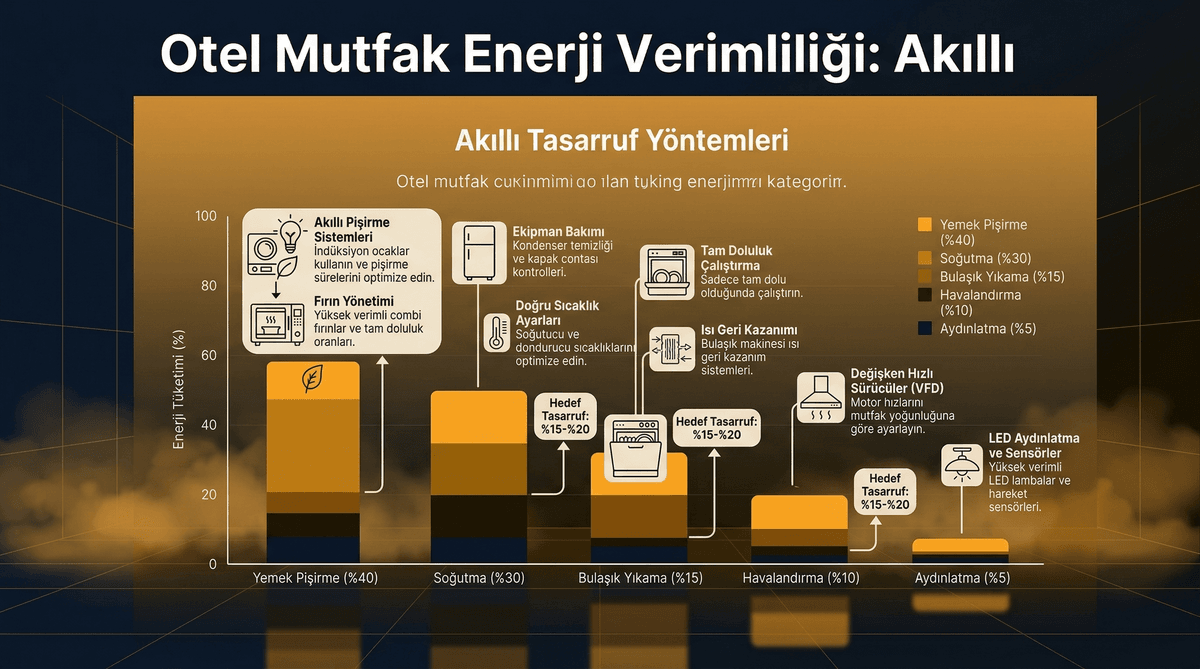
- Hotel kitchens typically account for 25-35% of a hotel's total energy consumption, with equipment efficiency averaging only 40-60%.
- Implementing efficiency measures can lead to 20-30% savings in kitchen energy, translating to 200,000-500,000 TL in direct annual profit for a 300-room hotel.
- Major energy loss sources include outdated equipment (8-12 years old), idle operation, inadequate ventilation management, and cooling system inefficiencies.
- Strategic investments in modern equipment (e.g., induction, convection ovens, Energy Star certified appliances), demand-controlled ventilation (DCKV), and sub-metering are crucial for significant savings.
- Effective staff training and behavioral changes, alongside technology, are vital for achieving an additional 8-12% in energy savings and maximizing ROI.
Hotel Kitchen: The Most Energy-Intensive Area of the Building
The kitchen often accounts for 25-35% of a hotel's total energy consumption. Ovens, stovetops, dishwashers, refrigerators, ventilation hoods, and hot water systems—all are high-energy-consuming equipment. According to data from the International Energy Agency (IEA), the average energy efficiency of commercial kitchen equipment ranges from 40-60%; meaning nearly half of the energy consumed is lost without being converted into useful work.
With energy prices in Turkey projected to increase by over 40% in the 2024-2025 period, kitchen energy efficiency has become a critical agenda item for financial sustainability. For a 300-room hotel, the monthly kitchen energy bill can range from 80,000-150,000 TL. Saving 20-30% of this amount translates to 200,000-500,000 TL in direct annual profit.
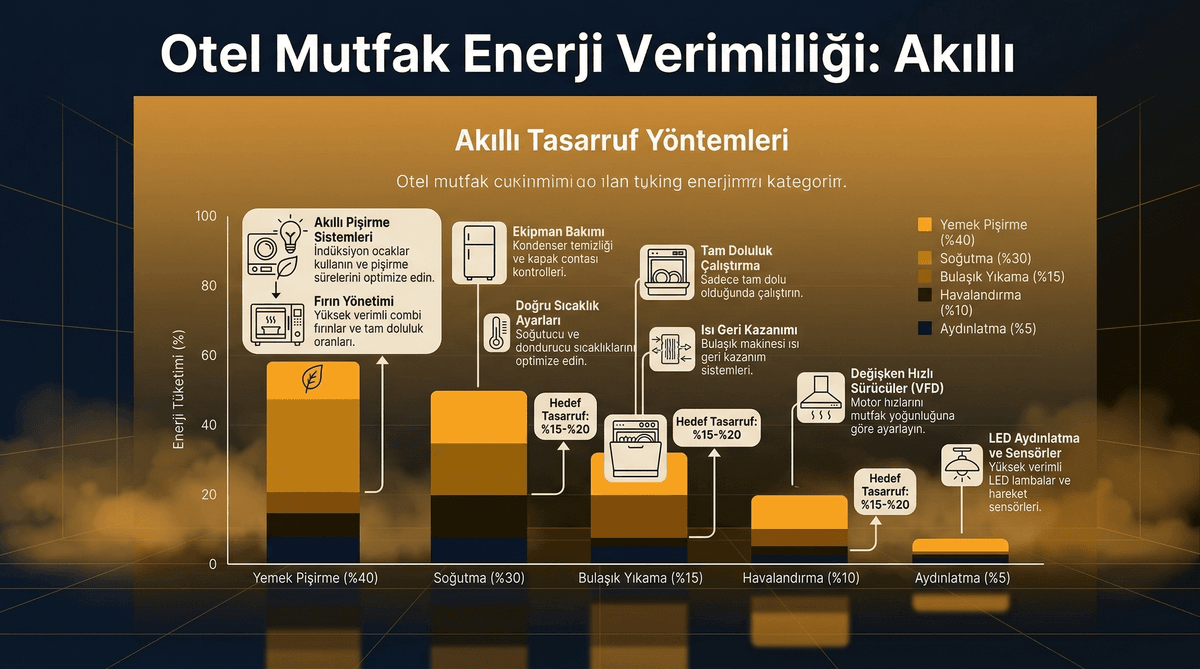
Embed this image on your site
<a href="https://otelciro.com/en/news/hotel-kitchen-energy-savings-a-2026-efficiency-guide">
  <img src="https://cdn.sanity.io/images/1la98t0z/production/e438bf782e9d131cce08837984be7b70fdf6cbbd-1200x669.png" alt="Hotel Kitchen Energy Efficiency Infographic" width="800" />
</a>
<p>Source: <a href="https://otelciro.com">OtelCiro</a> — AI Hotel Revenue Management</p>
Related reading: Automation in Hotel Operations: Digitalizing Business Processes
Main Sources of Energy Loss
1. Inefficient Cooking Equipment
The average age of equipment in hotel kitchens in Turkey is 8-12 years. During this period, equipment efficiency typically drops by 15-25%, while new generation models have become 30-40% more efficient. The result: an old oven can consume almost twice as much energy as a new model to do the same job.
2. Idle Operation
Leaving kitchen equipment on outside of service hours accounts for 15-25% of kitchen energy waste. A commercial griddle, even when idle, consumes 3-5 kWh of energy per hour. In a kitchen that opens at 6 AM and closes at 11 PM, non-service hours can constitute 40% of the total operating time.
3. Inadequate Ventilation Management
Kitchen hood and ventilation systems account for 30-40% of kitchen energy consumption. Traditional fixed-speed systems consume the same amount of energy regardless of kitchen intensity. A hood operating at full capacity even during non-cooking hours wastes 20,000-40,000 kWh of energy annually.
4. Cooling Losses
Walk-in coolers and freezers are 24/7 equipment in the kitchen. Worn door gaskets, overloading, insufficient defrosting, and lack of compressor maintenance can increase energy consumption by 20-40%. A walk-in cooler door left open for one minute requires 3-5 minutes of additional compressor operation to stabilize the internal temperature.
Equipment-Based Savings Strategies
Cooking Equipment
| Strategy | Savings Rate | ROI |
|---|---|---|
| Switch to convection ovens | %20-30 | 12-18 months |
| Switch to induction cooktops | %40-50 | 18-24 months |
| Combi oven (steam + convection) | %25-35 | 12-18 months |
| Energy Star certified equipment | %15-25 | 6-12 months |
| Optimize preheating time | %5-10 | Zero cost |
Induction cooking technology provides dramatic efficiency increases compared to traditional gas stovetops. While only 40% of energy is transferred to the pot on a gas stove, this rate reaches 90% with induction. Additionally, kitchen ambient temperature decreases, ventilation load is reduced, and staff comfort improves.
Dishwashers
Industrial dishwashers are responsible for 15-20% of kitchen water and energy consumption:
- Heat recovery system: Using waste hot water for pre-rinsing reduces energy consumption by 25%.
- Occupancy sensor: A system that operates the machine only when fully loaded prevents unnecessary wash cycles.
- Final rinse temperature optimization: Maintaining hygiene standards with minimum temperature use (82°C is sufficient, 90°C is unnecessary).
Related reading: Hotel IoT and Smart Room Technologies
Smart Ventilation and Hood Management
Demand Controlled Kitchen Ventilation (DCKV) is the area with the highest returns for kitchen energy savings. The system measures cooking intensity using temperature and smoke sensors within the hood and automatically adjusts fan speed:
- No cooking: Fan speed 20-30% (minimum ventilation).
- Light cooking: Fan speed 50-60%.
- Intensive cooking: Fan speed 80-100%.
A DCKV system reduces annual ventilation energy consumption by 50-70% compared to traditional fixed-speed systems. For a 300-room hotel, this means 80,000-120,000 TL in annual savings. The system investment typically has an ROI of 12-18 months.
Energy Monitoring and Sub-Metering System
The principle "You can't manage what you don't measure" also applies to kitchen energy management. A sub-metering system should be installed to understand and optimize kitchen energy consumption:
- Cooking line meter: Ovens, stovetops, and grill group.
- Cooling meter: Walk-in coolers, freezers, and prep counter refrigerators.
- Dishwashing line meter: Dishwasher and hot water system.
- Ventilation meter: Hood fans and make-up air system.
When sub-meter data is analyzed on a daily, weekly, and monthly basis, it clearly shows which area consumes how much, when abnormal increases occur, and the impact of implemented measures.
With the OtelCiro operations management module, kitchen energy consumption data can be monitored in real-time, anomalies can be detected, and department-specific energy reports can be generated.
Staff Training and Behavioral Change
Technology investments account for only half of energy efficiency; the other half is staff behavior. Simple yet effective habits:
- Turn on equipment 15-20 minutes before service, turn it off immediately after.
- Close refrigerator doors as quickly as possible.
- Avoid opening oven doors unnecessarily (each opening drops internal temperature by 25-30°C).
- Match pot size to burner size.
- Do not run the dishwasher half-empty.
Regular training, visual reminders, and reward systems based on energy-saving performance should be implemented to instill these habits. Behavioral changes alone can achieve 8-12% energy savings.
Conclusion: Kitchen Savings, Increased Profitability
Energy efficiency in the hotel kitchen is an undeniable area for both environmental responsibility and financial sustainability. Equipment modernization, smart ventilation, energy monitoring, and staff training—when these four strategies are implemented together, a total kitchen energy consumption saving of 30-45% is possible.
As energy costs continue to rise in 2026, it's essential to remember that every 1 TL invested in kitchen energy efficiency provides a 3-5 TL return. An energy-efficient kitchen means not only lower bills but also a hotel that moves closer to its sustainability goals with a reduced carbon footprint.
![Europe's Hotel Construction Boom: 2026 Oversupply Risks [Market Analysis]](https://cdn.sanity.io/images/1la98t0z/production/6dfe59137f56aa14bfcba86d9db3cf05ff89f406-2752x1536.jpg?w=1920&q=50&auto=format&fit=max)