Key Takeaways
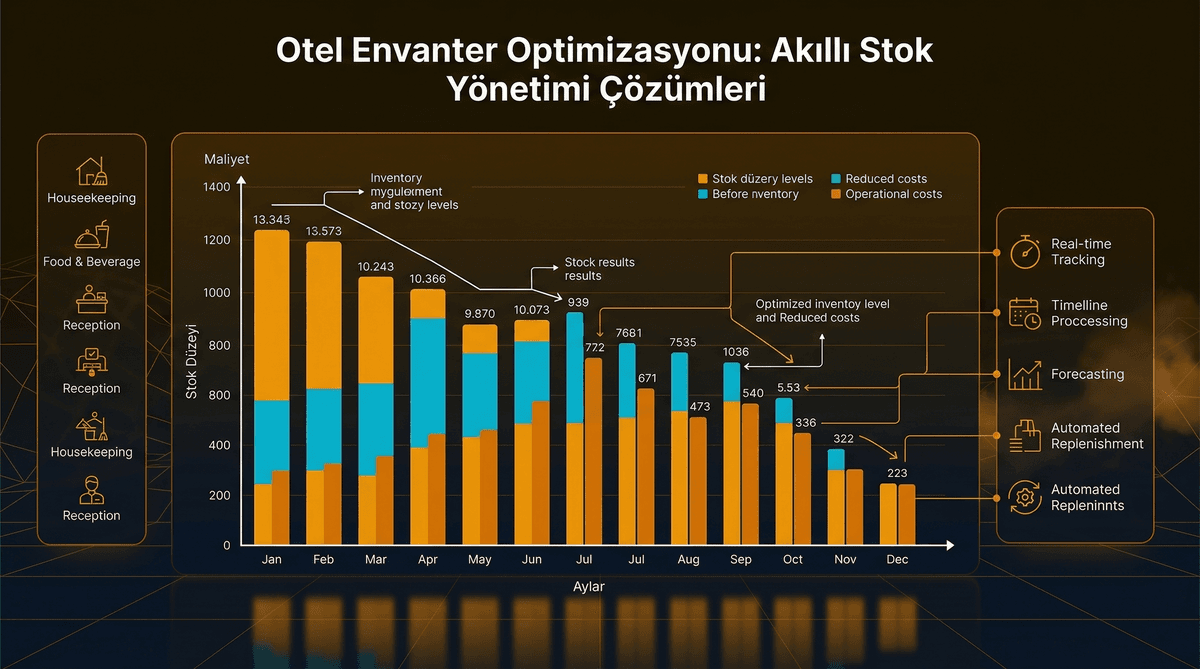
- Effective inventory management is a critical, often overlooked area that directly impacts 15-25% of operational costs.
- Implement ABC analysis to prioritize stock items by value and FIFO (First In, First Out) for all perishable goods to minimize waste and ensure food safety.
- Establish clear minimum and maximum stock levels for each item, supported by a robust safety stock, to prevent both overstocking and stockouts.
- Optimize warehouse layout, hygiene standards, and procurement strategies, including a hybrid purchasing approach and regular supplier performance evaluations.
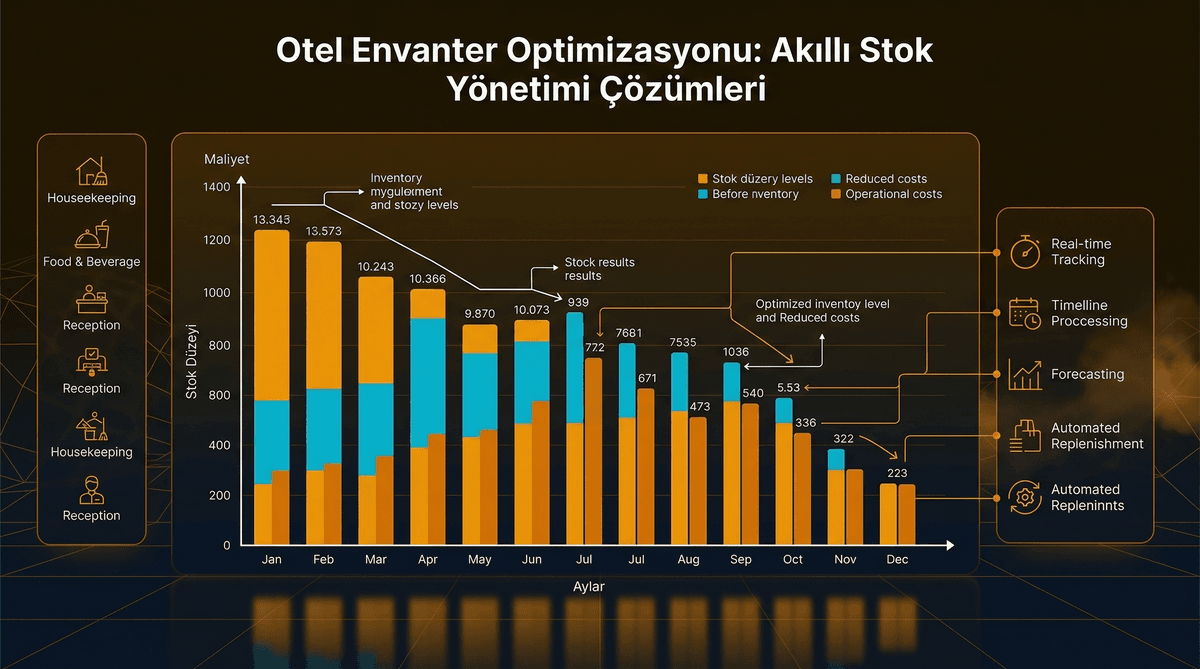
- Leverage digital inventory management systems for real-time tracking, automatic reordering, demand forecasting, and significant ROI, reducing costs by 20-30% and disruptions by 85%.
Inventory Management: The Hotel's Unseen Profit Center
Hotel inventory management directly affects 15-25% of operational costs, yet many hotels lack a systematic approach in this area. According to a PwC Hospitality report, 45% of hotels tie up capital unnecessarily by holding excessive stock, while 30% are forced into urgent purchases due to stock shortages, paying 20-40% more in unit prices.
Effective inventory management means procuring the right amount, at the right time, at the right cost — neither too much nor too little. In 2026, inflationary pressures and supply chain uncertainties have elevated inventory management to a strategic competency.
Embed this image on your site
<a href="https://otelciro.com/en/news/hotel-inventory-management-2026-optimization-guide">
  <img src="https://cdn.sanity.io/images/1la98t0z/production/0b810d11741ec27011f60d130fcef278ecb611ae-1200x669.png" alt="Hotel Warehouse and Inventory Management" width="800" />
</a>
<p>Source: <a href="https://otelciro.com">OtelCiro</a> — AI Hotel Revenue Management</p>
Related reading: Hotel Automation and Business Processes Guide
Hotel Stock Categories and Management Approaches
There are many different inventory categories in a hotel, and each requires a different management approach.
Inventory Categories
| Category | Examples | Inventory Turnover Rate | Criticality |
|---|---|---|---|
| Food — perishable | Fresh fruit, milk, meat | Daily-3 days | Very High |
| Food — non-perishable | Canned goods, spices, flour | 2-4 weeks | High |
| Beverage — alcoholic | Wine, beer, liquor | 2-6 weeks | High |
| Beverage — non-alcoholic | Water, juice, carbonated | 1-2 weeks | Moderate |
| Cleaning chemicals | Detergent, disinfectant | 2-4 weeks | High |
| Amenities | Shampoo, soap, toothbrush | 2-4 weeks | Moderate |
| Linen | Sheets, towels, napkins | 6-12 months (renewal) | High |
| Technical supplies | Light bulbs, batteries, filters | 1-3 months | Moderate |
| Stationery/office supplies | Paper, cartridges, envelopes | 1-2 months | Low |
ABC Analysis
ABC analysis classifies inventory items by their value to determine management priority:
- Group A (20% of items, 80% of value): Food raw materials, alcoholic beverages, linen. Strict control, low stock holding, frequent orders.
- Group B (30% of items, 15% of value): Cleaning chemicals, amenities, non-alcoholic beverages. Moderate control, weekly orders.
- Group C (50% of items, 5% of value): Stationery, small technical supplies, office consumables. Simple control, monthly orders, bulk purchases.
Management effort expended on Group A items should exceed the combined effort for Groups B and C. Research indicates that hotels implementing ABC analysis reduce their inventory costs by 18%.
FIFO Method and Shelf-Life Tracking
FIFO (First In, First Out) is a fundamental inventory rotation method in hospitality. It is especially mandatory for food safety.
FIFO Implementation Rules
- Each product must be labeled with its entry date
- New products should be placed at the back of the shelf, older products at the front
- Open packages should be labeled with an "opening date"
- Expired products must be removed through daily checks
- The oldest dated product must be issued first when exiting the warehouse
Food Waste Rate Targets
The waste rate is the clearest indicator of inventory management quality:
| Category | Acceptable Waste | Good Performance | Excellent |
|---|---|---|---|
| Fresh fruit/vegetables | <8% | <5% | <3% |
| Meat and fish | <5% | <3% | <1.5% |
| Dairy products | <4% | <2% | <1% |
| Dry food | <2% | <1% | <0.5% |
| Beverages | <1% | <0.5% | <0.2% |
In Turkey, the average hotel food waste rate is 6-8%, while with best practices, this rate can be reduced to 2-3%. This difference translates to an annual saving of 150,000-250,000 TL for a 200-room hotel.
Minimum and Maximum Stock Levels
Minimum (reorder point) and maximum stock levels must be determined for each inventory item.
Calculation Formulas
Minimum stock level (reorder point):
Minimum Stock = Average Daily Consumption x Lead Time (days) + Safety Stock
Safety stock:
Safety Stock = Average Daily Consumption x Number of Safety Days
Maximum stock level:
Maximum Stock = Minimum Stock + Economic Order Quantity
Example Calculation: Detergent
- Average daily consumption: 5 liters
- Lead time: 3 days
- Safety days: 2 days
- Minimum stock: (5 x 3) + (5 x 2) = 25 liters
- Economic order quantity: 50 liters (bulk purchase discount)
- Maximum stock: 25 + 50 = 75 liters
An automatic order should be triggered when stock falls below 25 liters.
Related reading: Hotel Business Intelligence and Reporting Guide
Warehouse Layout and Physical Management
Warehouse physical layout directly impacts operational efficiency. In a poorly organized warehouse, search time is 300% longer, and the error rate is 5 times higher.
Warehouse Layout Principles
- Temperature zoning: Dry storage (15-20°C), cold room (0-4°C), freezer (-18°C), chemical storage (separate ventilation)
- Circulation area: 20-25% of the warehouse area should be corridors and maneuvering space
- High-turnover products: Placed on shelves near the door, easily accessible
- Heavy products: On lower shelves, at ergonomic lifting height
- Hazardous materials: Locked, labeled, MSDS forms in an accessible area
Warehouse Hygiene Standards
- Daily floor washing and disinfection
- Weekly shelf cleaning schedule
- Monthly pest control and monitoring
- Automatic, hourly logging of temperature and humidity
- Food and chemicals must absolutely not be stored in the same area
Purchasing and Supplier Management
Inventory management is directly linked to the purchasing strategy. Correct purchasing can reduce inventory costs by 15-25%.
Purchasing Strategies
Advantages of centralized purchasing:
- Bulk purchase discounts (10-25%)
- Standardized quality control
- Easier supplier management
- Price consistency
Advantages of local/daily purchasing:
- Guarantee of fresh products
- Lower stock holding costs
- Opportunity to benefit from seasonal deals
- Supply flexibility
Hybrid strategy (recommended):
- Group A non-perishable items: Centralized, monthly/quarterly contracts
- Fresh food: Local, daily/weekly orders
- Group B items: Weekly orders, rotation of 2-3 suppliers
- Group C items: Bulk purchase, quarterly orders
Supplier Performance Scorecard
Each supplier should be evaluated monthly:
| Criterion | Weight | Measurement |
|---|---|---|
| Delivery timeliness | %25 | On-time delivery rate |
| Product quality | %30 | Rejection/return rate |
| Price competitiveness | %20 | Comparison to market average |
| Invoice accuracy | %10 | Error rate |
| Communication/response time | %15 | Average response time |
Suppliers scoring below 80% should be warned, and alternative suppliers should be sought after two consecutive low scores.
Counting and Inventory Control
Regular stock counting is fundamental to loss and waste control. In hotels without counting, the stock loss rate is 8-12%, while in those that count regularly, this rate drops to 1-3%.
Counting Types and Schedule
| Counting Type | Frequency | Scope | Duration |
|---|---|---|---|
| Daily count | Every day | High-value/high-risk items (meat, alcohol) | 15-30 min |
| Weekly count | Once a week | All Group A and B items | 2-3 hours |
| Monthly full count | Once a month | All inventory items | 4-8 hours |
| Annual general count | Once a year | All warehouses + distribution points | 1-2 days |
Counting Principles
- The person counting and the warehouse manager should be different individuals
- Digital counting should be done with a barcode/QR reader
- Discrepancy reports should be investigated immediately (over 2% discrepancy requires urgent investigation)
- Counting results should be shared with management and trend analysis performed
Technology and Automation
Automating inventory management with OtelCiro operations platforms dramatically increases efficiency.
Digital Inventory Management System Components
- Barcode/QR stock tracking: Every product entry and exit is digitally recorded
- Automatic order triggering: Automatic purchase requests when minimum stock levels are reached
- Real-time stock visibility: Instant stock levels, waste rates, consumption trends
- Demand forecasting: Automatic consumption prediction based on occupancy rates and historical data
- Cost reporting: Department and category-based inventory cost analysis
- Supplier integration: E-ordering, automatic invoice matching
Hotels implementing digital inventory management see inventory costs drop by 20-30%, while operational disruptions due to stock shortages decrease by 85%.
ROI Calculation
Digital inventory management system for a 200-room hotel:
| Item | Amount |
|---|---|
| Software license (annual) | 48,000 TL |
| Barcode reader and labeling | 15,000 TL |
| Training and installation | 12,000 TL |
| Total first-year cost | 75,000 TL |
| Savings from waste reduction | 180,000 TL/year |
| Labor savings | 85,000 TL/year |
| Bulk purchase optimization | 120,000 TL/year |
| Total annual savings | 385,000 TL |
| Return on Investment (ROI) period | ~2.5 months |
Conclusion
Inventory management is a critical operational area that quietly determines your hotel's profitability. With a systematic approach, the right technology, and disciplined implementation, you can reduce your inventory costs by 20-30%.
Steps you can take immediately:
- Subject all your inventory items to ABC analysis.
- Determine minimum and maximum stock levels for each item.
- Make FIFO implementation mandatory in all warehouses.
- Start a weekly counting program.
- Transition to digital inventory management with the OtelCiro operations platform.
Stock you cannot control is a cost you cannot control.
![Europe's Hotel Construction Boom: 2026 Oversupply Risks [Market Analysis]](https://cdn.sanity.io/images/1la98t0z/production/6dfe59137f56aa14bfcba86d9db3cf05ff89f406-2752x1536.jpg?w=1920&q=50&auto=format&fit=max)