![Hotel Influencer ROI: Measuring Campaign Success [2026 Guide]](https://cdn.sanity.io/images/1la98t0z/production/d9196612c937344230afff0849efed1d5bf2b524-1200x669.png?w=1920&q=65&auto=format&fit=max)
Key Takeaways
- Influencer marketing is projected to be a $32.5 billion industry by 2026. While 78% of hotels in Turkey use influencers, only 23% accurately measure campaign ROI.
- Influencer selection is critical, determining 80% of campaign success. Focus on engagement rates (minimum 3% for hospitality), audience demographics, content quality, and checks for fake followers (red flag if over 15%).
- Micro-influencers (10K-100K followers) offer significantly higher efficiency, with 4-6 times greater ROI per reservation compared to macro-influencers, despite lower reach. A hybrid model is often most effective.
- Robust ROI measurement requires a multi-layered approach, including direct tools like unique campaign codes, UTM parameters, and dedicated landing pages. Aim for a healthy ROI between 200-500%.
- Comprehensive contracts and post-campaign analysis are essential. Contracts should detail content rights, performance guarantees, and legal compliance (e.g., #ad disclosure, mandatory in Turkey as of 2024), while analysis drives continuous optimization and an average of 35% higher total returns.
The Rise of Influencer Marketing in the Hospitality Sector
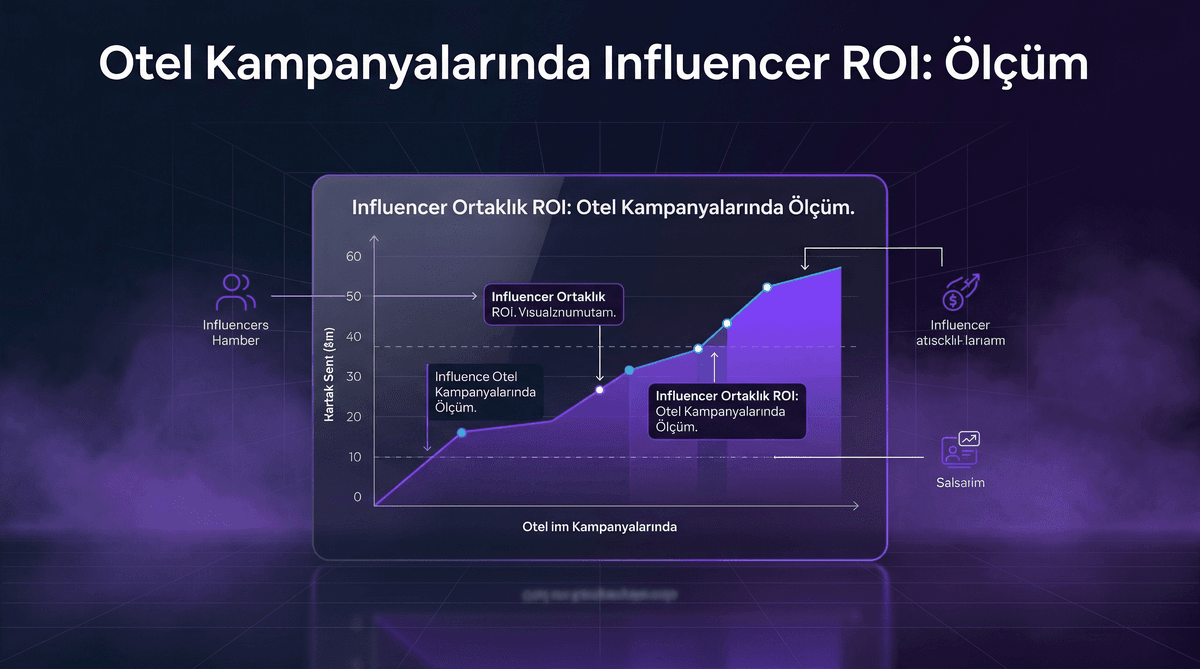
Influencer marketing has grown into a $32.5 billion global industry by 2026, with the hospitality sector emerging as one of its fastest-growing segments. In Turkey, 78% of hotels reported engaging in at least one influencer collaboration in the past 12 months, yet only 23% stated they could accurately measure campaign ROI.
This gap highlights one of the biggest problems in the industry: hotels are allocating significant budgets to influencer marketing but cannot concretely measure the return on their investment. Marketing managers who cannot answer the question, "The number of likes increased, but how many converted to bookings?" base their budget decisions on intuition rather than data.
Embed this image on your site
<a href="https://otelciro.com/en/news/hotel-influencer-roi-measuring-campaign-success-2026-guide">
  <img src="https://cdn.sanity.io/images/1la98t0z/production/d9196612c937344230afff0849efed1d5bf2b524-1200x669.png" alt="Influencer Partnership ROI Infographic" width="800" />
</a>
<p>Source: <a href="https://otelciro.com">OtelCiro</a> — AI Hotel Revenue Management</p>
In this guide, we detail how to accurately measure ROI in influencer hotel campaigns, compare micro and macro influencers, and discuss professional contract strategies.
Related reading: The Power of Hotel Marketing with User-Generated Content (UGC)
Key Criteria for Influencer Selection
Selecting the right influencer determines 80% of a campaign's success. Follower count alone is not a sufficient criterion; in fact, it can be misleading.
Engagement rate: This is a more critical metric than follower count. In the hospitality sector, the minimum acceptable engagement rate is 3%. Micro-influencers (10K-100K followers) typically have an engagement rate of 5-8%, while for macro-influencers (500K+), this rate remains between 1.5-3%.
Audience demographics: It is essential that the influencer's follower base aligns with your hotel's target market. For a luxury hotel, an influencer whose followers are 60% aged 18-24 is not suitable. Instagram and YouTube's audience analytics tools provide access to this data.
Content quality and consistency: The visual quality, textual consistency, and brand alignment of the last 30 posts should be evaluated. Hotel visuals require high-resolution and professionally composed content; low-quality photos can harm your brand.
Fake follower check: In Turkey, 34% of influencers are found to have abnormal follower growth patterns. Check the fake follower rate with tools like HypeAuditor, Social Blade, or Modash. A fake follower rate above 15% is a red flag.
Micro vs. Macro Influencers: Data-Driven Comparison
In the hospitality sector, the debate between micro and macro influencers is clarified by data.
| Feature | Micro-influencers (10K-100K) | Macro-influencers (500K+) |
|---|---|---|
| Average engagement rate | %5.7 | %1.8 |
| Cost per post | 5,000-15,000 TL (or barter) | 50,000-200,000 TL |
| Conversion rate (viewer → website visit) | %2.4 | %0.6 |
| Booking conversion | %0.8-1.2 | %0.2-0.4 |
| Perceived trustworthiness | High (followers see it as personal recommendation) | Moderate |
| Brand awareness impact | Moderate | Very high (wide reach) |
The numbers are clear: on a cost-per-booking basis, micro-influencers are 4-6 times more efficient than macro-influencers. However, if brand awareness is the goal—for example, for a newly opened hotel—the broad reach of a macro-influencer holds strategic value.
The most effective approach is a hybrid model: creating brand awareness with 2-3 macro-influencer campaigns per year while continuously producing regular content with 8-12 micro-influencers.
Related reading: Pinterest Travel Inspiration Boards: Hotel Visual Marketing
ROI Measurement Methodology
To accurately measure the ROI of influencer campaigns, a multi-layered measurement system should be established.
Direct measurement tools:
- Unique campaign codes: A special discount code for each influencer (e.g., TRAVEL15, AYSE20). Every booking made with this code is directly attributed to the respective influencer.
- UTM parameters: Add UTM tags to every link shared by the influencer. Track the behavior and conversion of this traffic on your website using Google Analytics 4.
- Dedicated landing page: Create a unique URL for each campaign (e.g., hotel.com/travel-influencer-name). This page isolates traffic originating from the campaign.
Indirect measurement:
- Overall website traffic increase during the campaign period
- Brand searches (change in "hotel name" search volume with Google Trends)
- Social media follower growth and mention count
- Increase in page views on OTA platforms
ROI calculation formula: Campaign ROI = (Revenue from campaign - Total campaign cost) / Total campaign cost × 100
A healthy influencer campaign ROI in the hospitality sector should be between 200-500%. This means a 50,000 TL investment should generate 150,000-300,000 TL in revenue.
Utilizing a sales and marketing ecosystem to monitor all these metrics on a single dashboard allows you to optimize campaign performance in real-time.
Contract Strategies and Legal Framework
Professional influencer collaborations should be secured with clear and comprehensive contracts.
Provisions to be included in the contract:
- Number and format of content to be produced (story, post, reel, video)
- Content approval process and revision rights (maximum 2 revisions)
- Publication dates and times
- Content usage rights (duration for which the hotel can use this content on its own channels)
- Performance guarantees (minimum engagement rate)
- Non-compete clause (how many days an influencer cannot collaborate with a competitor hotel)
- Payment terms and schedule
Payment models:
- Fixed fee: A pre-determined amount. The most common model.
- Performance-based: Base fee + bonus if certain metrics are exceeded. Recommended model.
- Barter + fixed fee: Accommodation + a small amount of cash. Ideal for micro-influencers.
- Pure barter: Only accommodation in exchange for content. Suitable for nano-influencers (1K-10K).
Legal compliance: In Turkey, according to the Advertising Board regulations updated in 2024, it is mandatory to clearly state commercial collaborations in influencer content. #ad, #collaboration, or in-platform partnership tags must be used. Non-compliance can result in an administrative monetary penalty for both the influencer and the hotel.
Post-Campaign Analysis and Optimization
Preparing a comprehensive evaluation report after each campaign is key to optimizing future investments.
Campaign report template:
- Total reach and impressions
- Engagement metrics (likes, comments, shares, saves)
- Website traffic (UTM data)
- Number of campaign code uses
- Direct and attributed revenue
- Cost-per-engagement and cost-per-booking
- Qualitative assessment (comment quality, brand perception)
Hotels that cumulatively track this data discover over time which influencer profiles, content formats, and campaign timings generate the highest ROI. This data-driven approach increases the efficiency of the influencer budget with each campaign and provides an average of 35% higher total return by year-end.
![Europe's Hotel Construction Boom: 2026 Oversupply Risks [Market Analysis]](https://cdn.sanity.io/images/1la98t0z/production/6dfe59137f56aa14bfcba86d9db3cf05ff89f406-2752x1536.jpg?w=1920&q=50&auto=format&fit=max)