Key Takeaways
- 72% of hotels in Turkey still rely on manual, paper-based housekeeping processes, leading to significant inefficiencies.
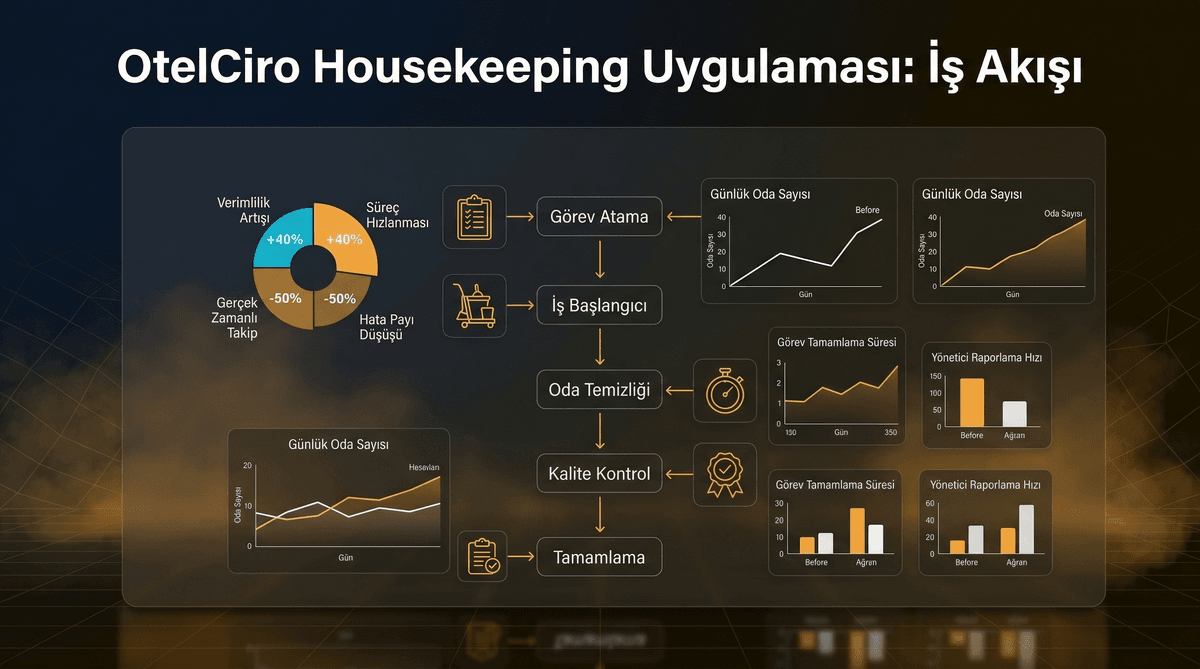
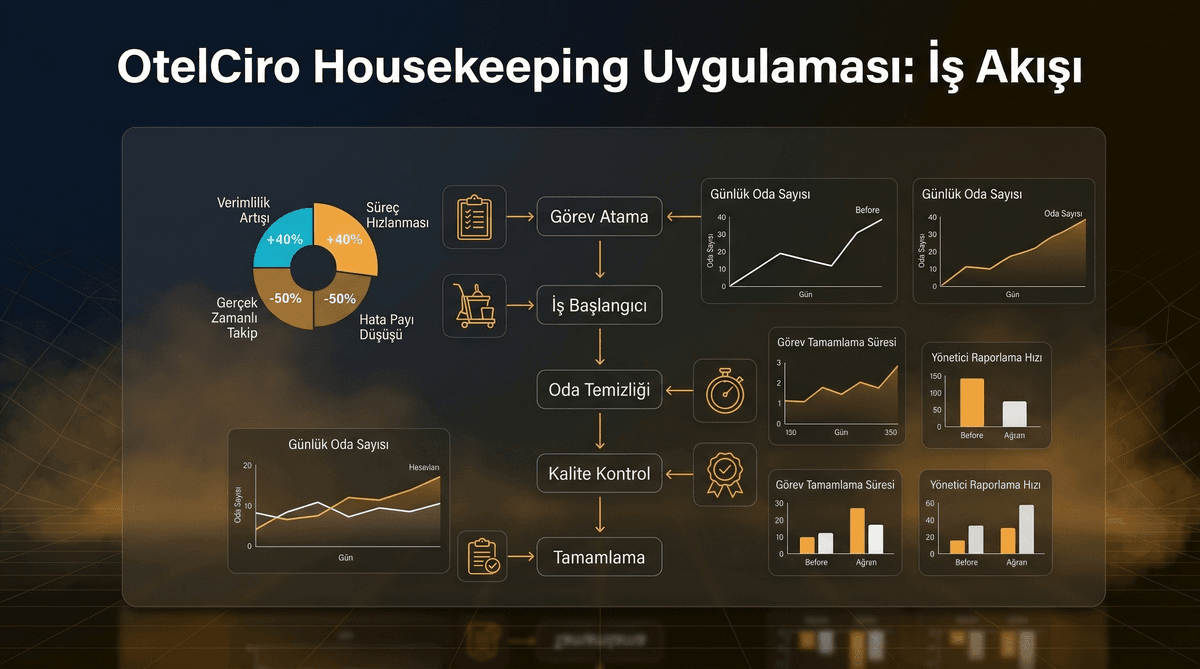
- Mobile housekeeping apps can reduce room turnaround time by an average of 25%, increase guest satisfaction by 15-20%, and boost staff efficiency by up to 30%.
- Key modules include automated task assignment, real-time room status updates, and systematic digital quality control.
- PMS integration is critical for a two-way data flow, ensuring all departments have access to accurate, real-time information.
- Robust performance metrics enable objective staff evaluation, continuous improvement, and data-driven management decisions.
- A planned 8-12 week implementation process, combined with careful app selection, can yield a 3-6 month return on investment.
From Paper to Digital: The Imperative of Housekeeping Transformation
72% of hotels in Turkey still manage their housekeeping processes using paper forms, radios, and face-to-face communication. While this traditional method might be manageable for a 50-room boutique hotel, it leads to serious inefficiencies for properties with 100 rooms or more. Task assignments are delayed, room status information is updated minutes or even hours late, quality control remains subjective, and management lacks performance data.
Housekeeping mobile applications are fundamentally changing this landscape. By 2026, hotels that have adopted mobile apps observe an average 25% reduction in room turnaround time, a 15-20% increase in guest satisfaction scores, and up to a 30% rise in staff efficiency.
Embed this image on your site
<a href="https://otelciro.com/en/news/hotel-housekeeping-mobile-apps-2026-digital-workflow-guide">
  <img src="https://cdn.sanity.io/images/1la98t0z/production/931aa66ac0ffbbf9f7ecca560bbbe1994ac8ba96-1200x669.png" alt="Housekeeping Mobile App Infographic" width="800" />
</a>
<p>Source: <a href="https://otelciro.com">OtelCiro</a> — AI Hotel Revenue Management</p>
Related reading: Operations Management with the OtelCiro Ecosystem
Core Modules of a Mobile Application
A comprehensive housekeeping mobile application consists of five main modules. Each solves a distinct operational problem, and together, when integrated, they deliver true transformation.
1. Task Assignment and Distribution
In the traditional method, the housekeeping supervisor writes down staff assignments for rooms on paper or communicates them verbally each morning. Mobile apps automate this process:
- Automatic task distribution: Tasks are automatically generated and assigned to staff based on check-out, stay-over, and VIP information from the PMS.
- Balanced workload: The algorithm assigns an equal number of rooms and difficulty level to each staff member. It accounts for suite rooms taking longer and stay-over rooms being quicker.
- Priority sequencing: Rooms expecting early check-ins, VIP rooms, and urgent requests are automatically moved to the top of the list.
- Real-time updates: Requests added during the day (early check-in, extra cleaning) instantly appear on the relevant staff member's list.
Staff members view their task list via the app, press "Started" when beginning a room, and mark it as "Completed" when finished. This allows the housekeeping supervisor and front desk to instantly track the status of all rooms.
2. Room Status Management
One of the hotel's most critical pieces of information is the answer to "Is this room currently available?" In traditional systems, this information is communicated verbally, making delays inevitable.
With a mobile app, room statuses are updated in real-time:
- Dirty (Kirli): Automatically transitions to this status after check-out.
- In Progress (Temizleniyor): Activates when staff begin cleaning.
- Inspected (Denetlendi): Once approved after supervisor inspection.
- Clean (Temiz): Ready for sale — instantly visible to the front desk.
- Out of Order: Rooms requiring maintenance are tracked in a separate category.
These transitions are reflected in the PMS within seconds. The front desk can tell a guest waiting in the lobby, "Your room was ready 3 minutes ago." This creates a measurable difference in guest experience.
3. Quality Control and Inspection
In traditional quality control, supervisors randomly inspect rooms and record results on paper. Mobile apps systematize this:
- Digital checklist: Standard control points are defined for each room type (bed making, bathroom cleaning, minibar, amenity check, glass/mirror, odor).
- Photo documentation: Supervisors take photos of problematic areas and add notes. This serves as both feedback and proof.
- Scoring system: Each control point is scored, and an average quality score is calculated per staff member.
- Trend analysis: Reports indicate which staff members consistently fall short in certain areas, and which room types generate more issues.
According to data from a chain hotel group, hotels that adopted digital quality control saw cleaning complaints decrease by 40%, and the standard deviation of staff-specific quality scores fell by 60% — indicating increased consistency.
Related reading: Housekeeping Automation: 7 Steps to Digitize Hotel Operations
PMS Integration: Single Point Data Flow
The true power of a housekeeping mobile application emerges with PMS (Property Management System) integration. Without integration, a mobile app is merely a digital piece of paper.
Data flowing from PMS to the app:
- Daily check-in and check-out lists
- VIP guest information and special requests
- Early check-in and late check-out notifications
- Room type and configuration information
- Guest profile (allergies, preferences)
Data flowing from the app to the PMS:
- Room status updates (real-time)
- Maintenance requests (automatic work order creation)
- Minibar consumption information
- Lost and found records
- Inspection results
This two-way data flow ensures that all hotel departments have access to the same information simultaneously. Front desk, housekeeping supervisor, and general manager all refer to a single, accurate source.
Staff Performance Management
Mobile applications generate rich performance data. This data is used for objective evaluation and continuous improvement.
Measured metrics:
- Cleaning time per room: Average time per room type. Target: 25-35 minutes for a standard room, 45-60 minutes for a suite.
- Number of rooms completed daily: Tracking productivity per staff member.
- Average quality score: Weekly/monthly score calculated from inspection results.
- Maintenance detection rate: Number of technical issues detected by staff during room cleaning. A high detection rate indicates proactive staff.
- Re-cleaning rate: Percentage of rooms that failed inspection and required re-cleaning. Target: below 5%.
The performance dashboard provides daily, weekly, and monthly reports to the housekeeping supervisor. Individual staff scorecards, team comparisons, and trend analyses are displayed on a single screen.
This data is directly used for bonus systems, training planning, and shift optimization. Objective data replaces management based on "I think" or "I guess."
App Selection and Implementation Process
Criteria to consider when selecting a housekeeping mobile application:
Technical criteria:
- PMS integration (API-based, real-time)
- Offline operation support (data is saved locally if Wi-Fi is lost, synchronized when connection is restored)
- Multi-language support (Turkish interface is essential)
- Android and iOS compatibility
- Photo and voice note support
Operational criteria:
- Ease of use (suitable for the average digital literacy of staff)
- Customizable checklists
- Depth of reporting and analytics
- Integration with a maintenance module
Implementation timeline (8-12 weeks):
- Week 1-2: App selection and contract
- Week 3-4: PMS integration and system configuration
- Week 5-6: Checklist and workflow definitions
- Week 7-8: Staff training (supervisor and staff in separate groups)
- Week 9-10: Pilot implementation (1-2 floors)
- Week 11-12: Full rollout and fine-tuning
Cost breakdown (200-room hotel):
- Software license: 3,000-8,000 TL/month
- Tablet/device cost (10-15 units): 50,000-100,000 TL
- Integration and setup: 20,000-40,000 TL
- Training: 10,000-20,000 TL
- First-year total: 150,000-280,000 TL
Expected return:
- Increased staff efficiency: 80,000-150,000 TL/year
- Reduced room turnaround time (early sales revenue): 50,000-100,000 TL/year
- Improved quality (reduced complaints, higher review scores): 30,000-60,000 TL/year in indirect revenue
- Total annual gain: 160,000-310,000 TL
![Europe's Hotel Construction Boom: 2026 Oversupply Risks [Market Analysis]](https://cdn.sanity.io/images/1la98t0z/production/6dfe59137f56aa14bfcba86d9db3cf05ff89f406-2752x1536.jpg?w=1920&q=50&auto=format&fit=max)