![Hotel Guest Journey Map: Optimizing 2026 Experience [Strategy Guide]](https://cdn.sanity.io/images/1la98t0z/production/10d4e1b11f217b87fd1b20bdce98ab8f0ebaed01-1200x669.png?w=1920&q=65&auto=format&fit=max)
Key Takeaways
- Enhanced Satisfaction & Loyalty: Hotels actively using journey maps achieve 20-30% improvement in guest satisfaction and a 15% increase in repeat visits.
- Holistic View of the Journey: The guest experience is a continuous journey, spanning seven critical stages from initial inspiration (Dreaming) to post-stay sharing and returning.
- Identify Pain Points: Comprehensive touchpoint analysis and emotion mapping workshops are crucial to identify areas for improvement and prioritize high-impact solutions.
- Seamless Omnichannel Experience: Success hinges on integrating digital and physical touchpoints to ensure consistency and a smooth transition across all guest interactions.
- Actionable Strategy: A journey map is a strategic tool, not just a visual. It requires departmental action plans, continuous feedback integration, and KPI monitoring to drive real operational improvements.
Guest Experience Is a Journey, Not a Moment
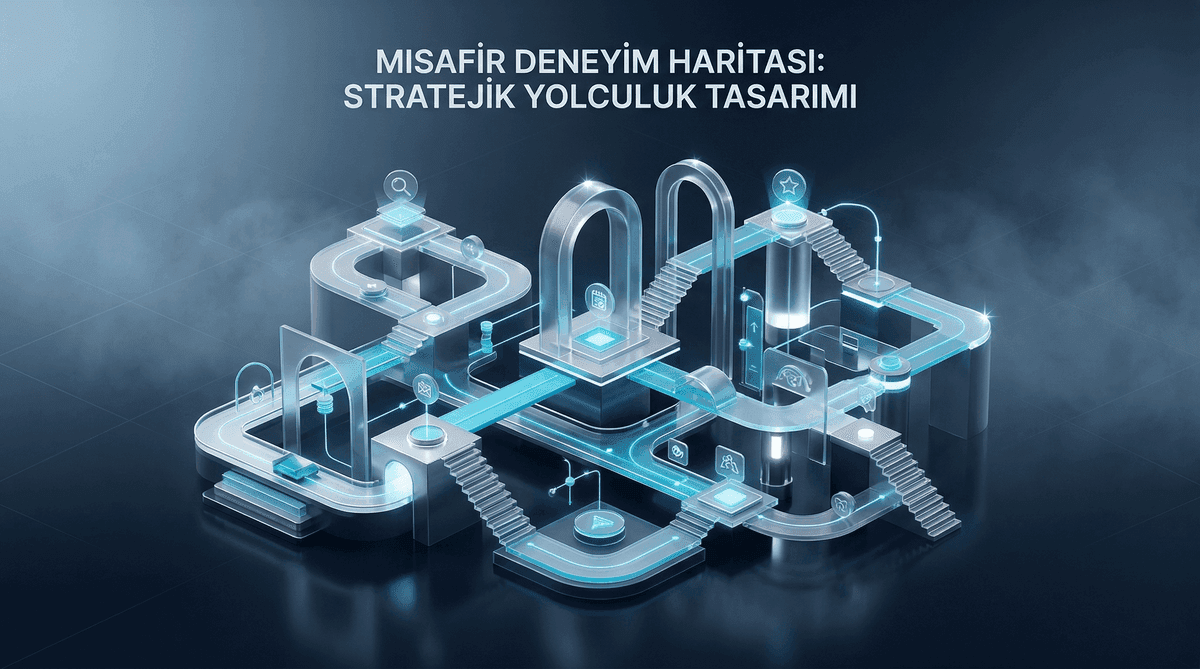
In the hospitality sector, guest experience is often perceived as limited to the period from check-in to check-out. However, in reality, the guest experience is a long journey that begins with the initial Google search and continues through the post-stay review phase. At every stop along this journey, the guest forms an impression of your hotel.
Customer journey mapping (guest experience map) is a strategic tool that visualizes this journey with all its touchpoints, revealing guest emotions, expectations, and opportunities for action at each stage.
Embed this image on your site
<a href="https://otelciro.com/en/news/hotel-guest-journey-map-optimizing-2026-experience-strategy-guide">
  <img src="https://cdn.sanity.io/images/1la98t0z/production/10d4e1b11f217b87fd1b20bdce98ab8f0ebaed01-1200x669.png" alt="Guest Experience Map Infographic" width="800" />
</a>
<p>Source: <a href="https://otelciro.com">OtelCiro</a> — AI Hotel Revenue Management</p>
Hotels that create and actively utilize journey maps achieve a 20-30% improvement in guest satisfaction scores and a 15% increase in repeat visit rates. In this article, we delve into how to create a guest experience map tailored for your hotel, which touchpoints are critically important, and how you can translate this map into operational decisions.
Related reading: Guest Segmentation and Persona Creation Guide
The 7 Stages of the Journey
The hotel guest journey consists of seven fundamental stages. Each stage presents different touchpoints, guest emotions, and optimization opportunities.
Stage 1 — Dreaming: The guest has not yet made travel plans but is seeking inspiration. Instagram posts, travel blogs, and friend recommendations trigger this stage. Your hotel's social media visibility and content marketing are critical at this point.
Stage 2 — Researching: The destination has been determined, and now a hotel is being sought. Google searches, OTA filters, reading reviews, and price comparisons constitute this stage. 83% of guests compare at least 4-6 hotels at this stage.
Stage 3 — Booking: A decision has been made, and the reservation is being placed. The simplicity of the booking process, payment options, and clarity of the confirmation message determine the experience at this stage. Complex booking processes lead to a 26% abandonment rate.
Stage 4 — Preparing: The period between reservation and check-in. Pre-arrival communication, collecting special requests, and managing expectations are done at this stage.
Stage 5 — Staying: The main experience from check-in to check-out. Room quality, service speed, food and beverage, and all touchpoints are evaluated at this stage.
Stage 6 — Departing: The check-out process, the farewell experience, and the final impression. The last impression reframes the entire stay — known as the "recency effect" in psychology.
Stage 7 — Sharing & Returning: Writing reviews, social media sharing, and the decision to revisit. This stage directly influences the "research" stage of the next guest's journey.
Touchpoint Analysis and Emotion Map
After listing the touchpoints at each stage, it's necessary to map the guest's emotional state at that point. This is called an emotion curve.
Steps to create a touchpoint inventory:
- List all physical and digital touchpoints at each stage (minimum 40-50 touchpoints).
- Evaluate what the guest feels at each touchpoint (1-5 scale: very negative - very positive).
- Identify the responsible department for each touchpoint.
- Mark the critical moments (Moment of Truth).
Critical touchpoints in a typical hotel journey map:
- First website visit: Your hotel's digital storefront. If loading speed exceeds 3 seconds, 53% of guests abandon the site.
- OTA profile page: Photo quality, review score, and description detail directly impact conversion.
- Check-in experience: When waiting time exceeds 5 minutes, satisfaction drops by 30%.
- First room impression: The impression formed within the first 30 seconds when the guest enters the room affects the perception of the entire stay.
- First dining experience: Restaurant quality accounts for 25% of overall satisfaction.
- Check-out process: A smooth and fast check-out maintains a positive final impression.
Pain points in the emotion map are the biggest opportunities for improvement. Identifying and resolving these points is the fastest way to increase overall satisfaction scores.
Journey Map Creation Workshop
Creating an effective journey map is not a desktop exercise. A workshop involving all departments yields the best results.
Workshop preparation:
- Select 8-12 participants from different departments (front desk, housekeeping, F&B, sales, IT).
- Compile guest reviews and complaint records from the last 3 months.
- Prepare guest persona profiles.
- Secure a large wall, sticky notes, and colored pens.
Workshop flow (4 hours):
- Persona selection (30 min): Determine which guest segment the map will be created for. A separate map should be created for each segment.
- Stage definition (30 min): Place the seven stages on the wall and determine the duration of each stage.
- Touchpoint listing (60 min): Add touchpoints for each stage using sticky notes.
- Emotion scoring (45 min): Assign a 1-5 emotion score to each touchpoint and draw the emotion curve.
- Opportunity identification (45 min): Mark pain points and develop improvement ideas.
- Action plan (30 min): For the top 5 most effective improvements, define the responsible party, timeframe, and success metric.
Related reading: Guest Expectation Management: Rapid Response Strategy
Integrating Digital and Physical Touchpoints
The modern guest journey constantly transitions between the digital and physical worlds. Consistency between these two worlds is the determinant of experience quality.
Digital-physical transition points:
- Website → Front Desk: The experience promised on the website being met at the front desk. If a "sea view room" was promised, it must be guaranteed at check-in.
- Mobile check-in → Room entry: Seamless transition with a digital key. The ability for guests to go directly to their room without stopping at the front desk.
- Chatbot → Live support: Seamless transition to human support when an AI chatbot cannot resolve issues.
- App → Room service: Consistency in time and quality between orders placed via the app and actual delivery.
With OtelGPT, you can manage digital touchpoints with AI support, providing 24/7 uninterrupted guest experience.
Omnichannel experience principles:
- Regardless of which channel the guest uses to communicate, information must be consistent.
- A conversation started on one channel should seamlessly continue on another.
- Guest history and preferences should be accessible across all channels.
- Information repetition should be avoided during channel transitions.
Turning the Map into Action
If a journey map stays hanging on the wall, it becomes a work of art; if it is reflected in operations, it becomes a strategic tool. To turn the map into action, follow these steps:
Prioritization matrix: Evaluate each improvement opportunity based on "impact" and "ease of implementation." High-impact and easily implementable actions should take priority. Generally, the greatest impact comes from improvements to the check-in experience and the first room impression.
Department-specific action plans: The responsible department for each touchpoint should be identified, and department-specific improvement goals should be set. Progress should be reported in monthly monitoring meetings.
Guest feedback integration: The journey map is not a static document but a living tool. Every new guest comment and feedback should be reflected in the map, and emotion scores should be updated. It is recommended to review the map quarterly.
Seasonal adjustments: The guest journey differs between the summer and winter seasons. During periods with a high concentration of leisure guests, pool, beach, and outdoor touchpoints come to the forefront, while during periods with a high concentration of business travelers, meeting rooms and business center touchpoints gain prominence.
Success metrics:
- Overall satisfaction score (NPS or CSAT) trend
- Change in emotion scores at critical touchpoints
- Repeat visit rate and loyalty program participation
- Average online review score
- Complaint rate and resolution time
The guest experience map is the cornerstone of your hotel's guest-centric transformation. This strategic tool, which unites every department around a common guest vision, concretizes improvement opportunities, and enables continuous development, is the key to competitive advantage in 2026.
![Europe's Hotel Construction Boom: 2026 Oversupply Risks [Market Analysis]](https://cdn.sanity.io/images/1la98t0z/production/6dfe59137f56aa14bfcba86d9db3cf05ff89f406-2752x1536.jpg?w=1920&q=50&auto=format&fit=max)