![Hotel Garden Lighting: Energy & Aesthetics [2026 Guide]](https://cdn.sanity.io/images/1la98t0z/production/f002db9d5462065a5128ffc1e1d823197df5fd97-1200x669.png?w=1920&q=65&auto=format&fit=max)
Key Takeaways
- First Impressions Matter: Garden lighting significantly shapes guest perception before they reach reception.
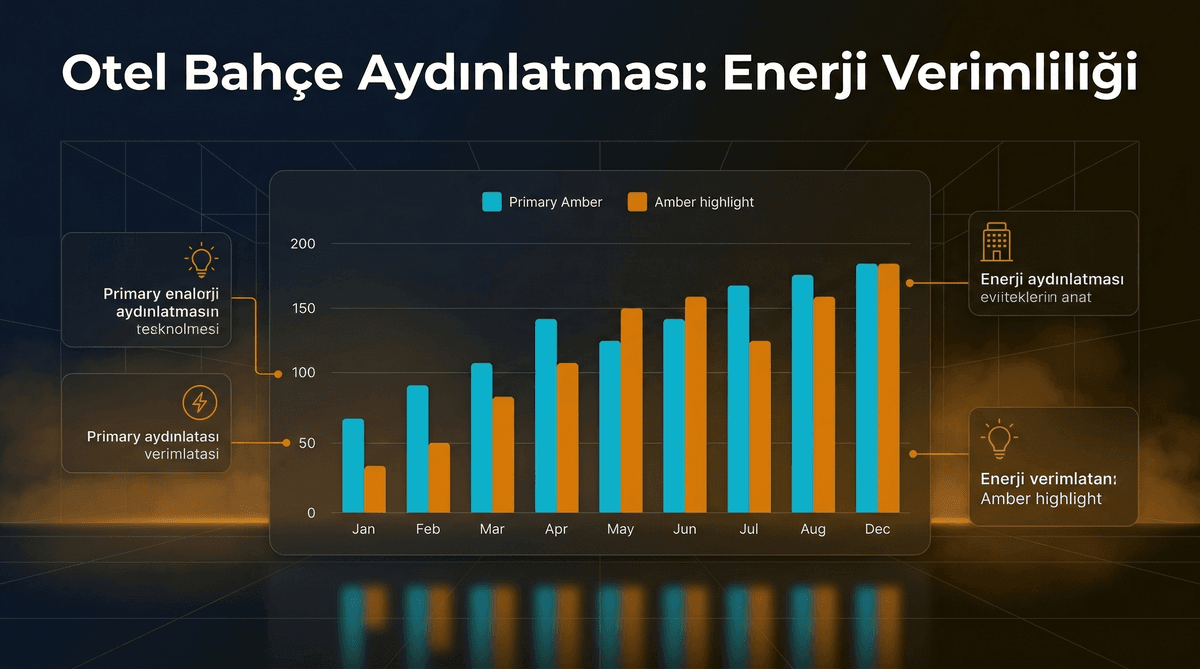
- High Costs of Traditional Lighting: Outdoor lighting accounts for 8-15% of total electricity, reaching 15,000-30,000 TL monthly for a 200-room resort.
- LED is Key to Savings: Switching to LED reduces energy consumption by 60-75%, offering 80,000-150,000 TL in annual savings with a 12-24 month ROI.
- Smart Controls Amplify Efficiency: Astronomical timers, motion, and daylight sensors, plus scene management, deliver an additional 20-30% energy savings.
- Integrated Approach for Sustainability: Combining LED, solar, and smart systems can reduce total energy costs by 70-85%, demonstrating a strong commitment to sustainability.
First Impressions Begin in the Garden
When a guest approaches a hotel, the first thing they see is not the building itself, but the garden and outdoor lighting. Gently illuminated pathways in the evening, warm spotlights hitting tree trunks, ambient lights by the pool — these are the elements that shape the hotel's perception of quality before guests even reach the reception desk.
However, garden lighting designed purely for aesthetic concerns can impose a significant burden in terms of energy costs. Hotel outdoor lighting accounts for 8-15% of total electricity consumption. In a 200-room resort hotel, this figure can reach 15,000-30,000 TL monthly. Moreover, traditional lighting systems waste energy through heat generation and contribute to environmental issues with light pollution.
In 2026, proper garden lighting design requires an integrated approach that reconciles aesthetics with energy efficiency, supported by smart control systems, and serving sustainability goals.
Embed this image on your site
<a href="https://otelciro.com/en/news/hotel-garden-lighting-energy-aesthetics-2026-guide">
  <img src="https://cdn.sanity.io/images/1la98t0z/production/f002db9d5462065a5128ffc1e1d823197df5fd97-1200x669.png" alt="Hotel Garden Lighting Design Infographic" width="800" />
</a>
<p>Source: <a href="https://otelciro.com">OtelCiro</a> — AI Hotel Revenue Management</p>
Related reading: Hotel IoT and Smart Room Technologies
Lighting Layers: Functional and Aesthetic Balance
Professional garden lighting design consists of three layers:
1. Functional Lighting
This is the basic lighting layer for safety and guidance:
- Pathways: Minimum 20 lux, evenly distributed lighting. Bollard fixtures or recessed ground spotlights are preferred.
- Parking lots: Minimum 50 lux. Sufficient brightness should be provided for security cameras.
- Entry and exit points: 100-150 lux. Focus lighting that emphasizes the hotel's brand and entrance.
- Steps and ramps: Edge lighting to prevent fall risks. Visibility of each step must be ensured.
2. Accent Lighting
This aesthetic layer creates the garden's character:
- Tree lighting: Uplight from the trunk or downlight from branches. A 35-50W LED spot is sufficient for large trees.
- Facade lighting: Wall wash or accent lighting to highlight the building's architectural details.
- Water features: Underwater lighting for pools, fountains, or decorative water elements. IP68 protection class is mandatory.
- Landscape highlighting: Spotlighting for special plant compositions, sculptures, or stone groupings.
3. Ambiance Lighting
This decorative layer enriches the guest experience:
- Outdoor restaurant/bar: 50-100 lux. Warm white (2700-3000K) color temperature creates a sense of comfort.
- Poolside: Indirect lighting and underwater LEDs. RGB color changing enhances the night ambiance.
- Garden furniture: Tabletop LED candles or recessed fixtures.
- Decorative strings: String lights (fairy lights) hung between trees are particularly popular for wedding and event venues.
LED Technology: The Foundation of Savings
Transitioning from traditional halogen and sodium vapor fixtures to LED is the highest-return investment in garden lighting:
| Parameter | Halogen | Sodium Vapor | LED |
|---|---|---|---|
| Energy Efficiency (lm/W) | 15-20 | 80-120 | 120-200 |
| Lifespan (hours) | 2,000 | 15,000 | 50,000-100,000 |
| Color Quality (CRI) | 100 | 20-40 | 80-98 |
| Heat Generation | Very High | High | Low |
| Instant On | Yes | No (5-10 min) | Yes |
With the switch to LED, garden lighting energy consumption decreases by 60-75%. Annual savings of 80,000-150,000 TL can be achieved in a 200-room hotel garden. The typical return on investment period is 12-24 months.
Color temperature selection directly impacts guest perception. 3000K (warm white) is recommended for general garden areas, and 4000K (neutral white) for security areas. Cool white light above 6000K should absolutely be avoided in a hotel garden, as it creates a cold and hospital-like atmosphere.
Related reading: Automation in Hotel Operations: Digitizing Business Processes
Solar-Powered Lighting Solutions
Solar-paneled garden fixtures are independent lighting solutions that operate without wiring costs. In 2026, advancements in solar panel and battery technology have made these systems a realistic option for hotel gardens.
Suitable application areas:
- Garden path bollard fixtures
- Decorative ground spotlights
- Signage and directional lighting
- Remote garden areas (locations with high wiring costs)
Limitations:
- May be insufficient for areas requiring intense illumination (parking lots, entrances).
- Battery capacity can be limiting on cloudy and winter days.
- Panel efficiency decreases in shaded areas, such as under trees.
A hybrid approach is the most rational solution: grid-powered LEDs for critical and intensely lit areas, and solar-powered fixtures for remote and decorative areas.
Smart Control Systems
Smart lighting control automates energy savings and eliminates reliance on human intervention:
- Astronomical timer: Automatic on/off based on sunrise and sunset. It tracks seasonal time changes.
- Motion sensors: In less-used areas (backyard, service paths), lighting activates upon detecting movement and dims to 10-20% when no movement is detected.
- Daylight sensor: Adjusts artificial lighting intensity according to ambient light levels.
- Scene management: Pre-defined lighting programs for different scenarios. Scenes like "dinner," "night," "event," or "security" can be activated with a single button or timer.
- Remote control: Monitoring and management of all garden lighting via a mobile app or a central BMS (Building Management System).
Smart control systems provide an additional 20-30% savings after switching to LED. By ensuring that garden lighting illuminates "as much as needed, when needed," both energy consumption and fixture lifespan are optimized.
With the OtelCiro operations management module, garden lighting programs can be digitally managed, energy consumption reports generated, and maintenance schedules automated.
Conclusion: Gardens That Speak with Light
Hotel garden lighting design is an intersection of engineering and art. A well-designed garden lighting scheme welcomes guests, offers a safe passage, and showcases the hotel's character during nighttime hours — all while consuming minimal energy.
The combined use of LED technology, solar-powered fixtures, and smart control systems can reduce garden lighting energy costs by 70-85% compared to traditional systems. This saving is not just a financial advantage; it is also a tangible demonstration of the hotel's commitment to sustainability.
![Europe's Hotel Construction Boom: 2026 Oversupply Risks [Market Analysis]](https://cdn.sanity.io/images/1la98t0z/production/6dfe59137f56aa14bfcba86d9db3cf05ff89f406-2752x1536.jpg?w=1920&q=50&auto=format&fit=max)