![Hotel Fire Safety Compliance: Training & Inspection Guide [2026 Guide]](https://cdn.sanity.io/images/1la98t0z/production/e53252159ea56277ab1642d90d3882bb37f0280a-1024x1024.png?w=1920&q=65&auto=format&fit=max)
Key Takeaways
- Most hotel fires are preventable; 42% are caused by electrical faults and 28% by kitchen incidents.
- Compliance with the "Regulation on the Protection of Buildings from Fire" is mandatory to avoid severe legal penalties.
- A tiered training approach—covering all staff, specialized security teams, and department-specific risks—is essential.
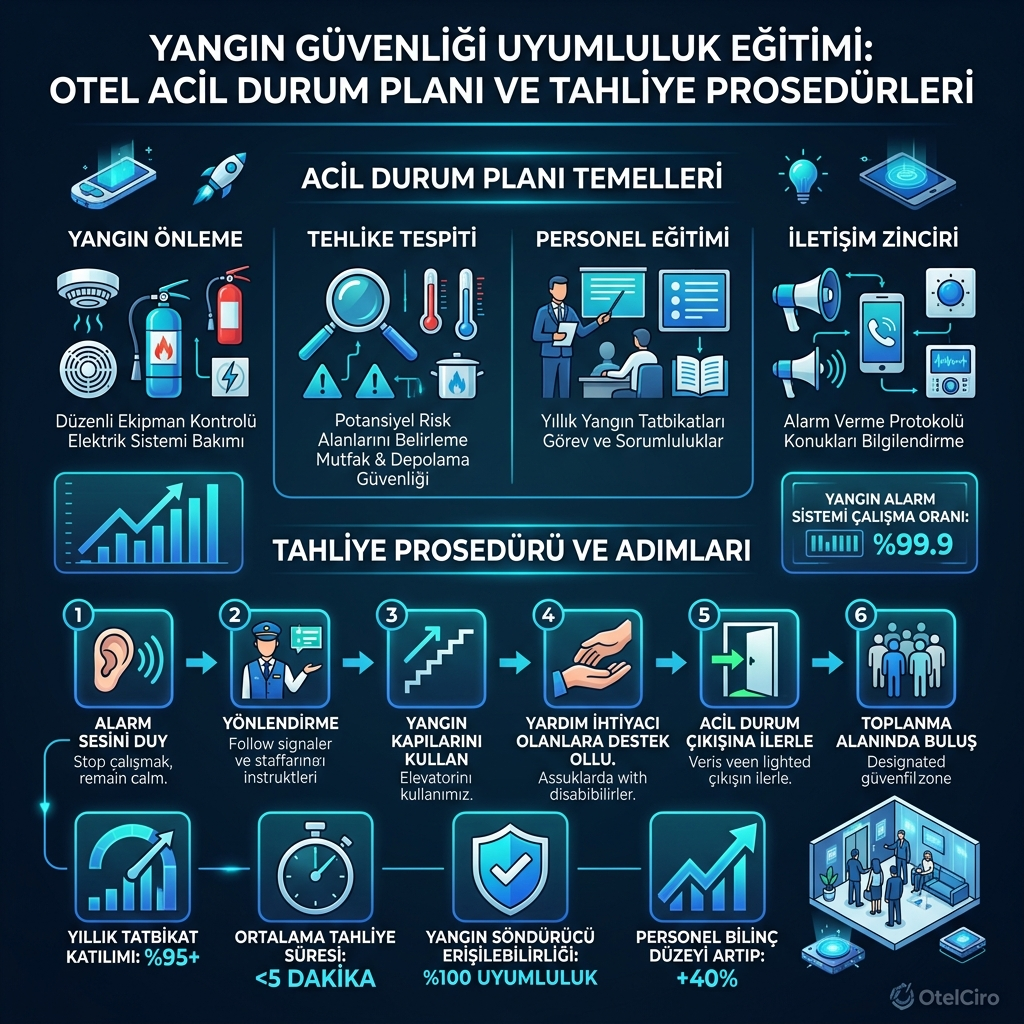
- Full evacuation drills must be conducted at least twice a year with a target building clearance time of 5 minutes.
- Digital management platforms can increase fire safety equipment reliability from 80% to 99.5% through automated maintenance tracking.
Fire Safety in Hotels: A Vital Responsibility
Fire is one of the most devastating risks within the hotel industry. According to data from the National Fire Protection Association (NFPA), more than 3,500 fires occur in hotels and lodging facilities worldwide each year, with 15% resulting in serious property damage or loss of life.
In Turkey, between 2020 and 2025, 42% of hotel fires were caused by electrical installation failures, 28% by kitchen-related incidents, 18% by smoking and open flames, and 12% by other causes. These statistics clearly demonstrate that the majority of fires are preventable.
Under Turkish legislation, hotels are classified as "high-risk structures" and are subject to strict regulations under the Regulation on the Protection of Buildings from Fire. Non-compliance leads to heavy criminal sanctions, cancellation of business licenses, and severe legal liabilities.
Embed this image on your site
<a href="https://otelciro.com/en/news/hotel-fire-safety-compliance-training-inspection-guide-2026-guide">
  <img src="https://cdn.sanity.io/images/1la98t0z/production/e53252159ea56277ab1642d90d3882bb37f0280a-1024x1024.png" alt="Fire Safety Compliance Guide Infographic" width="800" />
</a>
<p>Source: <a href="https://otelciro.com">OtelCiro</a> — AI Hotel Revenue Management</p>
Related reading: Hotel Security and Emergency Plan
Legal Requirements and Compliance Framework
Regulation on the Protection of Buildings from Fire
This regulation determines the minimum standards for fire safety systems in hotels:
- Detection systems: Smoke detectors must be in every room, heat detectors in corridors, and flame detectors in kitchens and laundries.
- Extinguishing systems: Sprinkler systems are mandatory for hotels of a certain size. Fire cabinets must be placed every 30 meters.
- Evacuation routes: Escape stairs must be fire-resistant for 120 minutes, and emergency lighting must operate for at least 60 minutes.
- Fire compartmentalization: Partitioning to prevent the spread of fire between floors is mandatory.
Inspection Schedule
Hotels are required to undergo regular inspections regarding fire safety:
- Daily: Verification that escape routes are clear.
- Weekly: Fire alarm panel testing and control.
- Monthly: Inspection of fire extinguisher pressure and accessibility.
- Quarterly: Testing of the sprinkler system and fire pumps.
- Semi-annually: Testing of emergency lighting and guidance systems.
- Annually: Comprehensive fire safety audit (conducted by an authorized firm).
Fire Safety Training Program
Basic Training (All Staff)
Every employee in the hotel, regardless of position, must receive basic fire safety training. This training should be provided before starting work and renewed annually:
- How the fire alarm system works and how to trigger it.
- Basic extinguishing techniques (PASS method: Pull, Aim, Squeeze, Sweep).
- Evacuation routes and assembly points.
- Rules for moving in smoke and toxic gas environments.
- Guest evacuation procedures and prioritization.
Advanced Training (Security Team and Managers)
Additional training modules for security personnel and department managers:
- Fire types and appropriate extinguishing methods (Class A, B, C, D, F).
- Coordination procedures with the fire department.
- Crisis communication protocols.
- Evacuation of guests with disabilities or limited mobility.
- First aid and basic life support.
Department-Specific Training
Kitchen Staff: Responding to oil fires, hood and duct cleaning, LPG/natural gas safety.
Housekeeping: Electrical appliance safety, detecting fire risks during room inspections, rules for using irons and dryers.
Reception: Guest evacuation coordination, providing room occupancy data to the fire department, tracking the location of guests with disabilities.
Technical Service: Electrical installation safety, maintenance of fire detection and extinguishing systems, fire risks in generator and mechanical rooms.
Related reading: Housekeeping Automation: 7 Steps to Digitalization
Evacuation Drills: From Planning to Execution
Fire evacuation drills are both a legal requirement and a true test of staff and guest safety. An effective drill program includes:
Drill Frequency: At least 2 full evacuation drills and 4 partial drills should be conducted annually. Drills performed before the summer season are particularly critical.
Scenario Variety: Drills should be planned with different scenarios: nighttime, kitchen fires, evacuation during elevator failure, or scenarios involving guests with disabilities.
Measurement and Evaluation: After each drill, evacuation times, encountered obstacles, and improvement suggestions must be reported. The goal: evacuating the entire building within 5 minutes.
Guest Information: Evacuation routes and emergency contact information should be available on room cards and digital guides. Providing a brief safety briefing during check-in is a best practice.
Fire Safety Equipment Maintenance
Regular maintenance of fire safety equipment is the foundation of system reliability:
| Equipment | Inspection Frequency | Maintenance Frequency |
|---|---|---|
| Smoke detectors | Monthly test | Annual cleaning and calibration |
| Sprinkler system | Weekly visual | Quarterly function test |
| Fire extinguishers | Monthly visual | Annual refill/renewal |
| Fire pump | Weekly operation | Annual comprehensive maintenance |
| Emergency lighting | Monthly test | 6-month battery replacement |
| Escape doors | Daily check | Quarterly hinge and lock maintenance |
| Alarm panel | Weekly test | 6-month software update |
The complete implementation of this maintenance schedule ensures that systems operate with 99.5% reliability during a real fire. In neglected systems, reliability can drop to 70-80%.
Digital Fire Safety Management
A modern hotel operations management platform facilitates compliance by digitizing fire safety processes:
- Automated maintenance reminders: Automatic tracking and notification of equipment maintenance dates.
- Digital checklists: Performing daily, weekly, and monthly checks via mobile devices.
- Training tracking: Recording staff training, certificate expiration dates, and renewal reminders.
- Drill reporting: Digital recording of evacuation times and findings.
- Audit readiness: Single-point access to all documents required for legal inspections.
Fire safety is a process that must be managed as if it is needed every day, not just "one day." A proactive approach protects both life safety and the hotel's sustainability. Remember: every investment made in fire safety potentially saves lives.

![Europe's Hotel Construction Boom: 2026 Oversupply Risks [Market Analysis]](https://cdn.sanity.io/images/1la98t0z/production/6dfe59137f56aa14bfcba86d9db3cf05ff89f406-2752x1536.jpg?w=1920&q=50&auto=format&fit=max)