![Hotel Email Drip Campaigns: Full Guest Journey Strategy [Guide]](https://cdn.sanity.io/images/1la98t0z/production/50bc1d87c5307ac59e6c245217271cf00868b430-1200x669.png?w=1920&q=65&auto=format&fit=max)
Key Takeaways
- Automated email drip campaigns are proven to generate 320% more revenue and achieve a 28% higher direct booking rate for hotels compared to single emails.
- Implement five strategic drip series: lead nurturing (pre-booking), post-booking excitement (pre-arrival), in-stay value, post-stay loyalty, and re-engagement for lost guests.
- Personalization, leveraging guest data like name, dates, and preferences, increases open rates by 26% and has a 760% greater revenue impact.
- Proactive upselling and cross-selling emails, especially during the pre-arrival phase, can generate an average of 18-25 TL (approx. $0.60-$0.80 USD as of 2024, exact value depends on exchange rate) per guest in additional revenue.
- Consistent A/B testing of subject lines, send times, and CTAs, combined with robust PMS-integrated platforms, is key to optimizing performance and securing significant annual revenue boosts of 200,000-800,000 TL per hotel.
What is a Drip Campaign and Why is it Critical for Hotels?
An email drip campaign is a pre-planned series of automated emails sent based on a specific trigger or time. In the hospitality industry, this means delivering the right message at the right time at every stage of the guest journey—from initial interest to post-reservation.
The numbers clearly demonstrate the power of drip campaigns. Automated email series generate 320% more revenue than single emails. Hotels that utilize drip campaigns in the hospitality sector have a 28% higher direct booking rate compared to those that don't. Furthermore, leads nurtured with drip campaigns have a 47% larger purchase value than unnurtured leads.
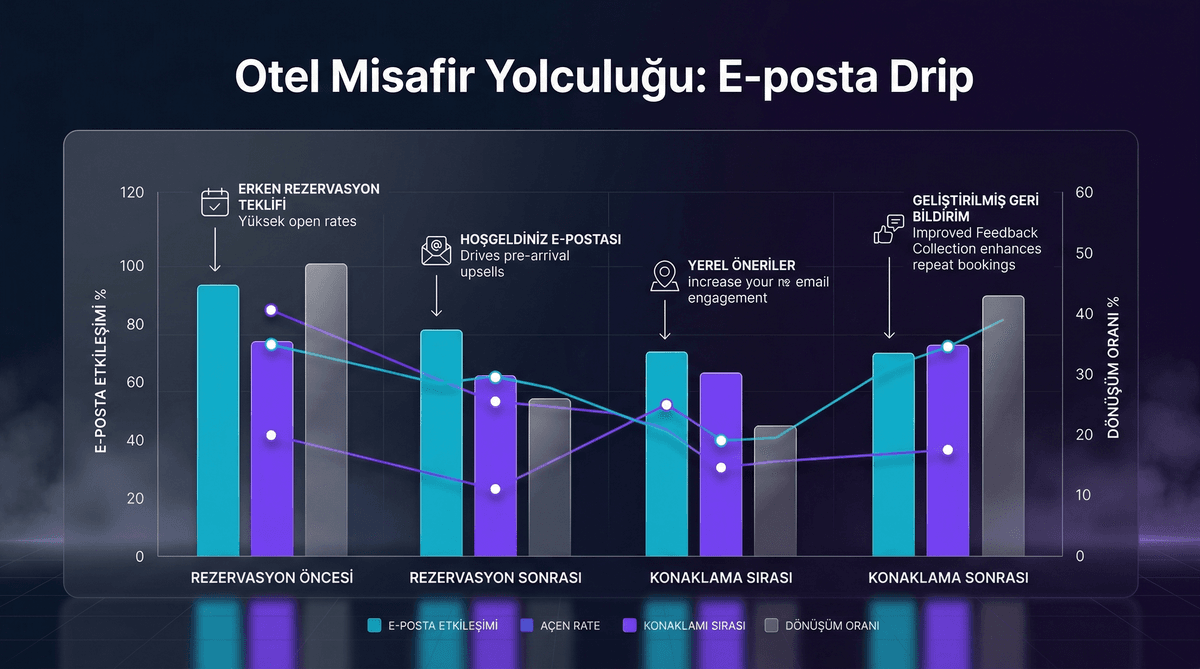
Embed this image on your site
<a href="https://otelciro.com/en/news/hotel-email-drip-campaigns-full-guest-journey-strategy-guide">
  <img src="https://cdn.sanity.io/images/1la98t0z/production/50bc1d87c5307ac59e6c245217271cf00868b430-1200x669.png" alt="Hotel Guest Email Drip Campaign Infographic" width="800" />
</a>
<p>Source: <a href="https://otelciro.com">OtelCiro</a> — AI Hotel Revenue Management</p>
Traditional mass email sending delivers the same message to all subscribers simultaneously, often resulting in low open rates. Drip campaigns, however, send personalized, time-optimized, and behavior-based messages to each recipient, significantly increasing open and click-through rates.
In this article, we detail drip campaign series tailored to five critical stages of the hotel guest journey, outlining the structure of each series and successful examples.
Related reading: Hotel Guest Communication with WhatsApp Business: Best Practices
Series 1: Lead Nurturing — Engaging Potential Guests
This series targets website visitors, newsletter subscribers, or price inquirers. It aims to convert potential guests who have shown interest but haven't yet made a reservation into warm leads.
Email 1 (Immediate): Welcome email. Sent immediately after subscription or a price inquiry. Briefly tell your hotel's story, share 3-4 of your most impactful visuals, and offer a welcome offer like "15% off your first reservation." Welcome emails have the highest average open rate among all email types, at 82%.
Email 2 (Day 3): Value proposition. Send a guide about the best activities in your area, seasonal events, or hidden gems. There is no sales message; pure value is offered. This approach builds trust.
Email 3 (Day 7): Social proof. Build trust with guest reviews, ratings, and UGC images. Share 3-5 authentic reviews under the heading "What Our Guests Say."
Email 4 (Day 14): Call to action with an offer. Present a limited-time offer or an early bird booking advantage. Add a countdown timer to create a sense of urgency. This final email has the highest conversion rate in the series, typically generating a 4.2% click-through rate.
Series 2: Post-Booking — Building Excitement
Cutting off communication with guests after a reservation is one of the most common mistakes. Pre-arrival emails manage guest expectations, create opportunities for additional revenue, and lay the groundwork for a positive experience.
Email 1 (Immediately after booking): Confirmation and thank you. Summarize reservation details, clarify the cancellation/change policy, and build an emotional connection with the message "we're excited for your trip."
Email 2 (14 days before check-in): Upselling opportunity. Suggest additional services such as a room upgrade, a romantic package, a spa package, or airport transfer. Post-reservation upselling emails generate an average of 18-25 TL (approx. $0.60-$0.80 USD) in additional revenue per guest. Personalization is crucial at this stage; suggesting a children's pool package to a family and a romantic dinner to a couple triples conversions.
Email 3 (3 days before check-in): Practical information. Send a transportation guide, weather forecast, check-in times, and a special requests form. This email ensures operational efficiency while making the guest feel valued.
Email 4 (Check-in day): Welcome message. Share last-minute information, mobile check-in options, and the WhatsApp communication line with the subject "We're expecting you."
Related reading: Instant Reach with SMS Marketing for Guest Engagement
Series 3: During Stay — Instant Value
Emails sent during the stay (or more effectively, push notifications and WhatsApp messages) enrich the guest experience and encourage additional spending.
Day 1 (4 hours after check-in): Welcome survey. A quick check-in asking, "Is everything alright?" Proactively identifying potential issues reduces the likelihood of negative reviews by 60%.
Day 2: Restaurant and spa recommendations. Information on the day's special menu, spa availability, or evening events. These messages increase F&B and spa revenues by an average of 22%.
2 hours before check-out: Late check-out offer. Offer a paid late check-out option based on availability. Acceptance rates are typically between 15-20%, generating an extra 200-500 TL (approx. $6.50-$16.00 USD) per room.
Automating in-stay messages and personalizing them based on guest behavior using a sales and marketing ecosystem maximizes additional revenue potential.
Series 4: Post-Stay — The Loyalty Loop
The post-checkout period is a critical window for building guest loyalty and triggering repeat bookings.
Email 1 (24 hours after check-out): Thank you and review request. Send a short satisfaction survey and a Google/TripAdvisor review link with the subject "Thank you for visiting us." The 24-hour period after check-out is the most likely time for guests to leave a review; a response rate of up to 31% is possible within this window.
Email 2 (7 days after check-out): Share memories. Send a mini-gallery of professional photos or photos from their stay with the message "your memories are here." Encourage sharing on social media. This email increases UGC production by 45%.
Email 3 (30 days later): Loyalty offer. Offer a special discount for a return stay with the message "We miss you." Include personalized details from their previous stay—such as "our favorite sea-view room awaits you."
Email 4 (Stay anniversary): Anniversary reminder. Offer a nostalgic touch and a special offer with the message "This time last year, you were with us." The conversion rate for anniversary emails is 56% higher than standard promotional emails.
Series 5: Re-engagement — Winning Back Lost Guests
The re-engagement series targets subscribers who haven't interacted for 6 months or longer, activating the passive database.
Email 1: Share recent renovations, newly opened restaurants, or news about updates at your hotel with a "We miss you" message. Aims to pique curiosity.
Email 2 (5 days later): Aggressive offer. Offer an attractive discount of 25-35% for a low-season period. This offer is exclusive to the re-engagement list; it is not offered to the standard list.
Email 3 (10 days later): Last chance. Ask if they want to remain subscribed with the subject "This might be our last message." Removing non-responders from the list helps maintain email sending health and deliverability.
Re-engagement series retrieve an average of 12-18% of lost guests, and the average order value of these returns is 33% higher than first-time guests.
Technical Infrastructure and Automation
The right tools and automation infrastructure are essential for managing drip campaigns.
Recommended platforms: Mailchimp (for beginners), Klaviyo (e-commerce focused), ActiveCampaign (advanced automation), or HubSpot (comprehensive CRM integration). For hotels with PMS integration, hospitality-focused platforms like Revinate or Cendyn are recommended.
Personalization variables: Name, stay dates, room type, spending amount, preferred activities—each should be used in dynamic content blocks to make every email feel personalized to the guest. Personalized emails are reported to have a 26% higher open rate than general emails, and their revenue impact is 760% greater.
A/B testing: Subject lines, send times, and CTA designs for each email in every series should be A/B tested. Even small improvements can lead to significant revenue differences across thousands of emails.
Drip campaigns, once set up, are 24/7 automated revenue machines. A correctly structured drip campaign system has the potential to generate 200,000-800,000 TL (approx. $6,500-$26,000 USD) in additional annual revenue per hotel. The important thing is to start—rather than waiting to build a perfect system, implementing the basic 5 series and continuously improving with data is the most effective approach.
![Europe's Hotel Construction Boom: 2026 Oversupply Risks [Market Analysis]](https://cdn.sanity.io/images/1la98t0z/production/6dfe59137f56aa14bfcba86d9db3cf05ff89f406-2752x1536.jpg?w=1920&q=50&auto=format&fit=max)