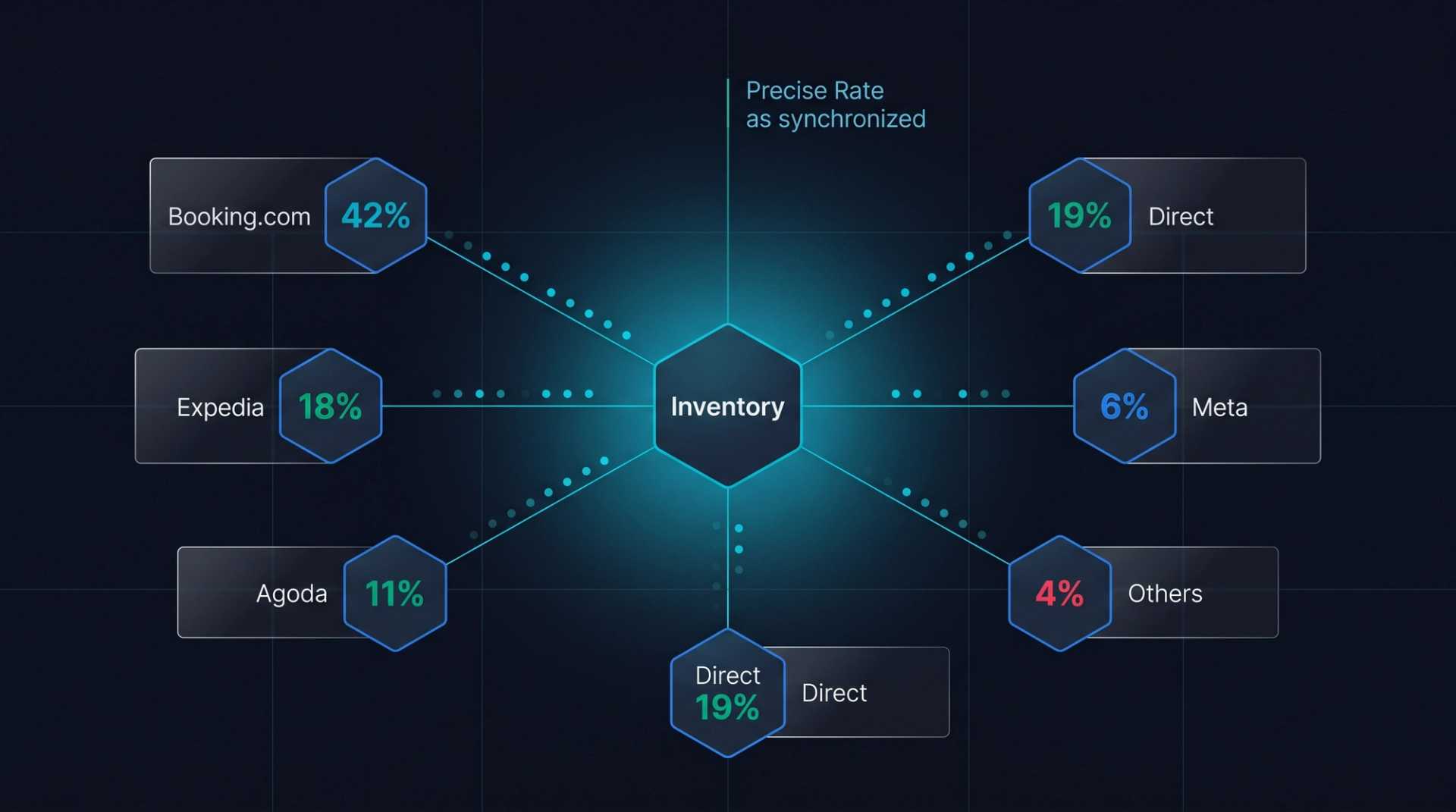
![Hotel Distribution Evolution: GDS to AI [2026 Strategy Guide]](https://cdn.sanity.io/images/1la98t0z/production/a01132695d334d1078aae2b585beef38de5886c9-1376x768.jpg?w=1920&q=65&auto=format&fit=max)
Key Takeaways
- Hotel distribution has undergone a 60-year transformation, evolving from manual phone and mail processes to sophisticated AI-driven systems.
- The GDS revolutionized global access for travel agents in the 1970s and still accounts for 35-40% of corporate travel bookings today.
- The Internet and OTA revolution (1995-2015) democratized bookings but introduced high commission costs (15-25%) and dependency for hotels.
- The rise of metasearch and direct channel strategies (2015-2023) empowered hotels, leading to efforts to reduce OTA reliance and promote "best price direct."
- The current AI era (2023-Today) is fundamentally reshaping distribution, with AI travel assistants expected to manage 20% of all hotel searches by 2027, favoring tech-savvy hotels and AI-native platforms.
How Hotel Distribution Has Changed in 60 Years?
In the 1960s, reserving a hotel room required finding a number in the phone book, calling the hotel reception, and receiving confirmation by mail. Today, artificial intelligence recommends hotels tailored to your travel plans, dynamically optimizes prices, and completes bookings in a few clicks.
This transformation is no coincidence — every major technological leap has fundamentally altered the hotel distribution model. Each era had its winners and losers. In 2026, the new era initiated by artificial intelligence is once again reshuffling the cards.

Embed this image on your site
<a href="https://otelciro.com/en/news/hotel-distribution-evolution-gds-to-ai-2026-strategy-guide">
  <img src="https://cdn.sanity.io/images/1la98t0z/production/a01132695d334d1078aae2b585beef38de5886c9-1376x768.jpg" alt="History of Hotel Distribution Technology: Journey from GDS to AI infographic" width="800" />
</a>
<p>Source: <a href="https://otelciro.com">OtelCiro</a> — AI Hotel Revenue Management</p>
Related reading: Competing with Airbnb: Alternative Accommodation Strategies for Hotels
Related reading: GDS 2026: Amadeus, Sabre, and Travelport Hotel Strategies
Era 1: The Age of Phone and Mail (1950-1970)
How Distribution Worked
Hotel reservations were an entirely manual process:
- Travel agents booked rooms by phone
- Group reservations were made via mail and telegram
- Prices were published as fixed annual rate lists
- International reservations could take days
Characteristics of the Era
- Distribution channel: Phone, mail, direct visits
- Pricing: Fixed annual rack rate
- Reach: Local/regional
- Decision-maker: Travel agent
Embed this image on your site
<a href="https://otelciro.com/en/news/hotel-distribution-evolution-gds-to-ai-2026-strategy-guide">
  <img src="https://cdn.sanity.io/images/1la98t0z/production/d7d8dd717a0471ca7d480294091db24c1186f694-1200x669.png" alt="2026 hotel channel manager selection guide" width="800" />
</a>
<p>Source: <a href="https://otelciro.com">OtelCiro</a> — AI Hotel Revenue Management</p>
Era 2: The GDS Revolution (1970-1995)
From Airlines to Hotels
The Global Distribution System (GDS) was initially developed for airline tickets. Sabre (1960), Apollo (1971), and Amadeus (1987) enabled travel agents to make instant reservations through electronic systems.
In the 1980s, hotels also joined the GDS. This marked the first major digital revolution in hotel distribution:
- Travel agents worldwide gained instant access to hotels
- International reservations could be completed within minutes
- Price and availability information was published digitally
Impact of GDS on the Hotel Industry
| Metric | Pre-GDS | Post-GDS |
|---|---|---|
| Reservation time | Days-weeks | Minutes |
| International reach | Very limited | Global |
| Number of intermediaries | Local agencies | 500,000+ agencies |
| Price transparency | Low | Medium |
GDS Today
In 2026, GDS remains active in the corporate travel segment. Globally, 35-40% of business travel hotel reservations are still made via GDS. However, its share in the leisure segment has fallen below 5%.
Related reading: Boost Direct Bookings: Reduce OTA Dependency
Related reading: Metasearch Advertising: Trivago, Google Hotels, and Kayak Strategy
Era 3: The Internet and OTA Revolution (1995-2015)
The Era That Changed Everything
Expedia launched in 1996, followed by Booking.com in 1997. The internet democratized hotel distribution — now any traveler could directly compare and book any hotel in the world.
Milestones of this era:
- 1996: Expedia launch
- 1997: Booking.com founded (Amsterdam)
- 2001: TripAdvisor launch — the era of user reviews began
- 2005: Booking.com rapidly grew with its commission model
- 2007: Mobile revolution with the iPhone
- 2011: Booking Holdings acquired Booking.com
How OTAs Transformed the Industry
OTAs brought both opportunities and threats to the hotel industry:
Opportunities:
- Worldwide visibility
- Increased occupancy rates
- Digital marketing infrastructure
Threats:
- 15-25% commission costs
- OTA dependency
- Price transparency pressure
- Indirect revenue via the billboard effect
Embed this image on your site
<a href="https://otelciro.com/en/news/hotel-distribution-evolution-gds-to-ai-2026-strategy-guide">
  <img src="https://cdn.sanity.io/images/1la98t0z/production/e41b7ac3104ad8488f70d83e78d4135e4a401e88-1200x2150.png" alt="AI dynamic hotel pricing model" width="800" />
</a>
<p>Source: <a href="https://otelciro.com">OtelCiro</a> — AI Hotel Revenue Management</p>
Era 4: Metasearch and Direct Channel (2015-2023)
The Balance of Power Began to Shift
Metasearch engines like Google Hotels, Trivago, and Kayak elevated price comparison to the next level. During the same period, hotels began investing in direct channel strategies.
Key developments:
- 2015: Google Hotel Ads launch
- 2018: EU Digital Markets Act discussions
- 2019: Marriott, Hilton increased direct channel investments
- 2021: Google Free Booking Links — free listings
- 2022: DMA approved — pricing freedom began
Direct Channel Awakening
During this period, many hotel chains adopted a "best price on direct channel" strategy. Efforts to reduce Booking.com dependency accelerated.
Era 5: The Age of Artificial Intelligence (2023-Today)
AI Rewrites Everything
The AI revolution, which began with the widespread adoption of ChatGPT in 2023, has started to fundamentally change hotel distribution:
- AI travel assistants — The quest for commission-free bookings with ChatGPT
- Google AI Mode — The transformation of search engines into AI
- Dynamic pricing AI — Hourly, even instant price optimization
- Agentic AI — Autonomous decision-making AI systems
- MCP protocol — Communication standard between AI systems
Winners and Losers in the AI Era
| Actor | AI Impact | Status |
|---|---|---|
| Traditional OTAs | Under threat | Transitioning among AI intermediaries |
| AI-native platforms | Growth | New distribution layer |
| Technology-adopting hotels | Advantageous | Direct channel strengthening |
| Technologically distant hotels | Disadvantaged | Falling behind in competition |
| Travel agencies | Pressure to transform | Evolving into AI consultancy |
The Future: What's Next After 2026?
Predictions:
- 2027: AI travel assistants will manage 20% of all hotel searches
- 2028: Hotel bookings via voice assistants will become widespread
- 2030: Blockchain-based direct distribution models will mature
- 2032: OTAs will either transform into AI platforms or shrink
Related reading: Expedia Group Hotel Strategies: Including Hotels.com and Vrbo
OtelCiro: The AI Era's Distribution Solution
OtelCiro is designed to meet the needs of distribution technology in the AI era. Beyond traditional channel management, it offers AI-supported pricing, autonomous channel optimization, and intelligent distribution strategy.
Capture the distribution advantages of the AI era with OtelCiro Sales Ecosystem
Conclusion
The 60-year history of hotel distribution technology clearly reveals one truth: early adopters of technology won in every era. Those who transitioned to GDS in the telephone age, those who embraced OTAs in the internet age, and now hotels adopting artificial intelligence in the AI age. The question is: in which era do you choose to remain?
Elevate your distribution technology into the future with OtelCiro's sales ecosystem.
![Europe's Hotel Construction Boom: 2026 Oversupply Risks [Market Analysis]](https://cdn.sanity.io/images/1la98t0z/production/6dfe59137f56aa14bfcba86d9db3cf05ff89f406-2752x1536.jpg?w=1920&q=50&auto=format&fit=max)