![Hotel Cybersecurity: Guest Data Protection & PCI-DSS [Guide]](https://cdn.sanity.io/images/1la98t0z/production/9b97fc6f7c09833a7eb10112e6784fd5f5970b20-1200x669.png?w=1920&q=65&auto=format&fit=max)
Key Takeaways
- Hotels are high-value targets for cyberattacks due to the sensitive guest data they process, making them the second most breached sector after retail.
- Key threats include phishing, ransomware, POS malware, unsecured Wi-Fi, and insider risks, each requiring specific prevention strategies.
- PCI-DSS compliance is mandatory for hotels to protect credit card data, involving 12 core requirements from network security to access control and regular testing.
- A phased security roadmap, starting with strong passwords and staff training, progressing to PCI-DSS compliance and advanced measures like penetration testing, is vital.
- Beyond payment data, hotels must also comply with privacy regulations like KVKK and GDPR for general guest personal data.
Hotels are Prime Targets for Cyberattacks
The hospitality sector is one of the most targeted industries by cyber attackers because it processes sensitive data such as credit card information, personal identification data, and accommodation habits. According to Trustwave's 2025 Global Security Report, the hotel industry is the second most common sector for data breaches after retail.
According to IBM's Cost of Data Breach report, the average cost of a data breach in the hospitality sector is $3.9 million. This cost includes legal penalties, reputational damage, guest compensation, and operational disruption expenses.
Small and medium-sized hotels often neglect security, believing "we are not a target." However, attackers typically prefer small businesses with weak security infrastructures.
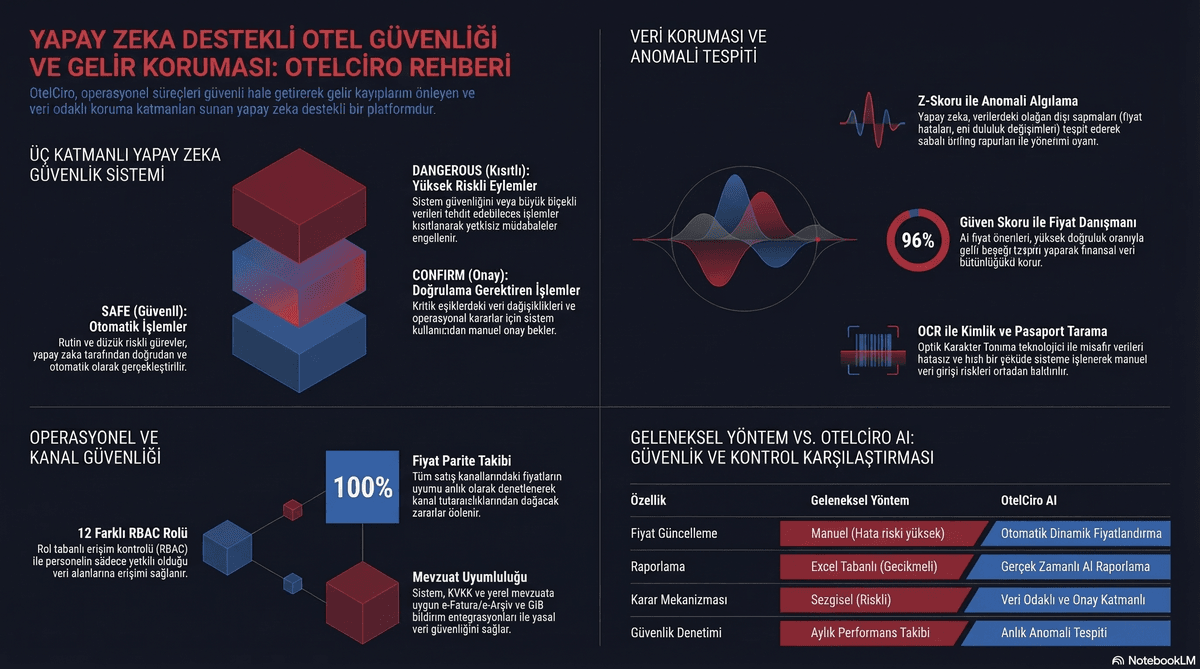
Embed this image on your site
<a href="https://otelciro.com/en/news/hotel-cybersecurity-guest-data-protection-pci-dss-guide">
  <img src="https://cdn.sanity.io/images/1la98t0z/production/9b97fc6f7c09833a7eb10112e6784fd5f5970b20-1200x669.png" alt="Hotel cybersecurity threats and protection strategy" width="800" />
</a>
<p>Source: <a href="https://otelciro.com">OtelCiro</a> — AI Hotel Revenue Management</p>
Related reading: Hotel Management with Smart PMS: Transitioning from Traditional Systems to AI-Powered Platforms
Related reading: Hotel AI Email Automation: Personalized Communication
Most Common Cyber Threats
1. Phishing Attacks
Fake emails sent to hotel staff are the most common attack vector. Emails disguised as "invoice from Booking.com" or "guest complaint" often contain malicious software.
Protection: Staff training, email filtering, multi-factor authentication (MFA)
2. Ransomware
Attacks that encrypt hotel systems and demand a ransom can completely halt operations. Loss of PMS access means inability to check-in/out guests.
Protection: Regular backups, up-to-date antivirus, network segmentation
3. POS Malware
POS software that steals credit card information is particularly prevalent in hospitality. Payment terminals and network traffic are targeted.
Protection: PCI-DSS compliance, end-to-end encryption, tokenization
4. Wi-Fi Attacks
Hotel Wi-Fi networks can be used to capture guest and staff data. Man-in-the-middle attacks are common.
Protection: Separation of guest and staff networks, WPA3 encryption, captive portal
5. Insider Threat
Unauthorized data access or deliberate leaks by current or former staff. High staff turnover in the hotel industry increases this risk.
Protection: Principle of least privilege, access logs, exit procedures (account deactivation)
Embed this image on your site
<a href="https://otelciro.com/en/news/hotel-cybersecurity-guest-data-protection-pci-dss-guide">
  <img src="https://cdn.sanity.io/images/1la98t0z/production/213b3b1fc5afe459c03c8d691a6983147d790b17-1200x2150.png" alt="AI integration architecture with MCP Server" width="800" />
</a>
<p>Source: <a href="https://otelciro.com">OtelCiro</a> — AI Hotel Revenue Management</p>
PCI-DSS Compliance Requirements
PCI-DSS (Payment Card Industry Data Security Standard) is a mandatory security standard for all businesses that process credit card data. Hotels fall under PCI-DSS scope because they process guest credit card information.
12 Core Requirements
| # | Requirement | Practical Application for Hotels |
|---|---|---|
| 1 | Firewall | Network segmentation, PMS network isolation |
| 2 | Change default passwords | Customize all device and software passwords |
| 3 | Protect cardholder data | Encrypt stored card numbers or tokenize them |
| 4 | Encrypt transmission | SSL/TLS for all data transfers |
| 5 | Antivirus | Up-to-date on all computers and servers |
| 6 | Secure systems | Keep PMS and POS security patches current |
| 7 | Restrict access | Role-based authorization |
| 8 | Authenticate access | Unique account for each user, MFA |
| 9 | Physical security | Access control for server rooms |
| 10 | Monitor access | Keep logs and review regularly |
| 11 | Test security | Regular penetration testing and vulnerability scans |
| 12 | Security policy | Written policy, staff training |
PCI-DSS Non-Compliance Risks
- Increased credit card processing fees
- Suspension of card acceptance privileges
- Severe penalties in case of a data breach
- Cancellation of OTA and bank agreements
Related reading: E-Invoicing and Digital Accounting in Hotels: GİB Integration Guide (2026)
Related reading: Hotel API Integration: The Foundation of Modern Hotel Management
Hotel Security Implementation Roadmap
Phase 1: Basic Security (0-3 months)
- Strong password policy and MFA on all systems
- Staff cybersecurity training
- Network segmentation (separate guest Wi-Fi, separate operational network)
- Up-to-date antivirus and firewall
Phase 2: PCI-DSS Compliance (3-6 months)
- Completion of PCI-DSS SAQ (Self-Assessment Questionnaire)
- Review of cardholder data storage practices
- POS and PMS security updates
- Vulnerability scanning
Phase 3: Advanced Security (6-12 months)
- Penetration testing (at least annually)
- SIEM (Security Information and Event Management) implementation
- Business continuity and disaster recovery plan
- Cyber insurance evaluation
Embed this image on your site
<a href="https://otelciro.com/en/news/hotel-cybersecurity-guest-data-protection-pci-dss-guide">
  <img src="https://cdn.sanity.io/images/1la98t0z/production/d2071d97fead43e0ad7397aaa4b3feefc6d1625f-1200x669.png" alt="Hotel guest special request management" width="800" />
</a>
<p>Source: <a href="https://otelciro.com">OtelCiro</a> — AI Hotel Revenue Management</p>
KVKK and GDPR Compliance
Guest personal data is covered by KVKK in Turkey and GDPR for EU guests:
- Clearly state data processing purposes
- Obtain guest consent (explicit consent)
- Determine data retention period
- Comply with deletion requests (right to be forgotten)
- Data breach notification obligation (72 hours)
Related reading: Housekeeping Automation: 7 Steps to Digitizing Hotel Operations
OtelCiro Security Infrastructure
OtelCiro's Smart PMS module operates on a SOC 2 and ISO 27001 compliant cloud infrastructure. Keep your guest data secure with PCI-DSS compliant payment integrations, encrypted data storage, and role-based access control.
Secure Hotel Management with OtelCiro Smart PMS
Conclusion
Cybersecurity is an invisible but critical component of hotel operations. A single data breach can erase years of accumulated guest trust in a day.
Start with fundamental security steps: strong passwords, staff training, and network segmentation. Then complete the PCI-DSS compliance process. Security is not a one-time setup; it is a continuously updated process.
Discover how you can automate this process with OtelCiro's Smart PMS.
![Europe's Hotel Construction Boom: 2026 Oversupply Risks [Market Analysis]](https://cdn.sanity.io/images/1la98t0z/production/6dfe59137f56aa14bfcba86d9db3cf05ff89f406-2752x1536.jpg?w=1920&q=50&auto=format&fit=max)