![Hotel CRM & Loyalty: Integrated Strategy [2026 Guide]](https://cdn.sanity.io/images/1la98t0z/production/7aa32eb9404c69fb57afcc545c27ccb1d1a7824d-1200x669.png?w=1920&q=65&auto=format&fit=max)
Key Takeaways
- Integrating CRM and loyalty programs significantly boosts guest lifetime value and hotel revenue.
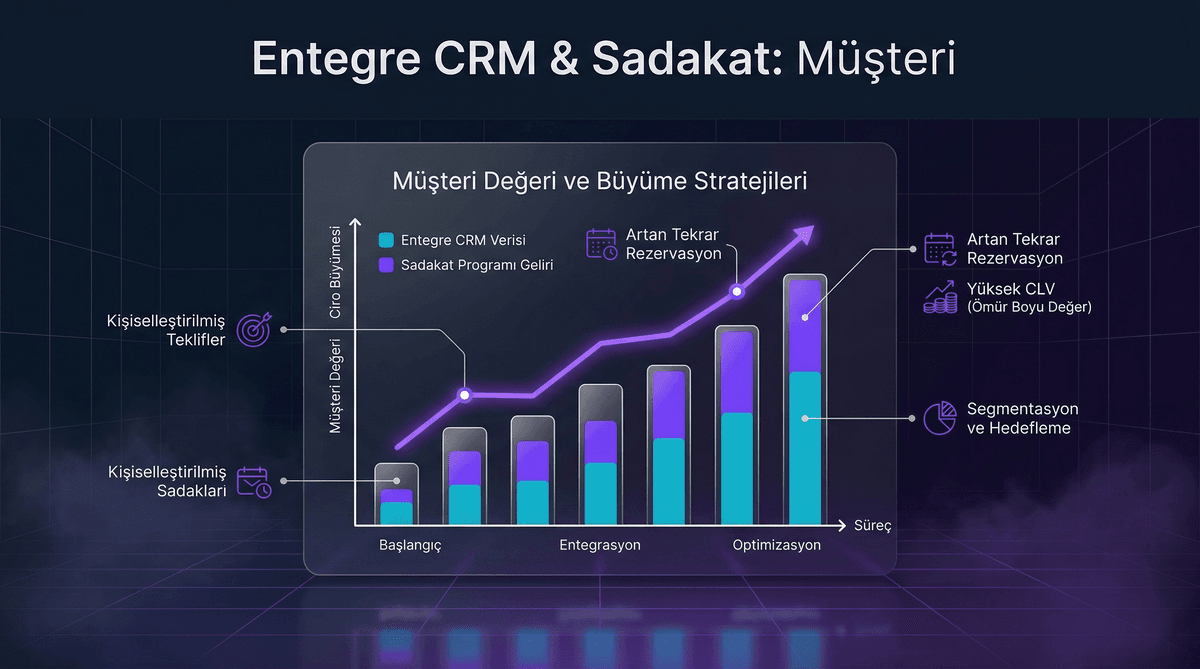
- Loyal guests spend 67% more, and an integrated strategy can raise repeat stay rates from 22% to 40-55%.
- Effective integration requires a 'Single Customer View,' multi-layered data (demographic, behavioral, relational), and RFM analysis for personalization.
- Modern loyalty programs should be tiered, offer instant rewards, use digital cards, and include partnership networks for enhanced experiences.
- Leverage CRM data for personalized pre-stay, in-stay, and post-stay communication, and utilize AI for predictive marketing to increase conversion rates by 28%.
Why Guest Loyalty Is Hospitality's Most Valuable Asset
Acquiring a new guest costs 5-7 times more than retaining an existing one. According to Bain & Company's hospitality sector research, loyal guests spend 67% more on repeat visits compared to their first stay. However, the average repeat stay rate in the hotel industry is only 22% — a figure that can be increased to the 40-55% range with CRM and loyalty program integration.
The problem is that many hotels manage CRM systems and loyalty programs as separate silos. Guest data resides in the PMS, marketing interactions in the email platform, and loyalty points in separate software. This disconnect leads to missed personalization opportunities and a fragmented guest experience.
Embed this image on your site
<a href="https://otelciro.com/en/news/hotel-crm-loyalty-integrated-strategy-2026-guide">
  <img src="https://cdn.sanity.io/images/1la98t0z/production/7aa32eb9404c69fb57afcc545c27ccb1d1a7824d-1200x669.png" alt="Infographic on Integrated CRM and Loyalty Program Strategy" width="800" />
</a>
<p>Source: <a href="https://otelciro.com">OtelCiro</a> — AI Hotel Revenue Management</p>
Related reading: Hotel Upselling and Cross-selling Techniques
Fundamentals of CRM and Loyalty Program Integration
Effective integration is achieved by unifying data from all guest touchpoints into a single platform, using this data to inform both operational and marketing decisions.
Single Customer View: A guest's PMS records, OTA bookings, website interactions, email open/click data, restaurant spending, spa usage, and review history should be consolidated into a single profile. This 360-degree profile is the foundation of true personalization.
Data layers: CRM should feature three fundamental data layers:
- Demographic data: Name, contact information, nationality, language preference, special dates (birthday, wedding anniversary)
- Behavioral data: Frequency of stay, preferred room type, average spending, restaurant visits, check-in/out times
- Relational data: Last communication date, complaint history, satisfaction score, NPS score, loyalty level
RFM analysis: Segment your guests using Recency (when did they last stay), Frequency (how often do they stay), and Monetary (how much do they spend) metrics. This segmentation allows you to develop tailored communication strategies for each group.
Loyalty Program Design: From Points to Experiences
Traditional point-based loyalty programs are no longer sufficient on their own. Modern guests expect personalized experiences and instant rewards more than just accumulating points.
Tiered structure: Design your loyalty program with 3-4 tiers. Offer tangible and attractive privileges at each level:
- Bronze: Welcome discount, free Wi-Fi, early check-in (subject to availability)
- Silver: Room upgrade (15% probability), guaranteed late check-out, spa discount
- Gold: Guaranteed room upgrade, complimentary breakfast, VIP welcome
- Platinum: Suite upgrade, personal concierge, 20% discount at all restaurants
Instant rewards: Offer small surprises during the stay, not just after each stay. A complimentary drink from the minibar, a welcome chocolate in the lobby, or a personal note in the room — these small gestures build great loyalty. According to the Cornell Hospitality Quarterly, instant rewards increase repeat visit intent by 34%.
Digital loyalty card: Utilize mobile app or digital wallet integration instead of physical cards. Mobile loyalty programs boost participation rates by 47% because guests don't have to carry a physical card.
Partnership network: Expand the utility of loyalty points by partnering with local restaurants, museums, transfer companies, and tour operators. These partnerships both enrich the guest experience and contribute to the regional tourism ecosystem.
Personalization: Turning CRM Data into Action
The true power of CRM and loyalty program integration lies in personalization.
Pre-stay: Prepare the room based on the guest's past preferences. Personalize the room before the guest arrives by pulling details like pillow preference, minibar contents, and room temperature from the CRM. A message like "Mr. Yılmaz, we've prepared your extra firm pillow in your room, just like last time" creates a powerful impact.
During the stay: Set up real-time triggers. A birthday cake surprise if the guest's birthday falls during their stay, a spa offer 4 hours after check-in, complimentary coffee after dinner at the restaurant — all these can be automatically managed with CRM triggers.
Post-stay: Send a personalized thank-you email within 24 hours of departure. Reference the guest's room type and services used in the email. Maintain communication with a repeat visit offer after 30 days and a special seasonal discount after 6 months.
Predictive marketing: Analyze CRM data with artificial intelligence to predict the guest's next stay. Sending a personalized offer 2-3 weeks before the expected date increases the conversion rate by 28%.
Related reading: Hotel Revenue Metrics and KPI Guide
Technology Infrastructure and Integration Architecture
The right technology infrastructure is critical for CRM-loyalty integration:
PMS integration: The CRM needs to ensure two-way data flow with the PMS. Reservation data should be automatically transferred to the CRM, and guest preferences from the CRM should be reflected in the PMS.
Email marketing integration: Automated email campaigns should be triggerable based on segmentation data. Open rates, click data, and conversion information should feed back into the CRM.
API-based architecture: Adopt an API-first approach instead of closed-box systems. This makes it easy to add new channels (WhatsApp, chatbot, voice assistant) in the future.
Data security: Establish data processing procedures compliant with KVKK and GDPR. Do not use personal data for marketing purposes without guest consent. Define data retention periods and perform regular clean-ups.
OtelCiro's digital sales ecosystem unifies CRM, PMS, and loyalty program data into a single platform, creating a 360-degree guest profile and enabling personalized marketing automation.
ROI Calculation and Success Metrics
To measure the return on investment of your CRM and loyalty program, track these key metrics:
- Guest Lifetime Value (CLV): Pre- and post-integration comparison; target: 30%+ increase
- Repeat stay rate: Industry average 22%; target: 40%+
- Direct booking share: Reduce OTA dependency; target: 35%+ of total bookings
- Average spending: Per-guest spending on accommodation and additional services; target: 20%+ increase
- Program participation rate: Percentage of total guests participating in the loyalty program; target: 50%+
- Email engagement: Open rate 25%+, click-through rate 5%+, unsubscribe rate under 1%
According to McKinsey's 2025 hospitality report, hotels utilizing integrated CRM and loyalty programs increase their annual revenue by an average of 18-25%. 40% of this increase comes from repeat stays, 35% from increased spending, and 25% from reduced customer acquisition costs.
Guest loyalty is not built overnight, but with the right strategy, technology, and consistent implementation, it becomes the most powerful source of sustainable competitive advantage in the hospitality sector.
![Europe's Hotel Construction Boom: 2026 Oversupply Risks [Market Analysis]](https://cdn.sanity.io/images/1la98t0z/production/6dfe59137f56aa14bfcba86d9db3cf05ff89f406-2752x1536.jpg?w=1920&q=50&auto=format&fit=max)