![Hotel Content Pillars: Boost SEO Authority & Traffic [Strategy Guide]](https://cdn.sanity.io/images/1la98t0z/production/3fb19b0490ba46f0c6ae9498904f1b33e2000648-1200x669.png?w=1920&q=65&auto=format&fit=max)
Key Takeaways
- Boost SEO Authority: Content pillar strategies help establish your hotel as an authority on specific topics, aligning with Google's shift from keyword-centric evaluation to topical expertise.
- Significant Organic Growth: Implementing a topic cluster model can lead to a 50-70% increase in organic traffic and a 40% improvement in keyword rankings.
- Structured Content Architecture: The model consists of comprehensive Pillar Pages (2,000-5,000 words), detailed Cluster Content (800-1,500 words), and strategic Internal Links.
- Optimize Internal Linking: Employ diverse anchor text, contextual placement, and balanced link depth (5-10 links for blog posts, 15-25 for pillar pages) to optimize "link equity" and user navigation.
- Sustainable Strategy: Plan a phased content production schedule (Initial, Expansion, Maturity), commit to regular updates, and diversify content formats for long-term SEO success.
What is a Content Pillar Strategy and Why is it Critical for Hotels?
Google's algorithm no longer evaluates individual keywords, but rather a website's overall expertise and authority on specific topics. According to HubSpot research, websites implementing the topic cluster model achieve a 50-70% increase in organic traffic and a 40% improvement in keyword rankings compared to traditional blog strategies.
This strategy is particularly valuable for hotel websites because hospitality encompasses numerous related topics: accommodation, destination, gastronomy, wellness, events, transportation, and local exploration. Connecting these topics within a systematic content architecture signals to search engines that "this site is an authority on this topic."
Embed this image on your site
<a href="https://otelciro.com/en/news/hotel-content-pillars-boost-seo-authority-traffic-strategy-guide">
  <img src="https://cdn.sanity.io/images/1la98t0z/production/3fb19b0490ba46f0c6ae9498904f1b33e2000648-1200x669.png" alt="Hotel Content Pillar Strategy Topic Cluster SEO Infographic" width="800" />
</a>
<p>Source: <a href="https://otelciro.com">OtelCiro</a> — AI Hotel Revenue Management</p>
Related reading: Voice Search Optimization: The New Dimension of Hotel SEO
Topic Cluster Model: Architectural Structure
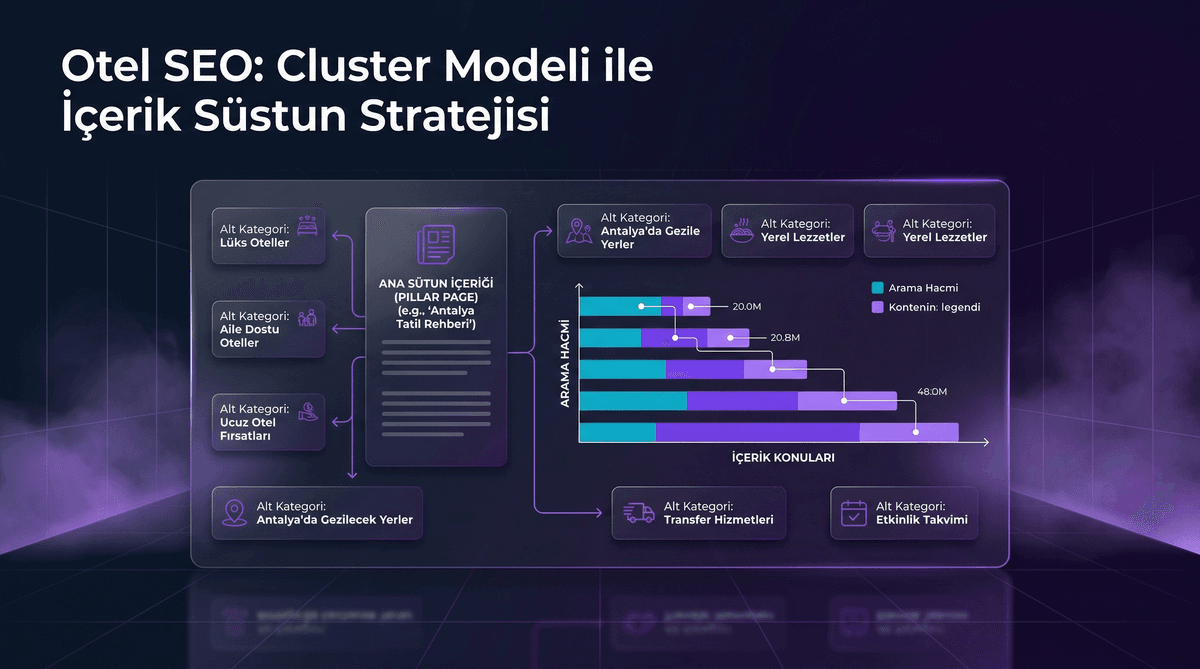
The topic cluster model consists of three components: pillar page, cluster content, and internal links.
Pillar Page: A comprehensive page, 2,000-5,000 words in length, that extensively covers a broad topic. This page touches upon all sub-topics and links to detailed cluster content for each sub-topic.
Cluster Content: Blog posts or guide pages, 800-1,500 words in length, that delve deeply into each sub-topic on the pillar page. Each piece of cluster content links back to the main pillar page and other related cluster content.
Internal Links: The reciprocal linking network between the pillar page and cluster content. These links facilitate user navigation and help search engine bots understand the site's structure.
An example cluster structure for a hotel:
Pillar Page: "Antalya Vacation Guide: Accommodation, Sightseeing, Dining, and Activities"
- Cluster 1: Antalya's Most Beautiful Beaches
- Cluster 2: Activities for Families in Antalya
- Cluster 3: Historic Tours in Kaleiçi
- Cluster 4: Antalya Gastronomy Guide
- Cluster 5: Transportation Options to Antalya
- Cluster 6: Seasonal Activities in Antalya
Designing Content Pillars for Hotel Websites
Each hotel should determine different pillar topics based on its location, target audience, and service structure. Here are common hotel pillar themes and how to structure them:
Pillar 1 — Destination Guide: A comprehensive guide to the region where your hotel is located. This pillar provides visibility for broad search queries like "Bodrum hotels." Cluster content: neighborhood guides, restaurant recommendations, beach comparisons, cultural events, transportation information.
Pillar 2 — Accommodation Experience: A detailed introduction to the experience your hotel offers. Cluster content: room type comparisons, spa and wellness services, restaurant menu presentations, special event venues, children's activities.
Pillar 3 — Travel Planning: Practical information potential guests seek before making an accommodation decision. Cluster content: best time to visit, budget planning guide, packing list, visa and travel requirements, airport transfer options.
Pillar 4 — Special Events: Wedding, meeting, conference, and celebration organizations. Cluster content: venue capacities, wedding packages, corporate meeting facilities, catering menus, technical equipment.
Each pillar page should link to all relevant cluster content. These links should be placed both in a "Related Content" section at the bottom of the pillar page and as natural references within the text.
Internal Linking Optimization
An internal linking strategy is a fundamental determinant of the topic cluster model's success. According to Ahrefs' analysis, pages with a strong internal linking structure receive 40% higher organic traffic compared to pages with a weak linking structure.
Anchor text diversity: Avoid repeatedly using the same phrase in link texts. Create a natural link profile by using variations such as "Antalya hotels," "accommodation options in Antalya," or "Antalya vacation hotels."
Contextual linking: Place links naturally within the flow of the text. Instead of generic phrases like "click here," use context-rich text such as "discover Antalya's most beautiful beaches."
Link depth: From each piece of cluster content, link back to the main pillar page and at least 2-3 related pieces of cluster content. The pillar page should also link to every piece of cluster content. This bidirectional linking structure optimizes "link equity" distribution.
Orphan page control: No page should remain an "orphan page" without any internal links. Identify orphan pages by checking "Indexed, not submitted in sitemap" pages in Google Search Console and integrate them with links.
Number of links: Using more than 100 internal links on a single page dilutes the SEO value of each link. An optimal range is 5-10 internal links for blog posts and 15-25 for pillar pages.
Related reading: Google Hotels Visibility Strategy
Content Production Schedule and Sustainability
The topic cluster strategy is a long-term commitment. To create a sustainable content production plan:
Initial Phase (Months 1-3): Create your first pillar page and 5-8 pieces of cluster content. Review your existing blog content and identify those that can be adapted to the cluster structure. Reorganizing existing content is more efficient than starting from scratch.
Expansion Phase (Months 4-6): Add a second pillar page and complete the first cluster's content to 12-15 pieces. During this stage, initial increases in organic traffic begin to appear.
Maturity Phase (Months 7-12): Reach 3-4 pillar pages, with 10-15 pieces of content in each cluster. Update existing content, and add new keyword opportunities.
Regular updates: Review each piece of content at least twice a year. Update outdated statistics, add links to new cluster content, and re-optimize underperforming content.
Content format diversification: Don't limit yourself to just blog posts; also use infographics, videos, interactive guides, comparison tables, and downloadable PDF formats. Diverse formats cater to different user preferences and provide visibility in various search results (image search, video search).
Measuring Success: Cluster Performance Metrics
To evaluate the effectiveness of the topic cluster strategy, track cluster-based metrics:
- Cluster organic traffic: Total organic traffic for the pillar page + all cluster content
- Keyword coverage: How many of your targeted keyword group rank in the top 10
- Internal link click-through rate: The percentage of clicks on links between cluster content
- Dwell time: Average time spent on cluster pages (target: 3 minutes+)
- Cluster conversion rate: Number of bookings or leads generated via cluster pages
- Topical authority score: Ahrefs or SEMrush's authority assessment for specific topics
Create custom filters in Google Search Console to monitor your cluster pages collectively. Filter all pages whose URLs contain the pillar topic to holistically evaluate cluster performance.
OtelCiro's digital sales platform supports your content strategy performance with competitor analysis and keyword opportunity detection, helping you continuously optimize your cluster model.
The content pillar strategy is an investment that requires patience, but in the long term, it is the most sustainable and scalable SEO approach. With a systematic architecture, consistent content production, and strategic internal links, you can permanently strengthen your hotel's digital authority.
![Europe's Hotel Construction Boom: 2026 Oversupply Risks [Market Analysis]](https://cdn.sanity.io/images/1la98t0z/production/6dfe59137f56aa14bfcba86d9db3cf05ff89f406-2752x1536.jpg?w=1920&q=50&auto=format&fit=max)