![Hotel Competition: Turkey vs. Southeast Asia [2026 Guide]](https://cdn.sanity.io/images/1la98t0z/production/dc5535e9bd61346ef785453610a878226340a3f6-1200x669.png?w=1920&q=65&auto=format&fit=max)
Key Takeaways
- Southeast Asia (Thailand, Vietnam, Indonesia, Malaysia, Philippines) is a rapidly growing competitor, attracting 185 million international tourists by 2026, a 34% growth in five years.
- SEA offers significantly lower average daily costs (36-55% less than Turkey), although flight costs from Europe are higher.
- Turkey's competitive advantages include geographic proximity to Europe, its perfected all-inclusive concept, rich cultural and historical sites, and strong MICE tourism infrastructure.
- SEA excels in price-value ratio, exotic experiences, advanced digital nomad infrastructure, and globally recognized wellness tourism.
- To compete, Turkey must redefine its value proposition, strengthen its winter tourism offerings, develop digital nomad-friendly infrastructure, and leverage AI for data-driven revenue management and hyper-personalization.
New Dynamics in Global Tourism Competition
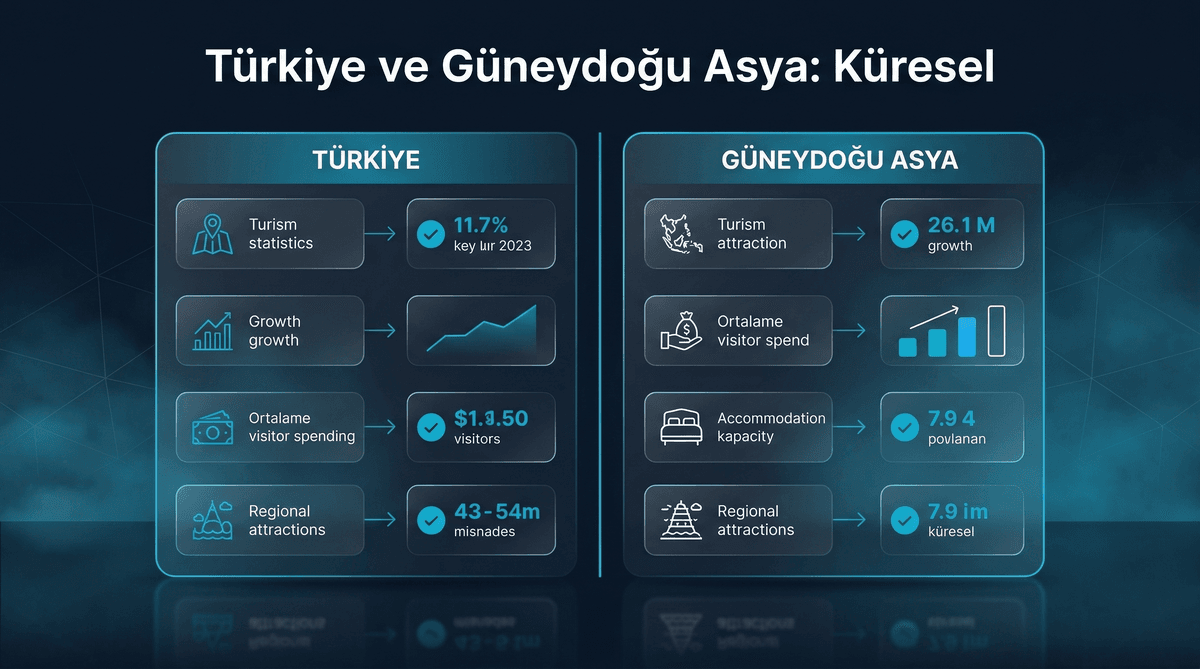
Southeast Asian countries — Thailand, Vietnam, Indonesia, Malaysia, and the Philippines — have rapidly increased their share of the global tourism market over the past five years, becoming serious competitors for all Mediterranean destinations, including Turkey. In 2026, the Southeast Asian region is projected to host a total of 185 million international tourists, up from 138 million in 2019 — a 34% growth in five years.
For Turkey, this competition is directly felt. Travelers, especially from Northern European countries, are increasingly opting for Thailand over Turkey for winter holidays. In search data for "winter sun" in the German, British, and Scandinavian markets, Thailand surpasses Turkey by 18%.
Embed this image on your site
<a href="https://otelciro.com/en/news/hotel-competition-turkey-vs-southeast-asia-2026-guide">
  <img src="https://cdn.sanity.io/images/1la98t0z/production/dc5535e9bd61346ef785453610a878226340a3f6-1200x669.png" alt="Güneydoğu Asya vs Türkiye Turizm Rekabeti İnfografiği" width="800" />
</a>
<p>Source: <a href="https://otelciro.com">OtelCiro</a> — AI Hotel Revenue Management</p>
Related reading: Global Traveler Profiles: Who's Going Where in 2026?
Price Comparison: What Do the Numbers Say?
Price is one of the most decisive factors in destination selection, and Southeast Asia holds a strong advantage in this area. Average daily costs for 2026 (accommodation + F&B + transportation):
| Expense Category | Turkey (Antalya) | Thailand (Phuket) | Vietnam (Da Nang) | Bali |
|---|---|---|---|---|
| 4-star hotel (ADR) | 142 $ | 95 $ | 68 $ | 85 $ |
| Daily F&B | 45 $ | 25 $ | 18 $ | 22 $ |
| Local transportation | 20 $ | 12 $ | 8 $ | 10 $ |
| Total daily cost | 207 $ | 132 $ | 94 $ | 117 $ |
| Difference (Turkey-based) | Base | -%36 | -%55 | -%43 |
These price differences are striking: a holiday in Vietnam can be nearly half the price of one in Turkey. However, price alone does not determine destination choice — accessibility costs (airfare), visa ease, and cultural affinity are also significant factors.
Flight Cost Balance
The cost of flights from Europe to Southeast Asia presents a significant disadvantage compared to Turkey:
- Europe → Turkey (average): 180-350 dollars (2-4 hour flight)
- Europe → Thailand (average): 450-750 dollars (10-12 hour flight)
- Europe → Bali (average): 550-900 dollars (14-16 hour flight)
When factoring in the flight cost difference, the total cost balance for a 7-night holiday changes: the difference between Turkey and Thailand narrows to 12%. For 14-night holidays, Southeast Asia regains its price advantage.
Areas of Competition and Comparative Advantages
Beyond price, a multi-dimensional competition analysis is essential:
Turkey's Strengths
Geographic proximity: 2-4 hour flight distance from Europe's main markets. This is a huge advantage for short breaks (3-5 days) and weekend getaways. Southeast Asia is only logical for minimum 7-day holidays.
All-inclusive concept: Antalya's perfected all-inclusive model eliminates price uncertainty. All-inclusive is not widespread in Southeast Asia — making Turkey attractive for budget-conscious families.
Cultural-historical richness: World heritage sites like Istanbul, Cappadocia, and Ephesus provide Turkey with a unique cultural tourism advantage. While Southeast Asia's temple and nature tourism is strong, Turkey's East-West synthesis is unique.
MICE and business tourism: Istanbul's conference and meeting tourism infrastructure is an area where Southeast Asia, outside of Singapore, cannot compete.
Southeast Asia's Strengths
Price-value ratio: A combination of low cost and high service quality. A 5-star resort experience in Thailand can be offered at the price of a 4-star hotel in Turkey.
Exotic experience: Tropical beaches, rainforests, and diving spots create a unique draw. The perception of "distant and different" is particularly strong for young travelers and digital nomads.
Digital infrastructure: Destinations like Bali and Chiang Mai are world leaders in digital nomad infrastructure. Co-working spaces, strong internet, and digital nomad visa programs are areas Turkey has yet to match.
Wellness tourism: Thai massage, Balinese spa culture, and yoga retreats possess global brand power.
Related reading: 2026 Travel Trends and the Impact of AI Assistants
Strategic Responses for Turkey
In this competitive environment, Turkish hoteliers must adopt the following strategies:
Redefining the Value Proposition
Instead of engaging in price competition, Turkey needs to strengthen its unique value proposition. Research shows that 67% of tourists who choose Turkey prioritize the combination of "easy access + quality service + cultural richness" over price.
Strengthening Winter Tourism
The winter months are when Southeast Asia is strongest against Turkey. To capitalize on this period:
- Promotion of thermal tourism packages to international markets
- Ski + culture combination holidays (e.g., Uludağ + Istanbul)
- Winter gastronomy festivals and event tourism
- Remote work programs (especially in Antalya and the Aegean region)
Developing Digital Nomad Infrastructure
To respond to Bali and Chiang Mai's dominance in the digital nomad market, Turkey needs to take concrete steps. According to 2026 data, there are 45 million digital nomads globally, and this number is growing by 22% annually. Turkey, currently attracting only 3% of this market, can increase this to 8-10% with infrastructure and marketing investments.
Competitive Advantage with Artificial Intelligence
Data-driven revenue management can provide a critical advantage in competing with Southeast Asia. By using AI-powered reporting tools to:
- Analyze source market-based price elasticity
- Monitor price movements of Southeast Asian destinations and implement proactive pricing
- Track traveler search trends in real-time to detect demand shifts early
- Create segment-based value propositions to avoid price competition
Future Scenarios
How will this competition evolve in the 2027-2030 period?
Scenario 1 — Status quo continues: Southeast Asia continues to increase its market share, while Turkey focuses on its near-European market. Result: Turkey loses market share in the long-stay segment but strengthens in the short-stay segment.
Scenario 2 — Turkey adapts: With rapid investments in digital nomad infrastructure, winter tourism, and wellness, Turkey becomes a viable alternative to Southeast Asia. Result: New customer segments are gained.
Scenario 3 — Differentiation with AI: Turkish hoteliers become pioneers in technology adoption, offering hyper-personalized experiences. Result: A shift from price competition to value competition.
The most likely scenario is a combination of all three. However, one thing is certain: global tourism competition is intensifying every year, and it will become increasingly difficult to survive this competition without data-driven decision-making mechanisms.
![Europe's Hotel Construction Boom: 2026 Oversupply Risks [Market Analysis]](https://cdn.sanity.io/images/1la98t0z/production/6dfe59137f56aa14bfcba86d9db3cf05ff89f406-2752x1536.jpg?w=1920&q=50&auto=format&fit=max)