![Hotel Blockchain: Crypto Payments & Smart Contracts [2026 Guide]](https://cdn.sanity.io/images/1la98t0z/production/22d50f012ad8523bd3d3d5233394fd7c8176b4bb-1376x768.jpg?w=1920&q=65&auto=format&fit=max)
Key Takeaways
- Blockchain in hospitality is nascent but promising; 40% of tourism CEOs expect significant impact within the next 5 years.
- Accepting crypto payments is the most practical immediate step, attracting new customer segments and potentially offering lower transaction fees, despite a current low adoption rate of 3-5%.
- Smart contracts offer mid-term potential to reduce OTA commissions, automate payments, and streamline cancellation policies, reducing disputes.
- Longer-term applications include token-based loyalty programs for enhanced flexibility and transparency, and self-sovereign identity for improved guest privacy and GDPR compliance.
- Hotels should strategically evaluate crypto payment integration, research token-based loyalty systems, and participate in industry consortiums to prepare for future blockchain innovations.
What Does Blockchain Promise for Hospitality?
As of 2026, blockchain technology is not yet widespread in the hospitality sector, but pilot applications are showing promising results. According to Deloitte's research, 40% of tourism CEOs believe blockchain will significantly impact the sector in the next 5 years. Chains like Pavilion Hotels & Resorts and The Kessler Collection already accept crypto payments, while projects like Winding Tree aim to redesign the hospitality supply chain via blockchain.
In this guide, we explore the current and potential uses of blockchain technology in the hospitality sector, along with its opportunities and risks, from a realistic perspective.

Embed this image on your site
<a href="https://otelciro.com/en/news/hotel-blockchain-crypto-payments-smart-contracts-2026-guide">
  <img src="https://cdn.sanity.io/images/1la98t0z/production/22d50f012ad8523bd3d3d5233394fd7c8176b4bb-1376x768.jpg" alt="Infographic on hospitality and blockchain technology use cases — payment, identity verification, loyalty, and smart contract applications" width="800" />
</a>
<p>Source: <a href="https://otelciro.com">OtelCiro</a> — AI Hotel Revenue Management</p>
Related reading: Gen Z Travel Habits: A Guide for Hotels
Blockchain Use Cases
1. Accepting Crypto Payments
Enabling hotel payments with Bitcoin, Ethereum, and stablecoins:
| Advantage | Disadvantage |
|---|---|
| New customer segment (crypto-holding travelers) | Price volatility risk |
| Low transaction fees (especially international) | Regulatory uncertainty |
| Fast international payments | Low guest adoption rate (3-5%) |
| PR and brand value | Accounting complexity |
Implementation: Crypto payments can be added to your existing PMS system via BitPay, Coinbase Commerce, or custom integration. Stablecoins (USDT, USDC) eliminate volatility risk.
2. Smart Contracts
Automated contracts running on the blockchain can eliminate intermediaries:
- Reduce OTA commissions: Direct, conditional booking contracts between the hotel and guest
- Automated payment: Automatic payment at check-out if conditions are met
- Cancellation policy: Pre-coded cancellation conditions, zero dispute risk
- Supplier payments: Trigger automatic payment when service is delivered
3. Loyalty Token System
Transforming traditional points-based loyalty programs with blockchain:
- Token-based points: Guests earn tokens for stays, spending, and referrals
- Transferable: Tokens can be sent to others or sold on a marketplace
- Multiple uses: Spend the same token at hotels, restaurants, spas, partner businesses
- Transparency: Point balance and earning rules visible on the blockchain
4. Identity Verification and Privacy
With the concept of self-sovereign identity (SSI):
- Guest verifies identity information once on the blockchain
- No need to re-present ID at every hotel
- Personal data remains under guest control
- KVKK/GDPR compliance is naturally ensured
5. Supply Chain Transparency
Tracking the hotel's supply chain with blockchain:
- Traceability of food sources (farm to table)
- Tracking laundry service quality
- Supplier performance history
- Verification of sustainability certifications
Embed this image on your site
<a href="https://otelciro.com/en/news/hotel-blockchain-crypto-payments-smart-contracts-2026-guide">
  <img src="https://cdn.sanity.io/images/1la98t0z/production/81bc7a877e8a45c5e6bf4db244cf9b8cb0d343dd-1200x669.png" alt="Hotel technology infrastructure essential tools" width="800" />
</a>
<p>Source: <a href="https://otelciro.com">OtelCiro</a> — AI Hotel Revenue Management</p>
Adoption Status: The 2026 Reality
| Use Case | Maturity | Adoption Rate | Timeframe |
|---|---|---|---|
| Crypto payments | Early adoption | 5% | Implementable now |
| Smart contracts | Pilot | 1% | 2-3 years |
| Loyalty tokens | Pilot | 2% | 1-2 years |
| Identity verification | Experimental | 0.5% | 3-5 years |
| Supply chain | Experimental | 0.5% | 3-5 years |
Why is Adoption Slow?
- Technological complexity: Blockchain integration requires expertise
- Regulatory uncertainty: Crypto payment regulations vary by country
- Scaling issues: Existing blockchain networks can slow down with high transaction volumes
- User experience: Complex interfaces for the end-user
- Cost: High initial integration cost
Related reading: Climate Change and Hotels: Adaptation Strategies 2026
Practical Recommendations for Hoteliers
What can be done today:
- Evaluate accepting crypto payments (simple integration with BitPay)
- Research transitioning your loyalty program to a token-based system
- Add blockchain to your strategic plan
Plan for the mid-term:
- Research technology partners for smart contract pilot projects
- Follow blockchain-based identity verification standards
- Join industry consortiums (Winding Tree, HTng)
Things to be cautious about:
- Don't view blockchain as the solution to everything
- Don't invest if it doesn't solve an existing problem
- Closely monitor legal regulations (especially crypto payment regulations in Turkey)
Embed this image on your site
<a href="https://otelciro.com/en/news/hotel-blockchain-crypto-payments-smart-contracts-2026-guide">
  <img src="https://cdn.sanity.io/images/1la98t0z/production/d36123c644ddc3c115453411f9a55397cf34970b-1200x2150.png" alt="AI-powered revenue management platform architecture" width="800" />
</a>
<p>Source: <a href="https://otelciro.com">OtelCiro</a> — AI Hotel Revenue Management</p>
Preparing for the Future with OtelCiro
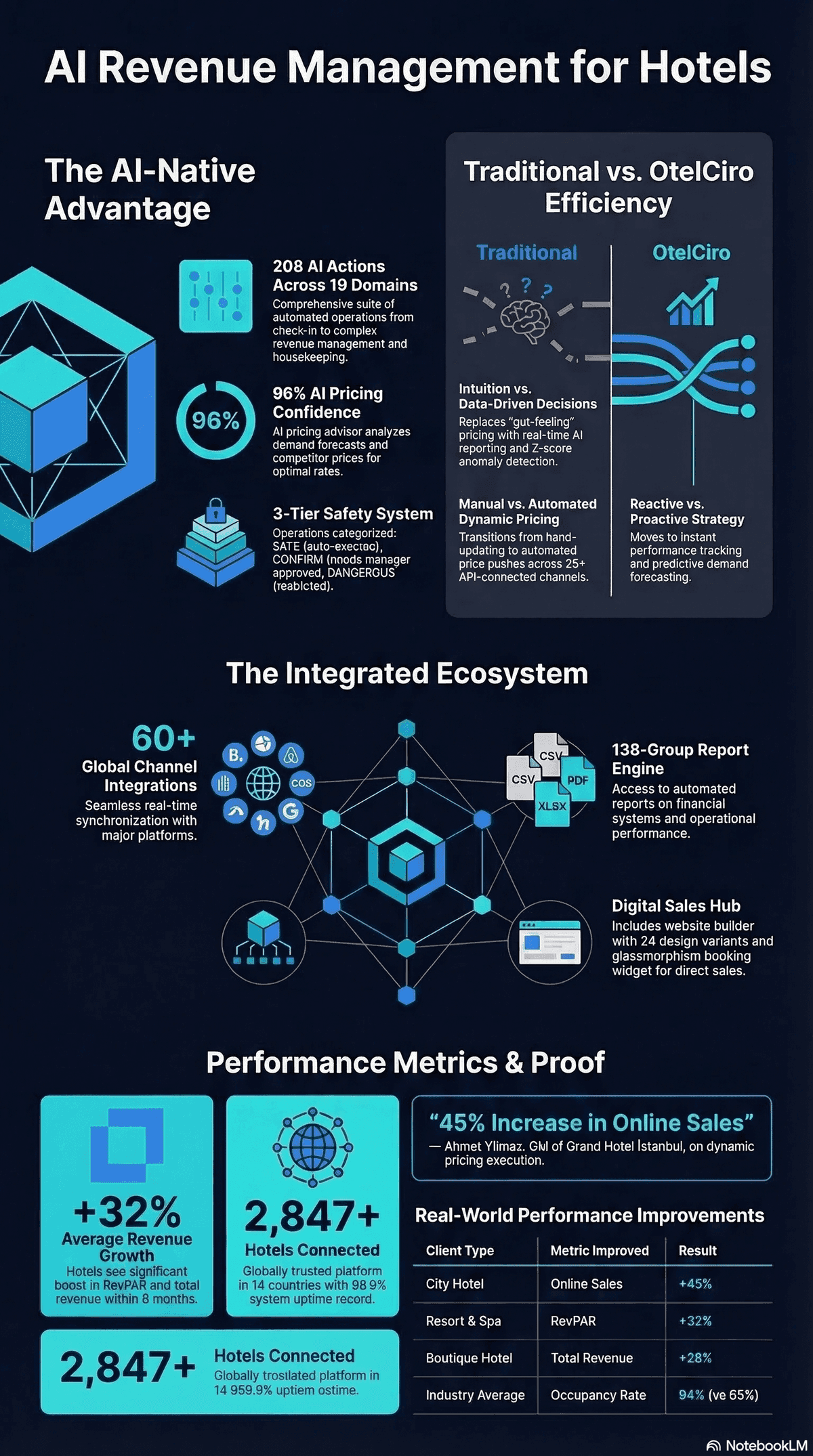
OtelCiro Smart PMS is ready for blockchain integrations with its open API architecture:
- Payment gateway integration: Connectivity with crypto payment providers
- API openness: Seamless integration with future blockchain applications
- Data structure: Structured data architecture, suitable for data sharing with blockchain
You can evaluate the place of blockchain among 2026 tourism technology trends from a broader perspective.
Related reading: Inflation and Hotels: Protecting Profitability Amidst Rising Costs
Conclusion
Blockchain has not yet created a revolutionary change in hospitality — but its potential is significant. Accepting crypto payments is the most practical step that can be taken today. Smart contracts and loyalty tokens will transform the sector in the mid-term, while identity verification and supply chain applications will do so in the long-term. The key strategy: Prepare today, be an early adopter tomorrow.
With OtelCiro's Smart PMS, you can have an infrastructure ready for future technology integrations and adapt to the blockchain revolution without delay.

![Europe's Hotel Construction Boom: 2026 Oversupply Risks [Market Analysis]](https://cdn.sanity.io/images/1la98t0z/production/6dfe59137f56aa14bfcba86d9db3cf05ff89f406-2752x1536.jpg?w=1920&q=50&auto=format&fit=max)