![Hotel Appliance Lifecycle Management [2026 Guide]](https://cdn.sanity.io/images/1la98t0z/production/19f1ff1276d7eb7aef097f81cb07cd6958e0dbb1-1200x669.png?w=1920&q=65&auto=format&fit=max)
Key Takeaways
- Significant Budget Item: Hotel appliances represent a hidden but substantial budget item, easily exceeding 3-5 million TL for a 200-room hotel.
- Total Cost of Ownership (TCO) Focus: Prioritize TCO over initial purchase price. Energy (30-40% of TCO) and maintenance (15-25% of TCO) are major cost drivers.
- Proactive Management Benefits: Implement a proactive lifecycle management strategy to reduce operational disruptions by 70% and cut total ownership costs by 20-30%.
- Data-Driven Decisions: Utilize a "50% Rule" for repair vs. replace decisions and leverage digital inventory management for real-time tracking, maintenance scheduling, and cost analysis.
- Strategic Imperative: Investing in energy-efficient appliances and systematic lifecycle management is a financial necessity, not a luxury, especially with rising energy costs in 2026.
Hotel Appliances: Invisible Yet Enormous Budget Item
The number of appliances in a hotel's technical inventory is surprisingly high. A 200-room resort hotel typically houses 50-80 minibars, 15-25 washing machines, 10-15 dryers, 20-30 dishwashers, 40-60 outdoor air conditioning units, and hundreds of small kitchen appliances. The total value of this inventory can easily exceed 3-5 million TL.
The most common mistake in appliance management is a reactive approach: a device breaks down, it's urgently repaired or replaced. This approach not only increases unit costs but also leads to operational disruptions. An unplanned washing machine breakdown can slow laundry operations by 30% during peak season; a malfunctioning walk-in cooler can result in thousands of liras in food spoilage.
Embed this image on your site
<a href="https://otelciro.com/en/news/hotel-appliance-lifecycle-management-2026-guide">
  <img src="https://cdn.sanity.io/images/1la98t0z/production/19f1ff1276d7eb7aef097f81cb07cd6958e0dbb1-1200x669.png" alt="Hotel Appliance Lifecycle Management Infographic" width="800" />
</a>
<p>Source: <a href="https://otelciro.com">OtelCiro</a> — AI Hotel Revenue Management</p>
Related reading: Automation in Hotel Operations: Digitizing Business Processes
Total Cost of Ownership: Purchase Price Is Misleading
The most frequent error in appliance purchasing decisions is focusing solely on the purchase price. Total Cost of Ownership (TCO) comprises the following components:
- Purchase cost: Initial investment amount. Typically 25-35% of the total cost.
- Energy cost: Electricity and water consumed by the device over its lifespan. 30-40% of the total cost.
- Maintenance cost: Periodic maintenance, spare parts, and service fees. 15-25% of the total cost.
- Operational loss: Lost productivity and alternative solution costs during downtime due to malfunctions. 5-15% of the total cost.
- Disposal cost: Removal and proper disposal of the end-of-life device.
Example: An A-class energy-efficient industrial washing machine may be 40% more expensive than a C-class model. However, over its 7-year lifespan, energy savings offset the price difference by the 2nd year and provide a 22% advantage in total TCO.
Lifecycle Stages and Management Strategies
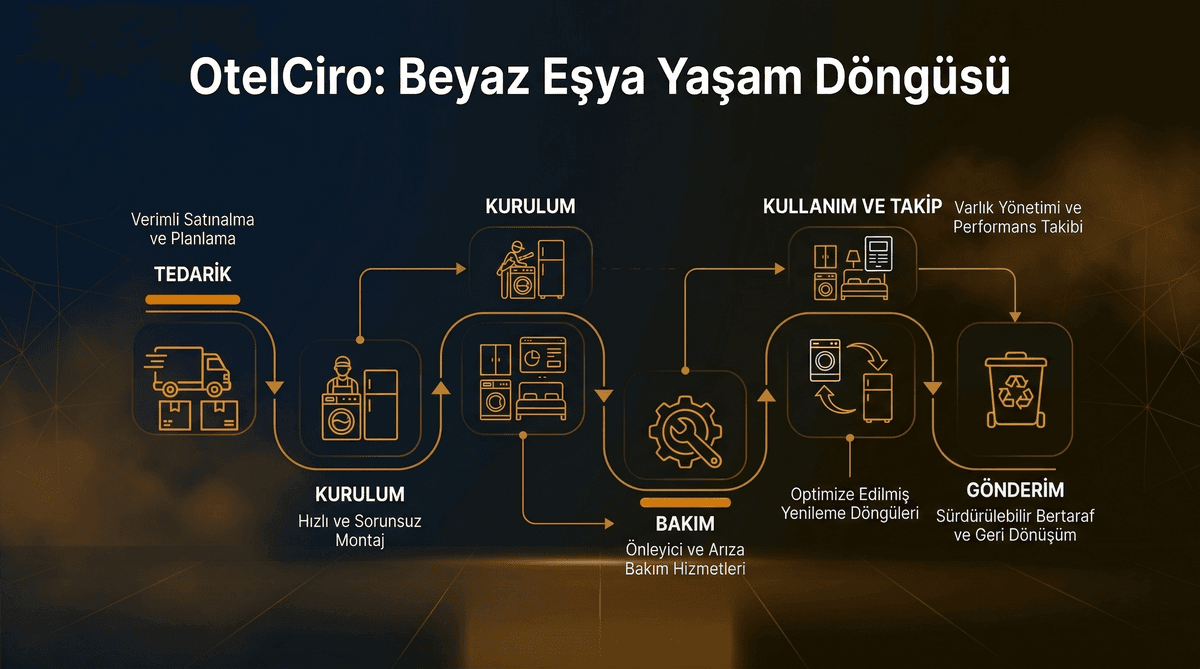
Stage 1: Purchase and Commissioning (0-6 Months)
Correct device selection is the most critical decision in the lifecycle:
- Capacity planning: Sizing should be based on hotel occupancy rates and peak period demand. An oversized device means energy waste, while an undersized one leads to excessive wear.
- Energy class: A minimum of A-class should be preferred according to EU energy labeling. Energy consumption in hotels is 5-10 times higher than in household use.
- Industrial vs. consumer model: Industrial models are mandatory for high-usage areas like kitchens and laundries. Household devices fail within an average of 18 months in these environments.
- Service network: The vendor's regional service capacity and spare part availability should be a primary purchasing criterion.
Stage 2: Efficient Use Period (6 Months - 5 Years)
During this period, devices operate at their design performance. To maintain efficiency:
- Periodic maintenance schedule: Manufacturer-recommended maintenance intervals must be strictly followed. Filter cleaning, seal checks, and descaling are essential maintenance items.
- Usage training: Staff must be trained on device usage. Incorrect program selection, overloading, and inappropriate detergent use shorten lifespan by 30-40%.
- Performance monitoring: Energy consumption and operating hours should be regularly recorded, and deviations from baseline values monitored.
Stage 3: Wear Period (5-8 Years)
Device performance begins to decline, and malfunction frequency increases:
- Energy consumption increases by 15-30% compared to a new model.
- Spare part replacement frequency increases 2-3 times per year.
- Downtime extends due to longer procurement times for older model parts.
At this stage, a decision must be made: repair and continue, or replace.
Related reading: Hotel IoT and Smart Room Technologies
Repair or Replace? Decision Matrix
This decision is the most challenging aspect of appliance management. The following formula provides an objective framework:
50% Rule: If the repair cost exceeds 50% of the device's current market value, replacement is more economical.
Additional evaluation criteria:
- Is the device older than 75% of its expected lifespan?
- Has it experienced more than 3 malfunctions in the last 12 months?
- Do new models offer more than 20% energy savings?
- Does the spare part delivery time exceed 72 hours?
If 3 or more of these criteria are "yes," a replacement decision should be made. 62% of hotels in Turkey do not use such a systematic decision mechanism, opting instead for instantaneous cost comparison.
Inventory Tracking and Digital Management
Manually tracking the maintenance schedule, warranty periods, malfunction history, and lifecycle stage of hundreds of devices is practically impossible. Digital inventory management should include the following components:
- Asset registration: Serial number, purchase date, warranty expiration date, location, and responsible personnel information for each device are recorded.
- Maintenance history: Every maintenance and malfunction intervention is recorded with date, cost, and details of the work performed.
- Automatic reminders: Notifications are sent to relevant personnel when periodic maintenance is due.
- Cost analysis: The cumulative cost (purchase + energy + maintenance + malfunction) of each device is calculated in real-time, and replacement thresholds are monitored.
- Bulk purchase planning: Devices nearing replacement are grouped to take advantage of bulk purchasing.
With the OtelCiro operations management module, appliance inventory can be tracked digitally, maintenance reminders automated, and lifecycle cost reports generated.
Conclusion: Planned Management Prevents Unplanned Costs
Appliance lifecycle management is the most effective way to control a hotel's technical infrastructure budget. TCO-based purchasing, a disciplined maintenance program, data-driven replacement decisions, and digital inventory tracking — when these four components are applied together, appliance-related operational disruptions decrease by 70%, and total cost of ownership falls by 20-30%.
In an environment where energy costs are continuously rising in 2026, investing in energy-efficient devices and systematic lifecycle management is no longer an operational luxury but a financial necessity.
![Europe's Hotel Construction Boom: 2026 Oversupply Risks [Market Analysis]](https://cdn.sanity.io/images/1la98t0z/production/6dfe59137f56aa14bfcba86d9db3cf05ff89f406-2752x1536.jpg?w=1920&q=50&auto=format&fit=max)