![Hotel API Integration: Modern Management Foundation [2026 Guide]](https://cdn.sanity.io/images/1la98t0z/production/46982eee55bf4225dd55170e11b536c3dcd9b3f4-1200x669.png?w=1920&q=65&auto=format&fit=max)
Key Takeaways
- Disconnected hotel systems lead to operational chaos and a loss of 8-12% of potential revenue.
- API integration is fundamental for modern hotel management, enabling real-time data exchange across critical systems like PMS, channel managers, and booking engines.
- Successful API integrations prioritize real-time synchronization (within 2 minutes), robust error management, data validation, strong security, and scalability.
- Emerging standards like MCP (Model Context Protocol) are paving the way for deeper AI integration and structured data access in future hotel systems.
- When selecting new hotel software, prioritize its integration capabilities as much as, or even more than, its standalone features.
The Problem of Disconnected Systems
An average hotel uses 6-10 different software systems for daily operations: PMS, channel manager, booking engine, POS, CRM, accounting, housekeeping, payment system, and more. If these systems are not connected, data silos emerge, and operational chaos is inevitable.
According to h2c Global's research, hotels lose 8-12% of their revenue potential due to lack of integration. This loss stems from delays in price updates, double bookings, data inconsistencies, and manual workload.
API (Application Programming Interface) integration is the technology that solves this problem. The foundation of modern hotel management is the instant and automatic sharing of data between systems.
Embed this image on your site
<a href="https://otelciro.com/en/news/hotel-api-integration-modern-management-foundation-2026-guide">
  <img src="https://cdn.sanity.io/images/1la98t0z/production/46982eee55bf4225dd55170e11b536c3dcd9b3f4-1200x669.png" alt="Hotel API integration diagram" width="800" />
</a>
<p>Source: <a href="https://otelciro.com">OtelCiro</a> — AI Hotel Revenue Management</p>
Related reading: Smart PMS for Hotel Management: Transitioning from Traditional Systems to AI-Powered Platforms
Related reading: Hotel AI Email Automation: Personalized Communication
What is API and Why is it Important in Hospitality?
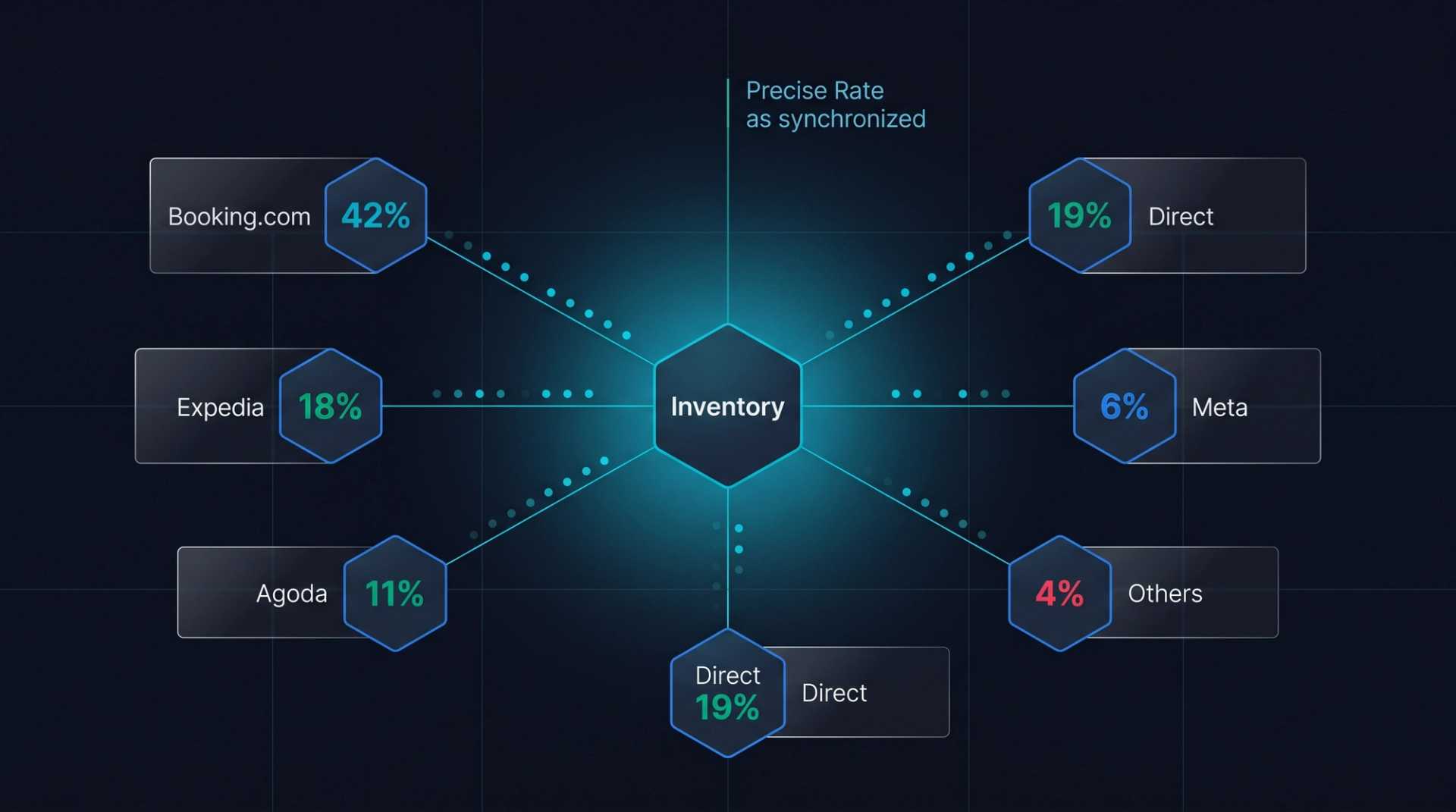
An API is an interface that allows different software systems to communicate with each other. To use a technical analogy: an API is the "translator" between two systems. The PMS notifies the channel manager via API that a room has been sold, and the channel manager updates inventory across all OTAs.
What Happens Without an API?
- Manual data entry: Each system must be updated separately (time-consuming, high error risk).
- Overbooking: Inventory synchronization delays lead to double bookings.
- Price inconsistencies: Channel prices diverge, causing parity violations.
- Reporting difficulties: Data must be manually consolidated for unified reports.
- Degraded guest experience: Service quality decreases due to disrupted information flow.
Embed this image on your site
<a href="https://otelciro.com/en/news/hotel-api-integration-modern-management-foundation-2026-guide">
  <img src="https://cdn.sanity.io/images/1la98t0z/production/81bc7a877e8a45c5e6bf4db244cf9b8cb0d343dd-1200x669.png" alt="Hotel technology infrastructure essential tools" width="800" />
</a>
<p>Source: <a href="https://otelciro.com">OtelCiro</a> — AI Hotel Revenue Management</p>
API Connection Points in the Hotel Ecosystem
Central System: PMS
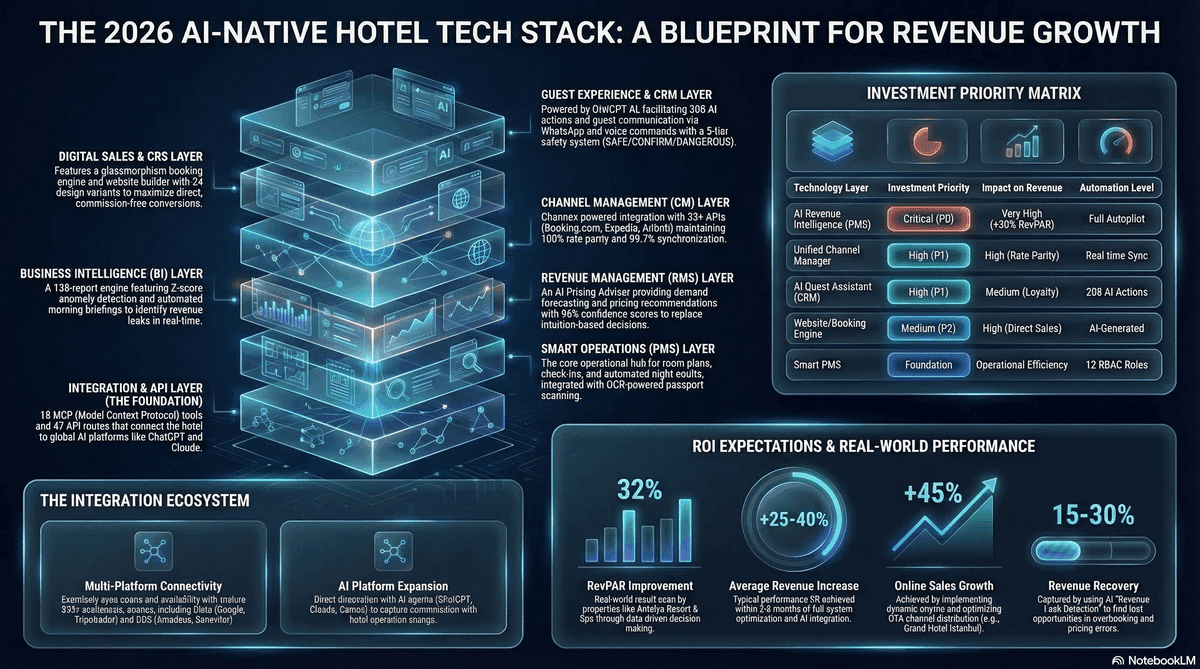
The PMS (Property Management System) is the heart of the hotel ecosystem. All other systems connect to the PMS:
| Connection | Data Flow | Criticality |
|---|---|---|
| PMS ↔ Channel Manager | Inventory, prices, restrictions | Critical |
| PMS ↔ Booking Engine | Availability, prices, reservations | Critical |
| PMS ↔ POS (Restaurant) | Guest account, sales data | High |
| PMS ↔ CRM | Guest profile, preferences | High |
| PMS ↔ Housekeeping | Room status, check-in/out | High |
| PMS ↔ Accounting | Revenue, expenses, invoicing | Medium |
| PMS ↔ RMS | Occupancy, pace, pricing recommendations | High |
| PMS ↔ Payment System | Transaction validation, PCI compliance | Critical |
API Types
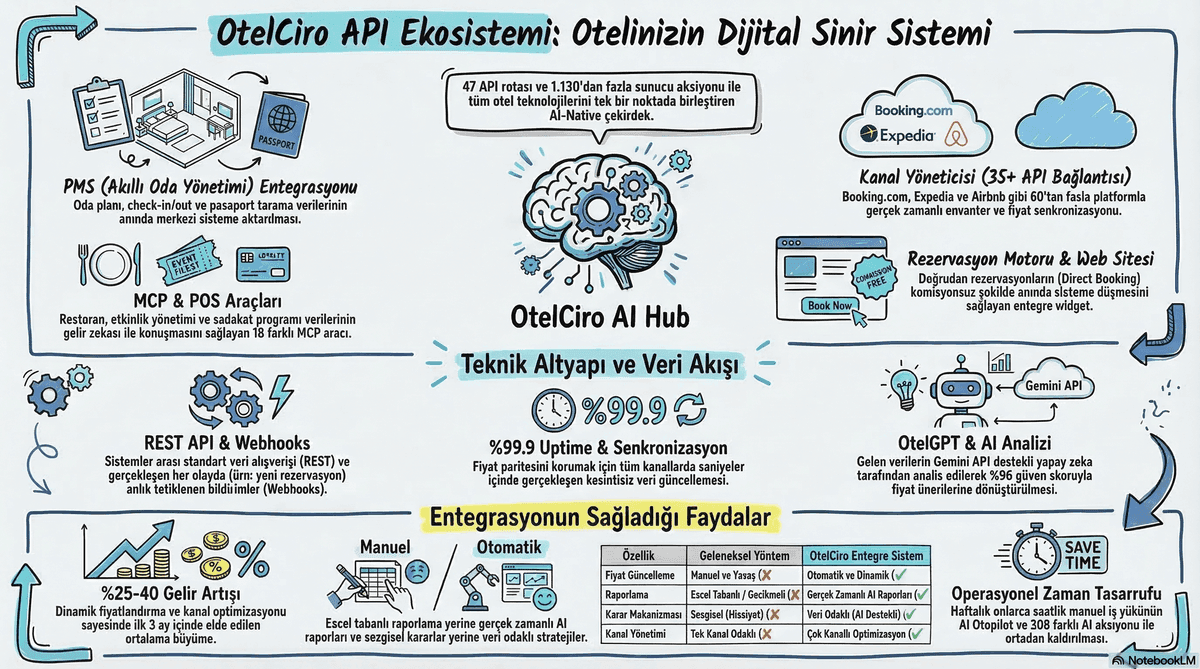
REST API: The most common API type. Exchanges data in JSON format over the HTTP protocol. It is easy to use and a widely supported standard.
SOAP/XML: An older generation API standard. GDS connections and some legacy PMS systems still use SOAP.
Webhooks: An event-based notification mechanism. When a new reservation comes in or is canceled, it sends instant notifications to the relevant systems. It is more efficient as it uses a push approach instead of polling.
GraphQL: A newer API approach. The client can request exactly the data it needs, avoiding unnecessary data transfer.
Related reading: E-Invoicing and Digital Accounting in Hotels: GIB Integration Guide (2026)
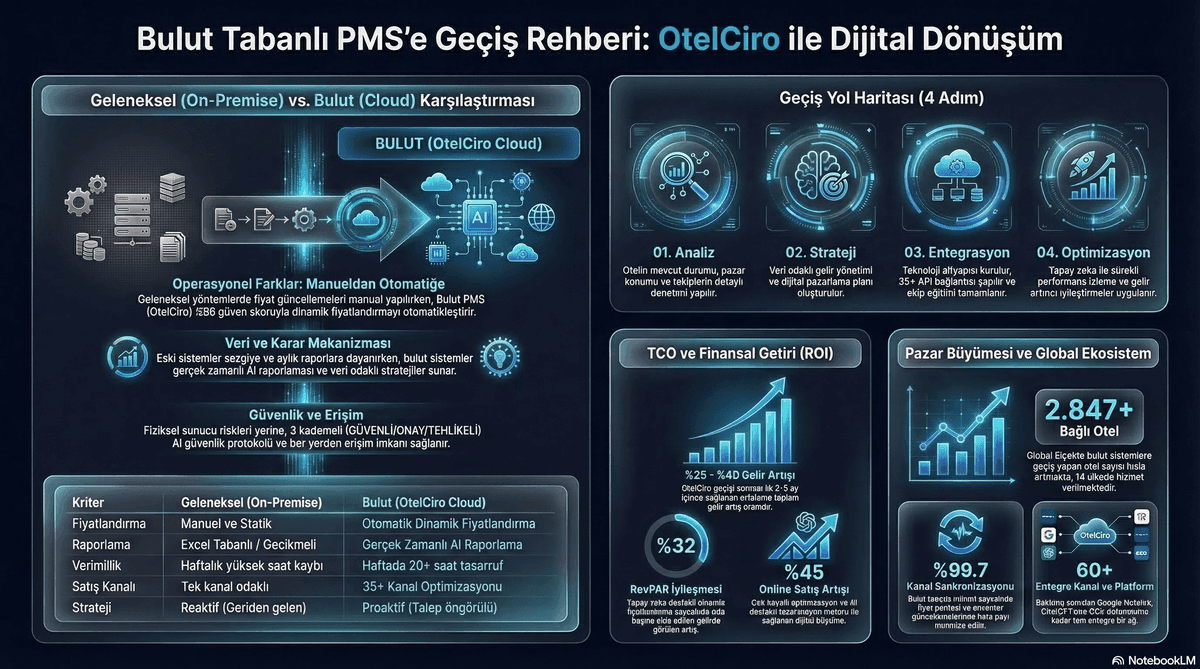
Related reading: Cloud-Based PMS: A Guide to Transitioning from On-Premise to Cloud
API Integration Success Criteria
1. Real-Time Synchronization
Price or inventory changes should reflect in all connected systems within 2 minutes. Longer delays create overbooking risks.
2. Error Management
What happens when an API connection breaks? A robust integration automatically detects connection outages, implements retry mechanisms, and alerts the administrator.
3. Data Validation
The accuracy of data transferred between systems must be checked. Incorrect price transmission or erroneous inventory updates can lead to operational crises.
4. Security
Hotel data contains sensitive information (personal data, credit card details). API connections must:
- Use SSL/TLS encryption
- Authenticate with API keys or OAuth 2.0
- Be PCI-DSS compliant
- Maintain data access logs
5. Scalability
During peak season, API request volume can increase by 5-10 times. The integration should operate without performance degradation during these peak periods.
Embed this image on your site
<a href="https://otelciro.com/en/news/hotel-api-integration-modern-management-foundation-2026-guide">
  <img src="https://cdn.sanity.io/images/1la98t0z/production/e7bafa9293f887b24a2d4d0d26684221705d0113-1200x669.png" alt="Cloud-based PMS advantages and comparison" width="800" />
</a>
<p>Source: <a href="https://otelciro.com">OtelCiro</a> — AI Hotel Revenue Management</p>
Considerations During the Integration Process
Review API documentation: Before starting integration, thoroughly read the API documentation of the system to be connected. Limitations, rate limits, and data format requirements are crucial.
Test in a sandbox environment: Validate all scenarios in a test environment before connecting to the live system.
Set up monitoring: Continuously monitor API response times, error rates, and data flow volume.
Create a backup plan: You should have a plan to switch to manual operations if the API connection is lost.
MCP (Model Context Protocol) and Future Integration
Beyond traditional APIs, new standards like MCP (Model Context Protocol) are emerging in the 2025-2026 period. MCP is a protocol that allows AI systems to securely and structuredly access hotel data.
MCP technology enables AI-powered hotel management systems to integrate seamlessly with multiple data sources. This means that in the future, hotel systems will be integrated much more deeply with AI assistants.
Related reading: Housekeeping Automation: 7 Steps to Digitalize Hotel Operations
OtelCiro Integration Ecosystem
OtelCiro seamlessly connects to all hotel systems with its modern API infrastructure. With REST API, webhooks, and MCP support, it easily integrates into your existing technology stack.
Strengthen your integration infrastructure with OtelCiro MCP
Conclusion
API integration is indispensable for modern hotel management. Disconnected systems create operational inefficiency, revenue loss, and a degraded guest experience.
When choosing new software, your first question should not be "what are its features?" but "which systems does it integrate with?". The quality of integration is far more determining than the standalone quality of the software.
Discover how OtelCiro can automate this process with MCP.
![Europe's Hotel Construction Boom: 2026 Oversupply Risks [Market Analysis]](https://cdn.sanity.io/images/1la98t0z/production/6dfe59137f56aa14bfcba86d9db3cf05ff89f406-2752x1536.jpg?w=1920&q=50&auto=format&fit=max)