Key Takeaways
- Google's 2026 Vacation Rentals expansion integrates short-term rentals into search results, creating a $320B market directly competing with hotels.
- Hotels face threats like price perception disadvantage, 25-30% search result sharing, and losing long-stay guests to vacation rentals.
- Opportunities exist by leveraging hotel advantages: brand trust (4.3 vs 4.1 average reviews), 24/7 service, professional amenities, and the robust corporate segment.
- Implement competitive strategies: optimize Google Business Profile (50+ professional photos), activate Google Hotel Free Booking Links, use Schema.org markup (35-45% CTR increase), and create value-driven content.
- Long-term adaptation involves developing hybrid accommodation models, such as apart-hotels, and listing hotel suites on vacation rental platforms to capture new market segments.
What is Google Vacation Rentals and Why Is It Trending?
Google, with its Vacation Rentals platform launched in 2024 and expanded to full capacity by 2026, has fundamentally changed the playing field in the accommodation sector. Now, alongside hotels, apartments, villas, summer houses, and short-term rental properties appear on the same Google search results page. This situation presents both a significant threat and a unique opportunity for the traditional hospitality industry.
The figures underscore the seriousness of the situation. The alternative accommodation market reached $320 billion globally in 2026 — accounting for approximately 45% of the traditional hotel market. In Turkey, the number of short-term rental accommodations has increased by 120% in the last 3 years. Google's integration of this growing market into its platform directly impacts hotels' visibility and market share.
While Google Vacation Rentals has the potential to break the monopoly of platforms like Airbnb and VRBO, it also pushes hotels into a broader competitive environment. Now, when a family searches for "accommodation in Antalya," a 5-star hotel and a 3-bedroom villa on the beachfront are compared on the same screen.
The Threat: Risks Hotels Face
The threats posed by Google Vacation Rentals to the hotel sector are concrete and measurable.
Price Perception Disadvantage: Vacation rentals, especially for family and group travel, appear much more advantageous per person compared to hotels. For a family of 4, a hotel room might cost 3,000 TL per night, while a similar 2-bedroom apartment in the same location can be offered for 2,000 TL — with the added benefit of a kitchen. Google's comparative display ruthlessly highlights this difference.
Search Result Sharing: Vacation rental results are now shown in 25-30% of hotel searches on Google. This means sharing organic traffic. A hotel now competes not only with other hotels for the same keyword but also with hundreds of vacation rentals.
Loss of Long-Stay Segment: With the widespread adoption of remote work, vacation rentals are overwhelmingly preferred for stays of 7 days or more. This segment leads to an estimated 8-12% annual revenue loss for the hotel industry.
Shifting Experience Expectations: Vacation rentals offer the promise of "living like a local." This creates a strong appeal, especially among Generation Z and young millennials. Hotels face a perception of being standard and sterile.
Related reading: The Billboard Effect: OTAs' Hidden Advantage
The Opportunity: Hotels' Advantage Areas
It is as important to see the opportunity side as it is to analyze the threats. The new dynamics created by Google Vacation Rentals can be turned in favor of hotels with the right strategy.
Trust and Security Advantage: The problem of "photos not reflecting reality" in vacation rentals negatively impacts 34% of guests. Hotels can capitalize on this trust gap with brand assurance, standardized quality, and 24/7 reception service. While vacation rentals average 4.1 in Google reviews, hotels are at 4.3 — this difference should be emphasized.
Professional Service Differentiation: Hotel services such as room service, pool, fitness, spa, concierge, laundry, and daily housekeeping are not available in vacation rentals. Effectively highlighting these services in your Google Business Profile can attract undecided guests to your hotel.
Hybrid Model Opportunity: Some innovative hotels have begun to capture market share from both segments by offering vacation rental-style suites or aparthotel concepts. You can gain an additional distribution channel by listing your hotel suites on Google Vacation Rentals.
Corporate Segment Protection: Vacation rentals are still not a strong alternative in the business travel segment. Invoicing, meeting rooms, business centers, and corporate agreement opportunities remain in the hands of hotels. This segment constitutes 30-40% of total hotel revenue.
Strategies for Competitive Positioning on Google
Appearing in the same search results as Google Vacation Rentals is inevitable. The important thing is to stand out in this competition. Here are the strategies to implement:
Google Business Profile Optimization: Fully complete your hotel's Google Business Profile. Over 50 professional photos, a virtual tour, up-to-date prices, detailed descriptions of all services and amenities, regular post sharing, and comment replies — all directly impact Google's ranking algorithm.
Google Hotel Free Booking Links: Activate Google's free booking links. This feature allows you to receive direct bookings through Google without paying OTA commissions. Vacation rentals are usually listed through Airbnb or Booking.com and pay commissions — your direct link provides an advantage here.
Rich Results and Structured Data: Implement Schema.org Hotel markup completely on your hotel website. Ensure that price, availability, review scores, amenities, and photos appear as rich snippets in search results. This increases the click-through rate by 35-45%.
Value-Driven Content: Produce blog content for comparative keywords like "hotel or villa in Antalya?" Content that objectively and persuasively explains the advantages of hotel accommodation guides guests in their decision-making process.
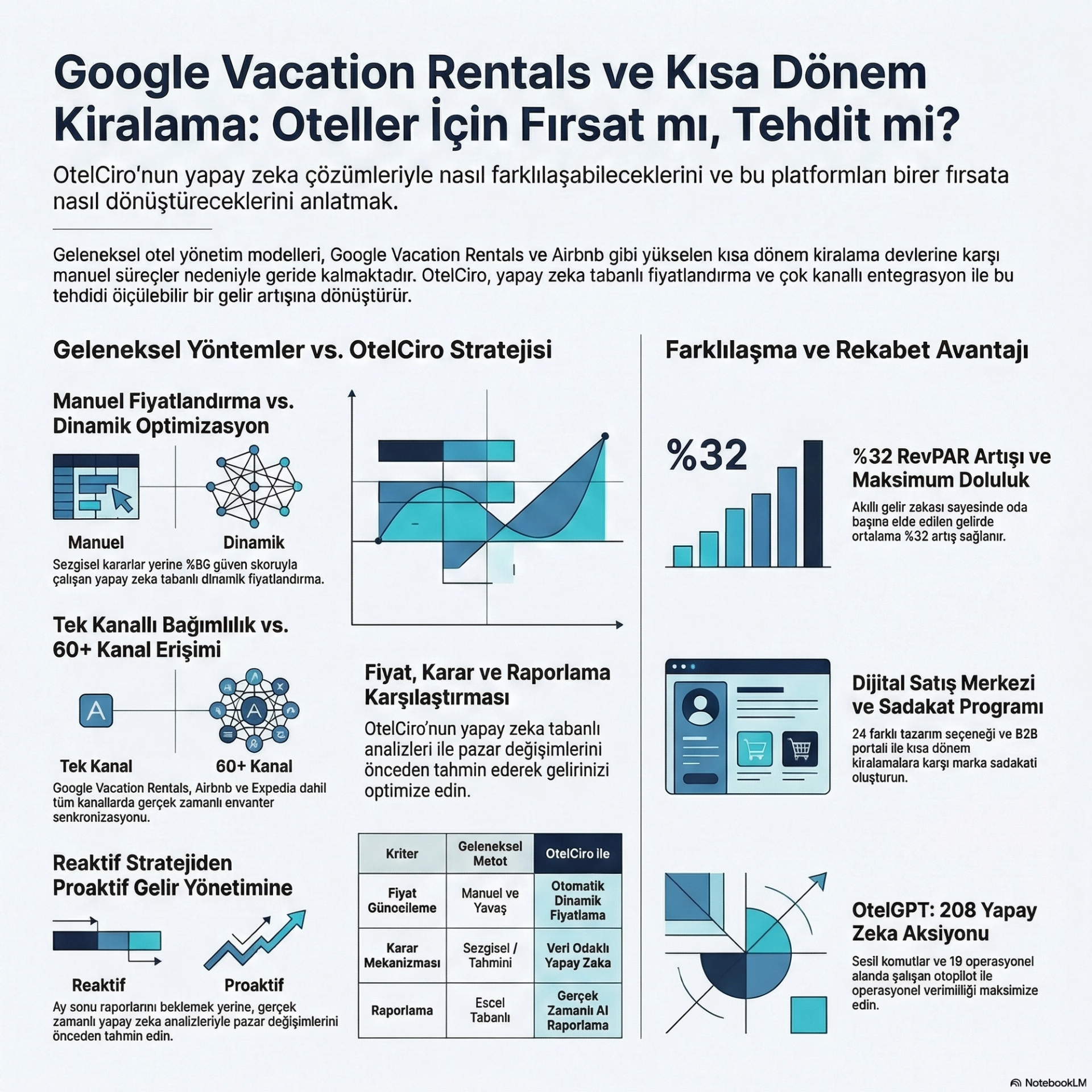
OtelCiro's sales ecosystem allows you to manage your visibility across Google channels and optimize all your distribution channels from a single platform.
Long-Term Adaptation: Hybrid Models
The strongest long-term strategy against the vacation rental threat is to develop hybrid accommodation models. Globally, the fastest-growing hotel segment is the aparthotel concept — leading with an 18% annual growth rate in 2026.
By adding suites with kitchens, long-stay rooms, or serviced apartment units to your existing hotel inventory, you can capture a share of the vacation rental market. These units can be listed on both Google Vacation Rentals and traditional hotel channels.
Airbnb and Booking.com offer special programs that allow hotels to make vacation rental-style listings. Participating in these programs enables you to reach a new customer segment.
In conclusion, Google Vacation Rentals is not a disruptive threat but an evolutionary change for the hotel industry. Hotels that understand their strengths, compensate for their weaknesses, and capitalize on new opportunities will profit from this change. The key is to act with strategy, not panic.

![Europe's Hotel Construction Boom: 2026 Oversupply Risks [Market Analysis]](https://cdn.sanity.io/images/1la98t0z/production/6dfe59137f56aa14bfcba86d9db3cf05ff89f406-2752x1536.jpg?w=1920&q=50&auto=format&fit=max)