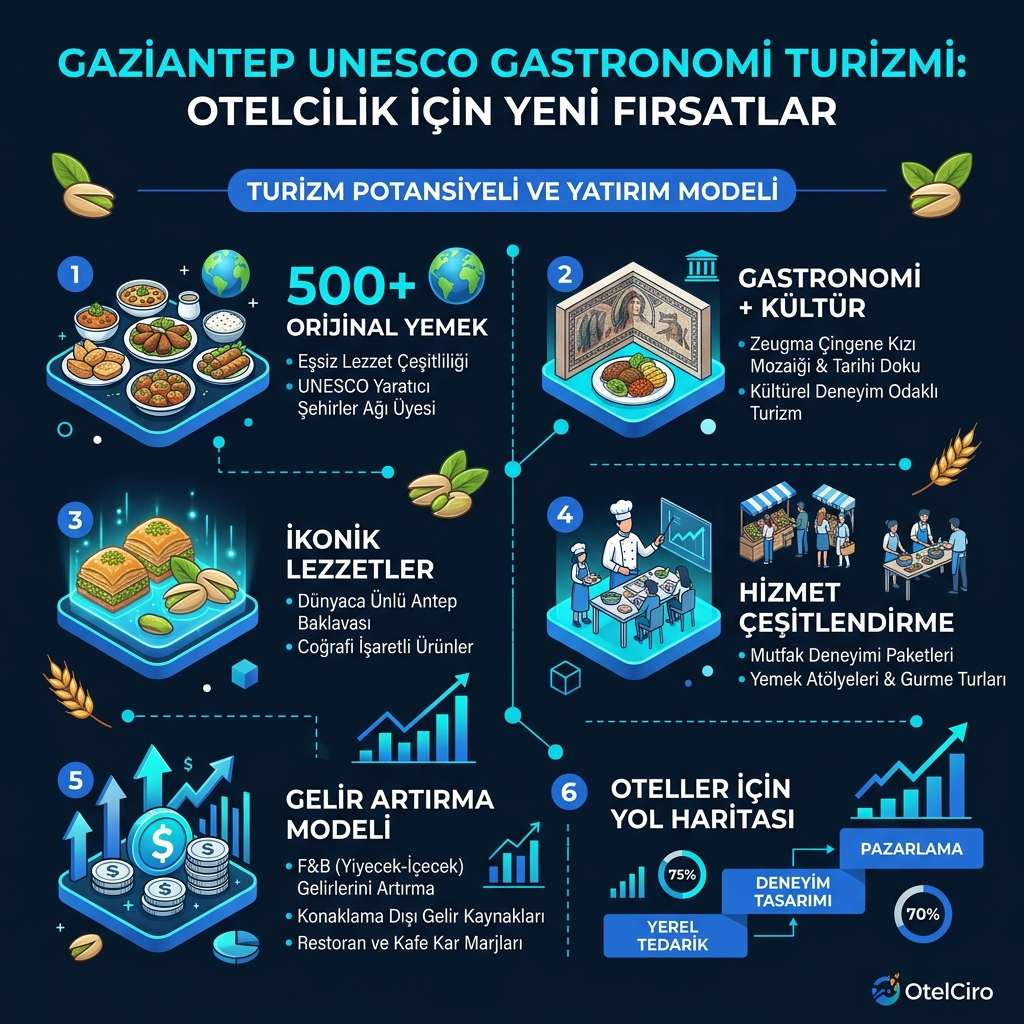
![Gaziantep Hotels: UNESCO Gastronomy Investment [2026 Outlook]](https://cdn.sanity.io/images/1la98t0z/production/53479ccda0c3ef38bf92acb74c072715520a2264-1024x1024.png?w=1920&q=65&auto=format&fit=max)
Key Takeaways
- Gaziantep, a UNESCO Gastronomy City, faces a significant hotel supply gap, with only 8,200 rooms accommodating 2.1 million annual visitors (2025 data).
- Gastronomy-motivated tourists account for 72% of visitors, spending 35% above the national average (totaling 1,200 TL per person per day), with F&B expenditure 81% higher than the Turkish average.
- Boutique and 5-star hotels show the highest occupancy rates (82% and 74% respectively), indicating strong demand for upper-segment and experience-oriented accommodations.
- Gaziantep offers attractive investment incentives (6th Region support) and a stable year-round tourism season, minimizing seasonal fluctuations seen in coastal areas.
- Leveraging digital platforms, AI-driven revenue management, and specialized gastro-tourism packages can significantly boost RevPAR and TRevPAR, capitalizing on events like the Gaziantep Gastronomy Festival.
Gaziantep: Turkey's Most Underrated Tourism Market
Gaziantep, one of 49 cities worldwide to be awarded the UNESCO Creative City of Gastronomy title in 2015, is Turkey's sole representative in this category. However, in the 11 years since, the city has not adequately translated this strategic advantage into its hotel supply capacity. According to TÜRSAB data, while 2.1 million domestic and international tourists visited the city in 2025, the total licensed room capacity remained at just 8,200.
What does this figure mean? With an average occupancy target of 65%, Gaziantep's current accommodation capacity can meet approximately 1.95 million overnight stays per year. However, for a destination with an average length of stay of 2.3 nights, 2.1 million visitors translate to a demand for 4.83 million overnight stays. The supply-demand gap is evident, a situation that both drives up prices, increasing RevPAR, and leads to potential tourist loss.
Embed this image on your site
<a href="https://otelciro.com/en/news/gaziantep-hotels-unesco-gastronomy-investment-2026-outlook">
  <img src="https://cdn.sanity.io/images/1la98t0z/production/53479ccda0c3ef38bf92acb74c072715520a2264-1024x1024.png" alt="Gaziantep Gastronomy Tourism Hotel Opportunities — UNESCO 2026" width="800" />
</a>
<p>Source: <a href="https://otelciro.com">OtelCiro</a> — AI Hotel Revenue Management</p>
Related reading: Hotel F&B Outlet Concept Design: Restaurant, Bar, Cafe
The Economic Impact of UNESCO Gastronomy City Status
The UNESCO Creative Cities Network provides tangible economic advantages to its member cities. According to UNWTO's 2025 gastronomy tourism report, in UNESCO gastronomy cities:
- Per capita spending is 25-40% higher than the general tourism average
- Length of stay is 0.5-1.2 nights longer
- Repeat visit rate is 28% higher
- Social media engagement is 2.3 times higher than other cultural destinations
These effects are even more pronounced in Gaziantep. According to 2025 data from the Ministry of Culture and Tourism, 72% of tourists visiting the city are motivated by gastronomy. This rate is higher than in Lima, the capital of Peru (58%), and Lyon, France's gastronomy hub (63%).
Per Capita Spending Analysis
The daily spending distribution of tourists visiting Gaziantep clearly reveals the city's F&B-centric structure:
| Spending Item | Gaziantep (TL) | Turkey Avg. (TL) | Difference |
|---|---|---|---|
| Accommodation | 420 | 380 | +%11 |
| Food & Beverage | 380 | 210 | +%81 |
| Shopping (gastronomy) | 250 | 140 | +%79 |
| Transportation | 90 | 110 | -%18 |
| Other activities | 60 | 50 | +%20 |
| Total | 1,200 | 890 | +%35 |
The most striking data point: F&B expenditure is 81% above the Turkey average. This indicates that F&B outlets should be positioned as the primary revenue driver in gastronomy-focused hotel investments. According to Deloitte's Southeastern Anatolia tourism report, the ratio of F&B revenues to total hotel revenues in Gaziantep is between 38-45% — significantly higher than the industry average of 22-28%.
Hotel Supply Gap: Segment-Based Evaluation
The segment distribution of Gaziantep's current 8,200 rooms indicates where investment opportunities lie:
| Segment | Number of Rooms | Share | Occupancy (2025) |
|---|---|---|---|
| 5-star | 1,200 | %15 | %74 |
| 4-star | 2,100 | %26 | %71 |
| 3-star | 2,400 | %29 | %63 |
| Boutique / Special | 500 | %6 | %82 |
| Other (aparthotel, B&B) | 2,000 | %24 | %55 |
It is notable that boutique and specially concepted hotels show the highest performance with 82% occupancy. McKinsey's 2025 Turkey tourism analysis emphasizes that demand for "experience-oriented" boutique accommodation in gastronomy destinations is growing annually by 18-22%. The fact that only 500 rooms in Gaziantep are in the boutique segment points to a significant gap.
Upper Segment Investment Opportunity
The 74% occupancy rate in 5-star hotels in the city is a strong demand signal. While the average 5-star hotel occupancy in Turkey is 62%, Gaziantep being 12 points above this segment indicates a need for new upper-segment capacity. Especially a 5-star property centered around the gastronomy experience, in a "culinary hotel" concept, could create a transformative effect for the city in terms of both brand value and revenue.
Gaziantep vs. Global Gastronomy Destinations
Comparative data is crucial to understanding Gaziantep's position on the global gastronomy tourism map:
| Metric | Gaziantep | Lima (Peru) | Lyon (France) | Chengdu (China) |
|---|---|---|---|---|
| UNESCO status year | 2015 | 2019 | 2019 | 2010 |
| Annual Tourists (million) | 2.1 | 4.5 | 6.2 | 3.8 |
| Hotel rooms | 8,200 | 28,000 | 22,000 | 45,000 |
| Per capita F&B spending ($) | 11 | 18 | 32 | 9 |
| Michelin/Awarded restaurants | 12 | 45 | 38 | 27 |
| Gastro tour operators | 8 | 62 | 85 | 35 |
The table shows that Gaziantep has the lowest ratio of hotel room capacity per tourist (3.9 rooms/1,000 tourists vs. Lima's 6.2). However, it can also be said that Gaziantep is the market with the highest growth potential. The city is on par with its global competitors in terms of the depth of its culinary culture but lags in infrastructure and branding.
Gastro-Tourism Package Opportunities and F&B Revenue Model
For hotel investors in Gaziantep, the most critical strategic decision is how to integrate the F&B concept into the accommodation product. Offering gastro-tourism packages instead of the traditional "room + breakfast" model increases both ADR and total revenue.
Package Design Suggestions
Package 1 — Gastronomy Discovery (2 Nights)
- Accommodation + full board local cuisine menu
- Bazaar gastronomy tour with a professional guide
- Baklava making workshop
- Estimated package price: 7,500-12,000 TL/person
- Profit margin: 55-62%
Package 2 — Chef Experience (3 Nights)
- Suite accommodation + personalized menu design
- Farm visit to local producers
- Pepper and spice workshop
- Private dinner (chef's table)
- Estimated package price: 15,000-25,000 TL/person
- Profit margin: 48-55%
Package 3 — Corporate Gastro Event (1 Night)
- Meeting room + gastronomy-themed team building
- Cocktail with local delicacies
- Estimated package price: 4,500-8,000 TL/person
- Profit margin: 60-68%
According to STR data, hotels offering gastronomy packages have an average ADR that is 32-48% higher compared to standard room sales. The TRevPAR difference can reach 55-70% due to the impact of F&B revenues.
Investment Environment and Incentives
The Southeastern Anatolia Region is covered by Turkey's 6th Region incentive scheme and offers significant advantages for hotel investments:
- VAT exemption: On all machinery and equipment purchases during the investment period
- Customs duty exemption: For imported equipment and furniture
- Tax reduction: Up to 90% reduction in corporate tax
- SSI premium support: State coverage of the employer's share for up to 10 years
- Interest rate support: Up to 7 points of interest support on investment loans
- Land allocation: 49-year allocation of Treasury lands at 1-10% of their value
According to 2025 data from the Ministry of Industry and Technology, the number of incentive certificates approved for tourism investments in Gaziantep has increased by 145% in the last 3 years. This increase shows that investors recognize the region's potential, but the proportion of hotel-focused projects is still low — only 12% of incentive certificates are for hotel investments.
Operational Strategies: Hotel Management in Gaziantep
Successful hotel operations in Gaziantep require region-specific strategies beyond standard management practices:
Seasonal Management
Gaziantep's tourism season differs from Turkey's coastal destinations. The city sees relatively balanced demand throughout 12 months:
- High season (April-June, September-November): Occupancy 75-85%
- Mid season (January-March, December): Occupancy 55-65%
- Low season (July-August): Occupancy 45-55% (due to hot weather)
This distribution is much more manageable than the extreme fluctuations of 90% vs. 25% experienced by coastal hotels. A more stable revenue stream throughout the year facilitates staff planning and cash management.
Local Supply Chain Advantage
Gaziantep is one of Turkey's strongest food production centers. The opportunity to establish direct producer relationships for essential food items such as Antep pistachios, pepper paste, olive oil, and legumes can provide 15-25% savings in F&B cost management. This directly increases the profit margin for gastronomy-focused hotels.
Related reading: Black Sea Region Hotel Investment Potential 2026
Transportation Infrastructure and Accessibility
A significant factor enhancing Gaziantep's tourism potential is its developing transportation infrastructure. Gaziantep Oğuzeli Airport served 4.2 million passengers in 2025, with an annual passenger growth of 14%. Daily direct flights are available to Istanbul, Ankara, and Izmir; international connections to Baghdad, Erbil, Amman, and Beirut provide access to the Middle East market.
The Gaziantep-Adana high-speed train project is scheduled for completion in 2028, which will significantly expand the city's attraction radius. According to TCDD data, accommodation demand in cities connected by high-speed rail increases by an average of 25-35%.
Middle East Market Opportunity
Gaziantep's geographical location creates a natural advantage for tourism originating from the Middle East. The average spending of tourists from Gulf countries in Turkey is 1,800 TL per person per day, double the overall average. Gaziantep's Islamic gastronomy tradition and rich halal cuisine create a strong attraction point in this market.
Differentiating with Digital and AI
A new hotel investor entering Gaziantep can gain a competitive edge by establishing the right digital infrastructure from the outset. The vast majority of existing hotels in the city use traditional management approaches — this opens an advantage window for new players implementing AI-powered revenue management.
Dynamic pricing, automatic price adjustments based on gastronomy event calendars, guest segmentation, and personalized package recommendations are strategies not yet widespread in Gaziantep. AI-native platforms like OtelCiro provide 15-22% RevPAR advantage to early adopter hotels in such markets.
Demand often shows sudden surges, especially during gastronomy festivals and local events. A system that predicts these peak periods and automatically adjusts prices can capture additional revenue of 8-12% of annual income. Events such as the Gaziantep Gastronomy Festival, Pepper Festival, and Pistachio Harvest are periods where correct pricing can increase room revenue by 40-60%.
Conclusion: Gaziantep 2026-2030 Projection
Gaziantep is on its way to becoming Turkey's most dynamic gastronomy tourism market. Projections based on current data:
- 2026: 2.3 million visitors, 9,000 room capacity
- 2028: Target of 3.0 million visitors, 12,000 room capacity
- 2030: Target of 4.0 million visitors, 18,000 room capacity (GAP Master Plan)
This growth scenario implies an investment of approximately 10,000 new rooms over the next 5 years. Hotels that center their concept around gastronomy, possess strong digital infrastructure, and focus on experiences will be the players that capture the largest share of this growth.
Gaziantep is preparing to be a market that satisfies not only with its flavors but also with its return on investment.
![Europe's Hotel Construction Boom: 2026 Oversupply Risks [Market Analysis]](https://cdn.sanity.io/images/1la98t0z/production/6dfe59137f56aa14bfcba86d9db3cf05ff89f406-2752x1536.jpg?w=1920&q=50&auto=format&fit=max)