![Franchise vs. Independent Hotels: [2026 Guide]](https://cdn.sanity.io/images/1la98t0z/production/53f9e683ef3722ce06d3e9c93202b75e1bbb960d-2752x1536.jpg?w=1920&q=65&auto=format&fit=max)
Key Takeaways
- Global Landscape: 42% of hotel rooms globally operate under franchise/management agreements, while 58% are independent. This balance is shifting, with franchise rates increasing by 2-3% annually.
- Franchise Advantages: Brands offer 12-18% higher occupancy, robust loyalty programs (45-55% of bookings), global distribution, operational standards, and easier financing (15-25% lower interest).
- Independent Advantages: Full operational control, cost savings (8-14% of gross revenue saved from franchise fees), unique identity, and flexibility for local market adaptation.
- Turkish Market: Only 18% of hotel rooms in Turkey are internationally franchised, significantly below the European average of 35%, presenting both challenges and opportunities.
- Decision Factors: The optimal choice depends on location (urban/business vs. leisure), investor profile (first-time vs. experienced), financial capacity, and willingness to explore hybrid solutions like soft brands.
Critical Decision in Hotel Investment: Brand or Independence?
One of the most strategic decisions in hotel investment is whether to operate under an international franchise brand or as an independent hotel. This decision directly impacts the investment's profitability, operational structure, and long-term growth potential.
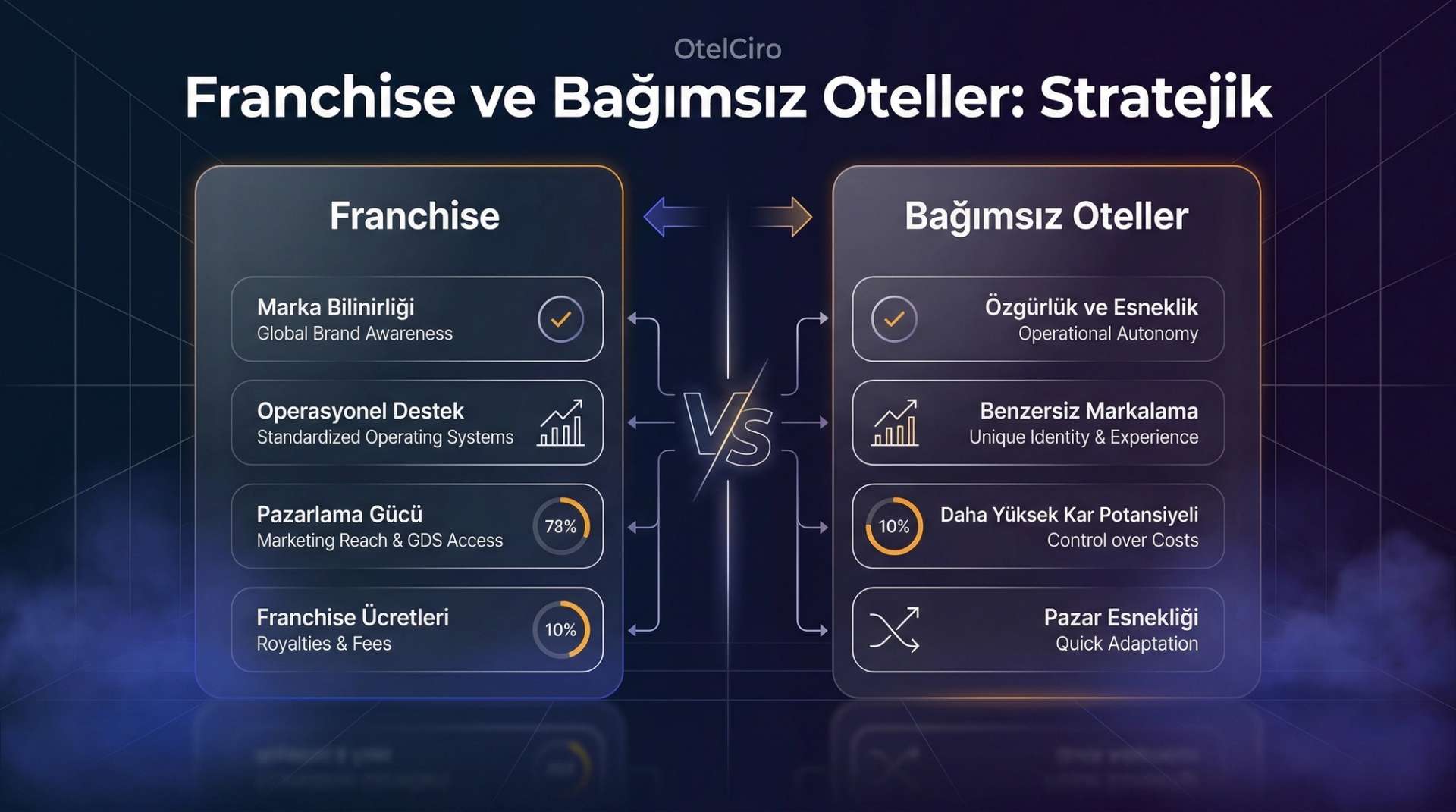
Globally, 42% of hotel rooms operate under franchise or management contracts, while 58% belong to independent hotels. However, this balance is rapidly changing: the franchise rate increases by 2-3% annually, while independent hotels are becoming competitive without needing brand strength, thanks to digital tools and technology platforms.
Embed this image on your site
<a href="https://otelciro.com/en/news/franchise-vs-independent-hotels-2026-guide">
  <img src="https://cdn.sanity.io/images/1la98t0z/production/53f9e683ef3722ce06d3e9c93202b75e1bbb960d-2752x1536.jpg" alt="Franchise vs Independent Hotel Decision Infographic" width="800" />
</a>
<p>Source: <a href="https://otelciro.com">OtelCiro</a> — AI Hotel Revenue Management</p>
The situation in Turkey is somewhat different: only 18% of hotel rooms are affiliated with international franchise brands. This rate is well below the European average (35%), posing both opportunities and questions. In this article, we compare the advantages and disadvantages of both models in detail to help you make an informed decision.
Related reading: Boutique Hotel Brand Building Strategy
Franchise Model: Advantages and Costs
The franchise model grants the right to use a global brand's name, standards, and distribution network. The presence of groups like Hilton, Marriott, IHG, and Accor in Turkey is expanding every year.
Advantages of Franchising
Brand Recognition: Global brands like Hilton or Marriott instantly build guest trust. Studies show that branded hotels achieve 12-18% higher occupancy rates than independent hotels.
Loyalty Programs: Programs such as IHG Rewards, Marriott Bonvoy, and Hilton Honors provide access to millions of members. 45-55% of total bookings for franchise hotels come from loyalty program members.
Global Distribution Network: Direct bookings from the brand's website, mobile app, and corporate agreements save on OTA commissions. Branded hotels have 20-30% lower OTA dependency compared to independent hotels.
Operational Standards: Proven SOPs (Standard Operating Procedures), training programs, and quality control mechanisms increase operational efficiency.
Easier Financing: Banks offer branded hotel projects 15-25% lower interest rates and longer repayment periods. Brand assurance increases investor confidence.
Franchise Costs
The financial burden of a franchise agreement is significant and must be accurately calculated:
| Cost Item | Rate | Description |
|---|---|---|
| Initial Fee | $50,000-$100,000 | One-time, at contract start |
| Royalty (license) Fee | 4-6% of gross revenue | Monthly, fixed rate |
| Marketing Contribution | 2-4% of gross revenue | Monthly, brand fund |
| Reservation System Fee | $4-$8 per room | Per reservation |
| Standard Compliance Investment | $500,000-$2,000,000 | To meet brand standards |
| PIP (Property Improvement Plan) | Variable | Mandatory renovation every 5-7 years |
Total franchise costs constitute 8-14% of gross revenue. For a 100-room hotel with an annual turnover of 20 million TL, this means an annual franchise fee of 1.6-2.8 million TL.
Independent Hotel: Advantages and Challenges
The independent model offers full operational freedom and cost advantages but carries the risk of lacking brand support.
Advantages of Independence
Full Control: You have complete freedom in pricing, marketing, design, and service standards. Rapid adaptation to the local market and guest profile is possible.
Cost Advantage: No franchise fees are paid. 8-14% of gross revenue is directly added to profit. For a 100-room hotel, this means an annual saving of 1.6-2.8 million TL.
Identity and Differentiation: Freedom to create a unique brand identity. In the boutique and lifestyle hotel segment, independent hotels report 25% higher guest loyalty compared to franchise brands.
Flexibility: Renovation and modification decisions are made independently; there is no PIP obligation. Quick response to market changes is possible.
Local Sourcing: Freedom in supplier selection, supporting the local economy, and optimizing costs.
Challenges of Independent Hotels
Lack of Brand Recognition: A new independent hotel needs 2-3 years to build brand trust. During this period, occupancy rates may remain 15-25% below those of branded hotels.
Limited Distribution: No corporate agreements or loyalty programs. OTA dependency increases — OTA commission expenses for independent hotels can constitute 18-25% of total revenue.
Operational Knowledge: Without proven SOPs and training programs, operational efficiency is entirely dependent on the management team's capabilities.
Related reading: Hotel Channel Manager Selection 2026
Decision Criteria: Which Model is Right for You?
This decision should be based not on a single factor but on a holistic assessment of multiple variables.
Location and Market
- City center, near airport, business travel-heavy: Franchise is generally advantageous. Corporate travelers prefer familiar brands.
- Tourist destination, coastal, nature: The independent model can be successful. Leisure travelers seek unique experiences.
- Highly competitive market: Franchise brand support and loyalty programs provide a competitive edge.
- Niche market: Independence offers flexibility for niche positioning and differentiation.
Investor Profile
- First-time hotel investor: Franchise compensates for lack of experience with operational standards and training.
- Experienced hotelier: Independence allows full utilization of accumulated knowledge and skills.
- Portfolio investor: Franchise offers standardization and scalability, simplifying multi-property management.
Financial Capacity
- Limited capital: The independent model saves on franchise entry fees and standard compliance investments.
- Strong capital: Franchise can accelerate return on investment (higher initial occupancy).
Hybrid Solutions and the Third Way
Various intermediate models also exist between franchising and independence:
Soft brand collections: Collections like Marriott Autograph Collection, Hilton Curio, and IHG Vignette allow hotels to maintain their independent identity while benefiting from the brand's distribution network and loyalty program. Franchise fees are 20-30% lower than standard brands.
Independent hotel associations: Associations like Preferred Hotels, Small Luxury Hotels, and Leading Hotels of the World offer global marketing, distribution, and quality standard support to independent hotels. Membership fees are 60-70% lower than franchising.
Technology platforms: Modern technology platforms, such as OtelCiro's reporting and analytics solutions, enable independent hotels to access data analytics, dynamic pricing, and channel management capabilities offered by franchise brands.
Turkish Perspective
Several factors contribute to the low franchise rate in the Turkish hotel sector: a strong tradition of family-run businesses, resistance to franchise costs, and the high value placed on local market knowledge.
However, changing dynamics are making franchising more appealing:
- International chain bargaining power (3-5% advantage in OTA commission rates)
- Growth of digital nomads and corporate segments (strong brand preference)
- Financing needs (brand advantage in bank loans)
Ultimately, there is no "best" model – only the most suitable model. Location, target audience, financial capacity, and personal vision are key determinants of this decision. Successful examples of both models exist in Turkey. The critical factor is making an informed and data-backed decision.

![Europe's Hotel Construction Boom: 2026 Oversupply Risks [Market Analysis]](https://cdn.sanity.io/images/1la98t0z/production/6dfe59137f56aa14bfcba86d9db3cf05ff89f406-2752x1536.jpg?w=1920&q=50&auto=format&fit=max)