![Floating Hotels: The Future of Marine Accommodation [2026 Guide]](https://cdn.sanity.io/images/1la98t0z/production/c746a1dcbde76161109b228139ebc4eb5f324b69-1024x1024.png?w=1920&q=65&auto=format&fit=max)
Key Takeaways
- The global floating accommodation market reached $2.3 billion in 2025, maintaining a dynamic annual growth rate of 19.2%.
- Structural models range from fixed anchored platforms to mobile and semi-submersible hybrid designs catering to premium niches.
- Operational success depends on marine engineering expertise, where maintenance typically accounts for 12-18% of total operating costs.
- Turkey’s 8,333 km coastline and 600+ marinas provide a high-potential landscape for pioneering marine hospitality investments.
Floating Hotels: The Experience of Staying on the Water
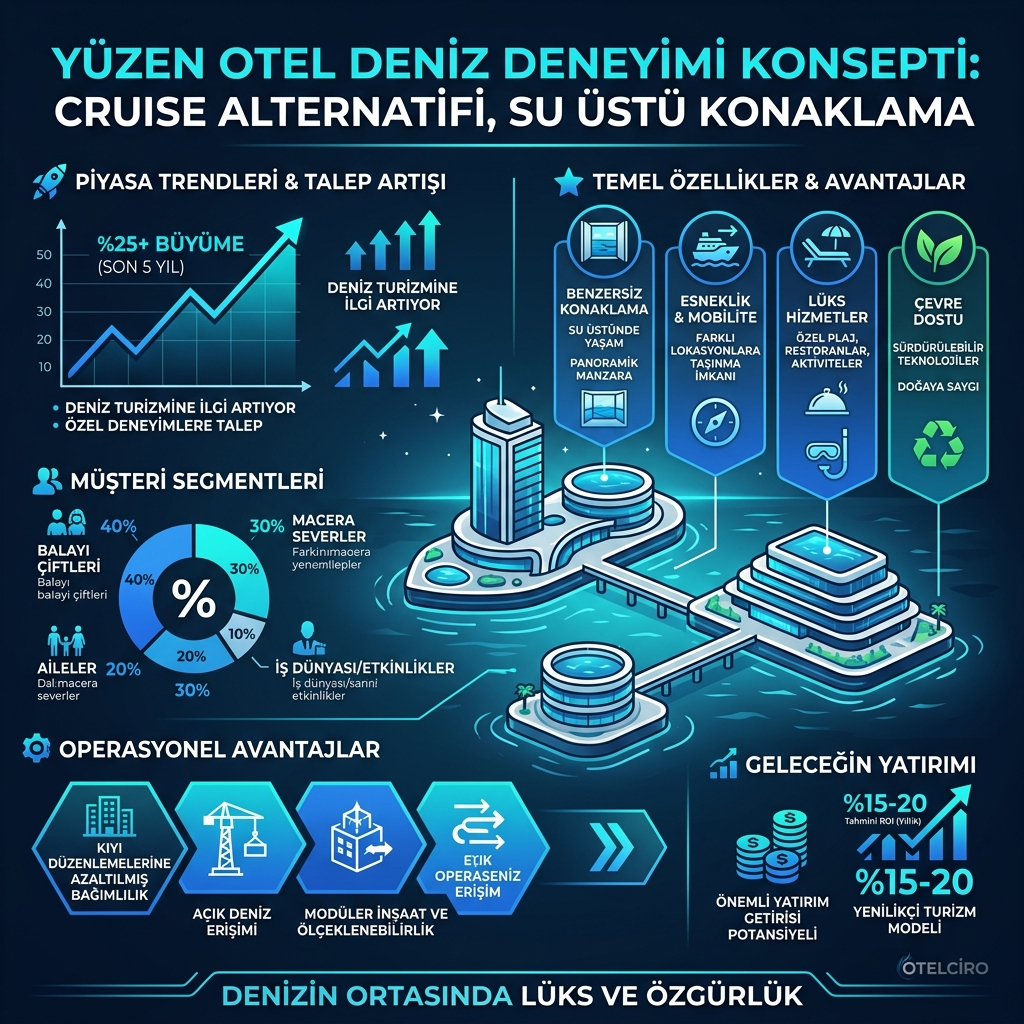
Marine tourism is one of the fastest-growing segments of the global tourism industry. Beyond the traditional cruise industry, stationary floating hotels are rising as a new category of accommodation. From Dubai to Norway, and the Maldives to the Netherlands, floating hotel projects are gaining momentum globally. This trend holds significant opportunities for Turkey’s 8,333 km coastline.
The global floating accommodation market reached $2.3 billion in 2025 and stands as the industry's most dynamic niche segment with an annual growth rate of 19.2%. Experts predict that more than 500 floating hotels and residences will be operational worldwide by 2030.
Embed this image on your site
<a href="https://otelciro.com/en/news/floating-hotels-the-future-of-marine-accommodation-2026-guide">
  <img src="https://cdn.sanity.io/images/1la98t0z/production/c746a1dcbde76161109b228139ebc4eb5f324b69-1024x1024.png" alt="Floating Hotel Concept" width="800" />
</a>
<p>Source: <a href="https://otelciro.com">OtelCiro</a> — AI Hotel Revenue Management</p>
In this article, we examine the operational model, legal requirements, design principles, and marketing strategies of the floating hotel concept in detail.
Related reading: Hotel Yield Management: A Guide to Revenue Management
Floating Hotel Models
Floating hotels are divided into four main categories based on structural design and operational models:
Permanently Anchored Floating Hotels
Built on platforms permanently moored in a specific location. They are connected to land via bridges, piers, or boat services. This is the most common and feasible model.
Advantages: Stable structure, lower operational costs, access to land infrastructure. Examples: Punta Caracol (Panama), Arctic Bath (Sweden).
Mobile Floating Hotels
Motorized or towable structures. These can change locations based on the season, demand, or weather conditions.
Advantages: Flexibility, movement to different destinations, seasonality management. Examples: The Floating Venice (Dubai), Seasteading projects.
Lake and River Floating Hotels
Structures located in inland waters rather than the sea. Because wave impact is minimal, structural requirements are lower.
Advantages: Low wave stress, easy access, lower investment costs. Examples: Makani (Finland), Amsterdam Botel.
Semi-Submersible Hotels
Hybrid structures designed partly underwater and partly above water. They offer both above-water views and underwater observation.
Advantages: Unique experience, premium pricing, dual perspectives. Examples: Water Discus (Dubai project), Underwater Room (Manta Resort).
Operations and Technical Requirements
Floating hotel management requires maritime and engineering knowledge in addition to standard hospitality expertise.
Structural Safety
Stability: The stability of the floating structure against waves is critical. Durability should target up to level 6-7 on the Beaufort scale. Anti-roll systems enhance guest comfort.
Mooring: Permanently anchored hotels use multi-point mooring systems. Each mooring point must have a holding capacity of at least 150% of the total weight of the structure.
Maintenance: Seawater corrosion is the greatest enemy of the structure. Anti-corrosion maintenance costs in a floating structure account for 12-18% of total operating costs. Underwater hull maintenance should be performed at least twice a year.
Infrastructure Systems
| System | Requirement | Solution |
|---|---|---|
| Fresh Water | 200-500 L/room/day | Desalination or land connection |
| Electricity | 15-25 kWh/room/day | Solar panels + generator + land connection |
| Wastewater | Zero discharge to sea | Biological treatment system |
| Internet | Fiber or Satellite | Submarine cable or 5G connection |
| Transportation | 24/7 Access | Boat service or pier bridge |
Emergency Planning
Emergency scenarios for floating hotels differ from land-based hotels:
- Evacuation: Life jackets and emergency boats must be available for every guest. Evacuation drills should be conducted monthly.
- Storm Protocol: Procedures for evacuating guests to land or towing the structure to a safe harbor during severe weather conditions.
- Fire: Firefighter access is limited on the sea. Automatic suppression systems and fire compartmentalization are mandatory.
- Medical Emergency: Transfer time to land is critical. A helicopter landing pad or high-speed boat must be maintained.
Related reading: Hotel Safety and Emergency Plan
Legal Framework and Regulations
Floating hotels sit at the intersection of hospitality and maritime legislation. In Turkey, the legal framework in this area is not yet fully defined, but the following permits are required under current regulations:
Maritime Permits: Marine structure permit from the Ministry of Transport and Infrastructure. Mooring and operational permits from the port authority.
Tourism Certification: Accommodation operation certificate from the Ministry of Culture and Tourism. Jurisprudence is still in the developmental stage regarding which class floating structures will be evaluated under.
Environmental Permits: EIA (ÇED) reports, marine pollution prevention plans, and waste management plans are mandatory.
Zoning and Coastal Legislation: Construction restrictions on the shoreline under the Coastal Law may be interpreted differently for floating structures. This uncertainty requires that projects not be started without legal consultancy.
Floating Hotel Potential in Turkey
Turkey offers unique advantages for the floating hotel concept:
Geographical Diversity: The Aegean, Mediterranean, Black Sea, and Marmara coasts offer different experience concepts. A bay experience in the Aegean, offshore luxury in the Mediterranean, and nature integration in the Black Sea.
Marina Infrastructure: There are more than 600 marinas and yacht harbors in Turkey. This infrastructure meets the logistics needs of floating hotels.
Tourist Demand: 35% of tourists coming to Turkey are motivated by coastal tourism. A floating hotel adds a new dimension to existing demand.
Potential Locations
- Göcek/Fethiye: Permanently anchored floating hotels in sheltered bays within the 12 Islands region.
- Bodrum: Premium floating hotels integrated with international yacht tourism.
- Bosphorus, Istanbul: A unique accommodation experience accompanied by city views and the historical silhouette.
- Lake Sapanca: Floating hotels on the lake near Istanbul, targeting the weekend getaway market.
Marketing and Revenue Optimization
Floating hotels possess a powerful marketing narrative due to their unique locations and experiences.
Experience Packaging: Comprehensive packages such as accommodation + diving + fishing + sunset cruises increase revenue per room by 35-50%.
Event Space: Floating platforms serve as high-margin revenue channels for weddings, corporate events, and special celebrations.
Social Media Impact: Floating hotels have some of the highest organic viral potential on Instagram and TikTok. 85% of guests share their stay experience on social media.
Direct reservation optimization, channel management, and guest relations can be managed in an integrated manner through sales and marketing tools.
The floating hotel concept is a bold approach that pushes the boundaries of the hospitality industry into the seas. Turkey's rich coastal geography, marina infrastructure, and tourism potential provide ideal conditions for this concept. With the clarification of the legal framework and the emergence of the first successful examples, it seems inevitable that floating hotels will gain a significant place in the Turkish tourism sector.
![Europe's Hotel Construction Boom: 2026 Oversupply Risks [Market Analysis]](https://cdn.sanity.io/images/1la98t0z/production/6dfe59137f56aa14bfcba86d9db3cf05ff89f406-2752x1536.jpg?w=1920&q=50&auto=format&fit=max)