![Facebook Hotel Ads: 2026 Targeting Strategies [Strategy Guide]](https://cdn.sanity.io/images/1la98t0z/production/b14e9b757475f28daa6889f1d9eb57eec53dde85-1200x669.png?w=1920&q=65&auto=format&fit=max)
Key Takeaways
- Facebook (Meta) remains a high-performance platform for hotel advertising, delivering an average ROAS of 8.7x in the travel sector, despite the rise of TikTok.
- 2026 targeting strategy hinges on three pillars: first-party data utilization, Meta's Advantage+ algorithmic optimization, and leveraging creative content signals.
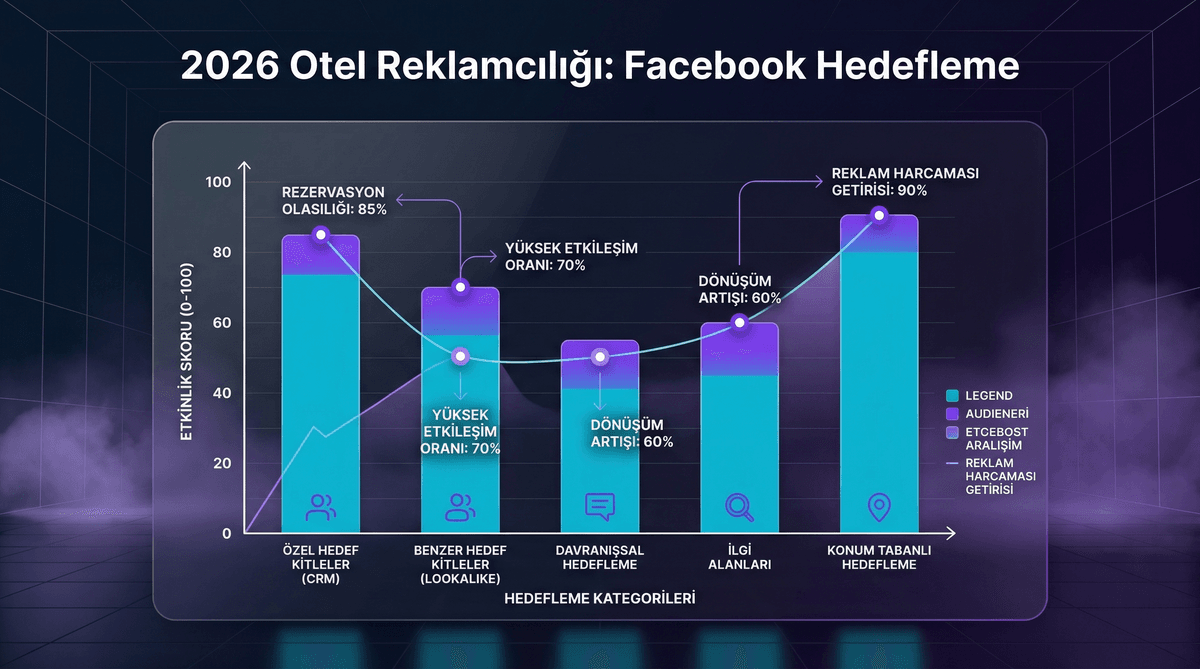
- Lookalike audiences from high-value guests or direct bookers offer significantly higher conversion value (up to 45% higher) compared to broader lists.
- Video and Carousel ad formats are top performers, with video ads showing 23% lower CPA and Carousel ads achieving 72% higher click-through rates.
- Effective budget management involves a funnel-based distribution, seasonal adjustments, and utilizing Campaign Budget Optimization (CBO) to maximize ad spend efficiency.
Are Facebook Ads Still Relevant for Hoteliers?
Despite the rise of TikTok and short-video platforms, Facebook (Meta) remains the social media advertising platform offering the highest conversion rate in the hospitality sector. According to Meta's Q4 2025 report, the average ROAS (Return on Ad Spend) for Facebook ads in the travel industry is 8.7x — meaning every 1 TL spent generates 8.7 TL in revenue.
Turkey has 47 million active Facebook users, and 62% of these users have interacted with travel-related content in the last 6 months. For hoteliers, this massive audience can be transformed into high-quality potential guests with the right targeting strategies.
However, in 2026, Facebook ad targeting does not work the same way it did in 2020. iOS privacy updates, third-party cookie restrictions, and Meta's algorithm changes have fundamentally altered the targeting strategy.
Embed this image on your site
<a href="https://otelciro.com/en/news/facebook-hotel-ads-2026-targeting-strategies-strategy-guide">
  <img src="https://cdn.sanity.io/images/1la98t0z/production/b14e9b757475f28daa6889f1d9eb57eec53dde85-1200x669.png" alt="Facebook Hotel Ad 2026 Targeting Strategies Infographic" width="800" />
</a>
<p>Source: <a href="https://otelciro.com">OtelCiro</a> — AI Hotel Revenue Management</p>
Related reading: 5 Channel Optimization
The Three Pillars of Targeting Strategy in 2026
Modern Facebook ad targeting operates on three fundamental layers: first-party data, algorithmic optimization, and creative content signals.
1. First-Party Data: Your own collected data is now the most valuable source for targeting. Website visitors, email subscribers, past guests, and your CRM database — this data is transmitted to Meta via Facebook Pixel and Conversions API to create custom audiences.
2. Algorithmic Optimization (Advantage+): Meta's Advantage+ campaign structure automates targeting with machine learning. By starting with broad audiences and entrusting the algorithm to find the individuals most likely to convert, you can achieve a 32% lower acquisition cost compared to manual targeting.
3. Creative Content Signals: Meta's algorithm now looks not only at demographic data but also at which audiences the ad content performs best with. Use different creative variations (carousel, video, single image) to allow the algorithm to find the most suitable content-audience match.
Lookalike Audience Strategy: Source Audience Selection
Lookalike audiences allow you to target users with profiles similar to your existing customers. However, the quality of the source audience directly determines the effectiveness of the lookalike.
High-value guest list: Create a lookalike from the top 20% guest segment who made the highest spending in the last 12 months. This audience provides 45% higher conversion value compared to a lookalike created from the entire guest list.
Direct bookers: Guests who book directly through your website or by phone, rather than OTAs, are more experience-driven than price-conscious. A lookalike created from this segment increases the direct booking rate.
Repeat guests: Loyal guests who have stayed two or more times represent the highest brand affinity potential audience.
Lookalike size: For Turkey, start with a lookalike size between 1-3%. 1% is the narrowest but most similar audience, while 3% is broader but slightly less precise. Determine the optimal size by testing.
Source list size: Use a source list of at least 1,000, ideally 5,000-10,000 people. The larger the list, the more accurately Meta can find common characteristics.
Interest and Behavior-Based Targeting
In addition to Lookalike audiences, you can refine your targeting by adding interest and behavioral targeting layers.
Travel behaviors:
- Frequent Travelers
- Those who used a travel app in the last 2 weeks
- Distinction between Business travelers vs. leisure travelers
- Recent travel planners
Interest layers:
- Luxury travel, boutique hotels, spa & wellness
- Specific destinations (Antalya, Bodrum, Cappadocia, Istanbul)
- Food and gastronomy tours
- Outdoor activities and nature tourism
Demographic filters:
- Age range (narrow according to your target audience)
- Income level (Facebook's estimated income segmentation)
- Relationship status (romantic getaways for couples, family packages for families)
Important note: In 2026, overly narrow targeting often yields worse results. Layering more than 3-4 interest categories can shrink the audience size too much and restrict Meta's optimization algorithm. The best results usually come from leaving room for the algorithm with 1-2 main filters.
Related reading: Hotel Distribution Cost
Ad Formats and Creative Content
In 2026, the ad formats showing the highest performance in Facebook hotel ads are:
Video ads (15-30 seconds): Short, attention-grabbing hotel tour videos provide the highest engagement and conversion rates. The first 3 seconds are critical — they must have an immediate attention-grabbing opening frame. The CPA (Cost Per Acquisition) for video ads is 23% lower compared to static images.
Carousel (rotating cards): In a 4-6 card carousel format, showcase different room types, common areas, and experiences. Use a separate CTA (call-to-action) on each card to appeal to different segments. The carousel format provides the highest click-through rate (72% higher) in the hospitality sector.
Dynamic ads: Offer dynamic retargeting ads to users who visited your website but didn't book, showing them the room type and price they viewed, based on Meta Pixel data. Dynamic ads achieve a 34% higher conversion rate compared to static retargeting.
Instant Experience (Canvas): A full-screen, fast-loading, and interactive ad experience. A hotel gallery, 360-degree virtual tour, and direct booking link can be presented within a single ad.
Budget Management and Campaign Structure
For effective Facebook hotel ad budget management:
Funnel-based budget distribution:
- Awareness (top of funnel): 30% of the budget — video and content ads to broad audiences
- Consideration (mid funnel): 30% of the budget — carousel and detailed information to interested audiences
- Conversion (bottom funnel): 40% of the budget — retargeting and direct booking CTAs
Seasonal budget adjustment: Increase the budget by 40-50% before peak seasons (April-May and September-October). Ad costs rise during peak season (June-August); focus on retargeting during this period.
Minimum budget threshold: Allocate a minimum daily budget of 200 TL for Meta's optimization algorithm to work effectively. Below this threshold, the algorithm cannot collect sufficient data, and optimization weakens.
CBO (Campaign Budget Optimization): Manage the budget at the campaign level, not at the ad set level. Meta's algorithm automatically directs the budget to the best-performing ad sets.
Measurement and Optimization Cycle
To measure the success of Facebook hotel ad campaigns, monitor the right metrics:
- ROAS: Aim for a minimum of 5x; 8x+ is excellent performance
- CPA (Cost Per Acquisition): Should not exceed 15-20% of the daily revenue per room
- CTR (Click-Through Rate): Hospitality sector average is 1.2%; target: 2%+
- Frequency: Ad impression frequency to the same user; ad fatigue begins above 3
- Attribution window: Use a 7-day click + 1-day view window
Implement a weekly optimization cycle: pause underperforming ad sets, increase the budget for high-performing ones, and launch at least 1 new creative content test each week.
OtelCiro's digital sales platform combines Facebook ad data with other channels to provide multi-channel ROI analysis and helps you distribute your ad budget most efficiently.
In 2026, Facebook hotel ads, with the right data infrastructure, smart targeting, and continuous optimization, continue to be one of the most effective digital marketing channels.
![Europe's Hotel Construction Boom: 2026 Oversupply Risks [Market Analysis]](https://cdn.sanity.io/images/1la98t0z/production/6dfe59137f56aa14bfcba86d9db3cf05ff89f406-2752x1536.jpg?w=1920&q=50&auto=format&fit=max)