![Europe's Budget Hotel Boom: Gen Z & Tech Trends [2026 Guide]](https://cdn.sanity.io/images/1la98t0z/production/719c679611b1656ae1c2f6750eb0f859f0d644e1-1200x669.png?w=1920&q=65&auto=format&fit=max)
Key Takeaways
- European budget hospitality is redefining itself, moving from "cheap" to "smart and design-focused," now a $34.7 billion segment and the fastest-growing.
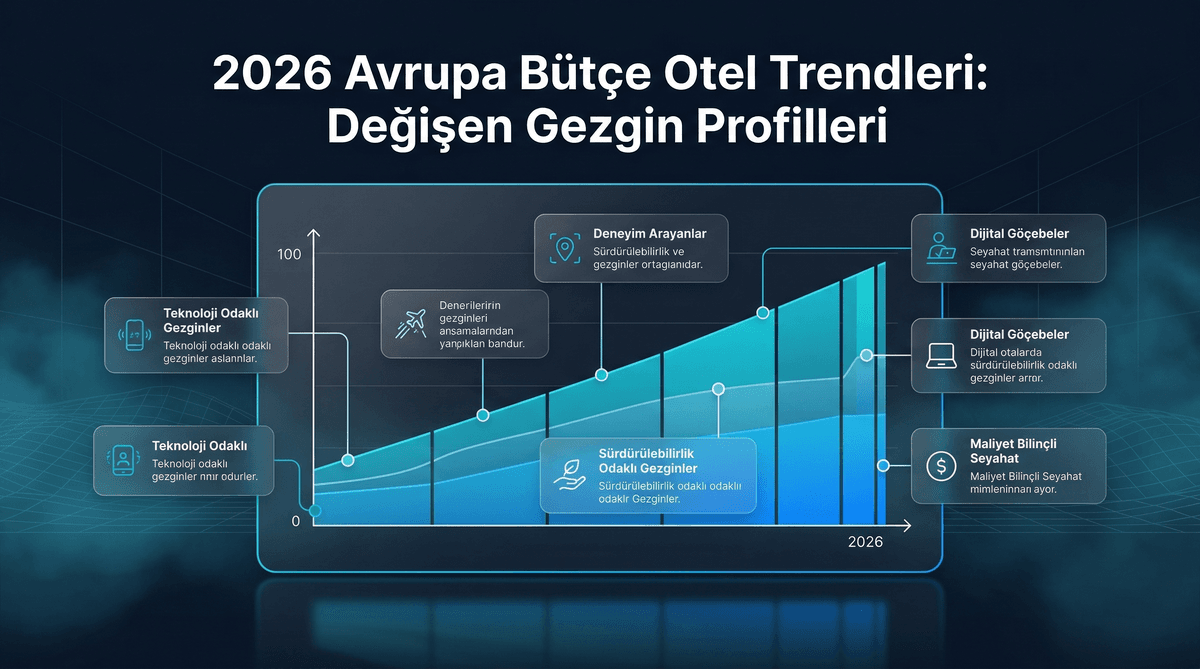
- Gen Z travelers (34% of the market by 2026) are driving this shift, demanding design, social spaces, advanced technology, authentic experiences, and sustainability.
- Micro hotels (8-15 sqm rooms) and Smart Budget Hotels (leveraging technology for operational efficiency) are leading the charge in this evolving market.
- These innovative concepts offer high profitability, with smart budget hotels achieving a 42% GOP margin, surpassing even the luxury segment.
- Turkey has significant potential to adapt these European trends, particularly for implementing micro hotels in urban centers and smart budget strategies in holiday regions to enhance profitability and attract new traveler segments.
Budget Hospitality Redefined
The European budget hotel segment is undergoing a radical transformation in 2026. The perception of "cheap and simple" is being replaced by "smart and design-focused" concepts. In the European accommodation market, which has reached a total size of $124 billion, the budget segment accounts for 28%, generating $34.7 billion — and is the fastest-growing segment.
This transformation presents direct learning opportunities for Turkey's budget and mid-segment hospitality. Europe's innovative budget concepts offer practical models that Turkish hoteliers can adopt to increase their revenue in the lower segments.
Embed this image on your site
<a href="https://otelciro.com/en/news/europe-s-budget-hotel-boom-gen-z-tech-trends-2026-guide">
  <img src="https://cdn.sanity.io/images/1la98t0z/production/719c679611b1656ae1c2f6750eb0f859f0d644e1-1200x669.png" alt="European Budget Hotel Trends Infographic" width="800" />
</a>
<p>Source: <a href="https://otelciro.com">OtelCiro</a> — AI Hotel Revenue Management</p>
Related reading: Hotel Open Pricing: Revenue Maximization with an Open Pricing Strategy
The Evolving Traveler Profile: Gen Z Impact
The biggest driving force behind the transformation in the budget hotel segment is the increasing weight of Gen Z in the travel market. In 2026, travelers aged 18-28 constitute 34% of the European accommodation market — an increase from 22% in 2019.
Gen Z travelers' preferences are fundamentally changing the traditional understanding of budget hotels:
- They value design: Instagram-worthy aesthetics, simple yet stylish interiors. They reject hotels that "look cheap."
- They demand social spaces: Instead of just a lobby, they seek co-working, bar, and event areas. Time spent in rooms is minimal, while time spent in common areas is maximized.
- They expect technology: Mobile check-in, digital keys, and fast Wi-Fi are no longer luxuries but basic requirements.
- They seek experiences: Access to local restaurant recommendations, neighborhood walks, and cultural events.
- They want sustainability: Environmentally conscious practices influence their purchasing decisions by 45%.
This profile indicates that the "sell a room and forget" approach is no longer viable, even in the budget segment.
Emerging Concepts
Micro Hotels
Offering maximum functionality in 8-15 square meter rooms, micro hotels are Europe's fastest-growing accommodation format. In 2026, 2,400 micro hotels are operating across Europe — up from just 680 in 2020.
Micro hotel leaders and their performance:
- citizenM: 42 hotels, average ADR $115, occupancy 82%. A pioneer of the "affordable luxury" concept.
- Moxy (Marriott): 120+ hotels, average ADR $95, occupancy 78%. A party-hostel hybrid focused on social spaces.
- YOTEL: 18 hotels, average ADR $88, occupancy 80%. Cabin concept in airports and city centers.
- Jo&Joe (Accor): 35 hotels, average ADR $72, occupancy 76%. A hostel-hotel hybrid.
The secret to micro hotels' success: the strategy of investing space saved from room size into common areas. In a citizenM hotel, while rooms are 14 m², the lobby, bar, and co-working areas occupy 40% of the total space.
Smart Budget Hotels
A concept that reduces operational costs through technology and passes the savings on to guests. Key features:
- Self-service check-in/check-out: 60% savings in reception staff costs.
- Robot cleaning assistants: 25% increase in housekeeping efficiency.
- Smart room controls: 35% decrease in energy consumption.
- AI-powered pricing: 15-20% RevPAR increase through occupancy optimization.
- Chatbot guest services: 40% savings in customer service costs.
The cumulative effect of these technologies: a 25-30% reduction in operational costs, which can either be reflected in pricing for a competitive advantage or boost profitability.
Hostel-Hotel Hybrids
Hybrid concepts, combining traditional hostel and hotel features, are rapidly spreading:
- Private room options (hotel comfort) + common areas (hostel sociality).
- Shared kitchens and laundry facilities (practical for long stays).
- Regular social events (city tours, dinner nights, movie evenings).
- Price range: $35-85 per night.
This format is particularly popular among solo travelers and digital nomads. Hybrid properties in Europe boast an occupancy rate 12% higher than traditional budget hotels.
Related reading: Bleisure Travel: Business and Leisure Combination 2026 Trends
Performance Metrics: How Profitable Is the Budget Segment?
Despite lower ADRs, the budget segment can achieve high profitability when managed correctly:
| Metric | Traditional Budget | Smart Budget/Micro | Luxury (Reference) |
|---|---|---|---|
| ADR ($) | 55 | 95 | 320 |
| Occupancy (%) | 72 | 81 | 68 |
| RevPAR ($) | 40 | 77 | 218 |
| GOP Margin (%) | 28 | 42 | 38 |
| Cost Per Key ($) | 45,000 | 65,000 | 280,000 |
| Payback Period (Years) | 9-12 | 6-8 | 10-14 |
A striking data point: the GOP margin of smart budget hotels (42%) exceeds that of the luxury segment (38%). Low personnel costs, technology automation, and efficient space utilization create this difference.
Opportunities for Turkey
How can Europe's budget hotel trends be adapted for Turkey?
Micro Hotel Potential in Istanbul
Istanbul's historic peninsula and Beyoğlu districts, with their small plots, are ideal for micro hotel concepts. Design-focused micro hotels with 30-50 rooms can achieve high occupancy and profitability with low investment. Estimated investment: $2-3 million, payback period: 5-7 years.
Smart Budget in Holiday Regions
Technology adoption in the budget segment hotels in Antalya and the Aegean is very low. With self-service systems and AI-powered pricing, the profitability of existing budget hotels can be increased by 30-40%.
Digital Nomad Hotel-Hostel Hybrids
Hybrid concepts targeting digital nomads in cities like Antalya, Izmir, and Trabzon can help Turkey capture a larger share of this growing market.
AI-powered sales and channel management tools enable revenue optimization even in the budget segment. Maximizing every dollar in the low-price segment can only be achieved through data-driven management.
Future Outlook
The European budget hotel market is expected to grow by 45% to reach $50 billion by 2030. The drivers of this growth include:
- The increasing share of Gen Z and Alpha generations in the travel market.
- The permanent establishment of remote work and digital nomadism.
- Strengthening demand for sustainable travel.
- Decreasing technology costs, making smart systems accessible even to smaller hotels.
Budget hospitality no longer means "cheap accommodation" but "smart accommodation." Hoteliers who embrace and implement this new definition — regardless of segment — will gain a competitive advantage.
![Europe's Hotel Construction Boom: 2026 Oversupply Risks [Market Analysis]](https://cdn.sanity.io/images/1la98t0z/production/6dfe59137f56aa14bfcba86d9db3cf05ff89f406-2752x1536.jpg?w=1920&q=50&auto=format&fit=max)