![ESG Mandates Reshaping Hotel Selection [2026 Strategy Guide]](https://cdn.sanity.io/images/1la98t0z/production/ed04f97b63375360c25a723c4833ff1756157a77-2048x2048.png?w=1920&q=65&auto=format&fit=max)
Key Takeaways
- ESG criteria are fundamentally reshaping corporate hotel selection, with non-certified hotels facing exclusion from preferred supplier lists.
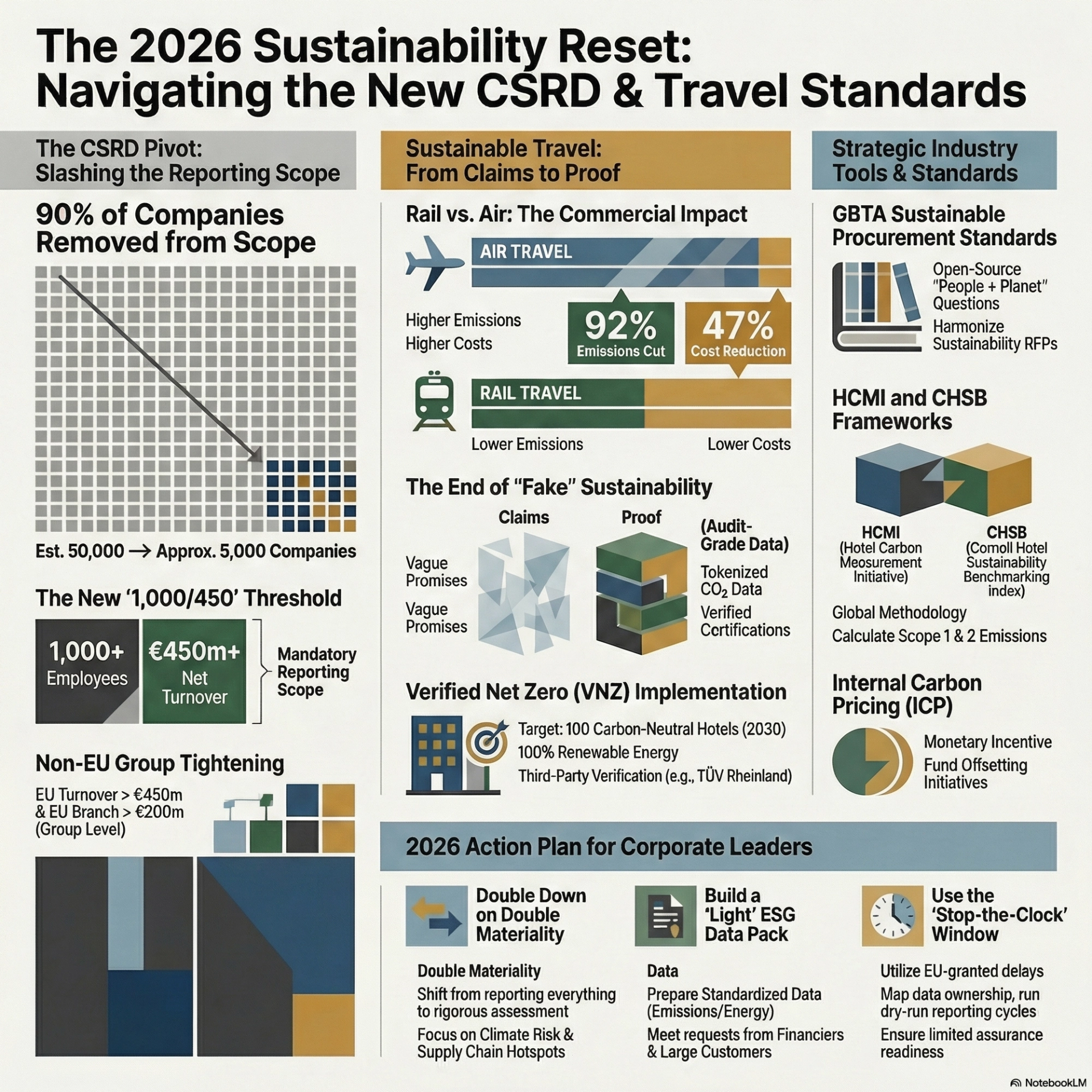
- A significant portion of the $1.55 trillion global corporate travel market (projected 67% by 2026) will prioritize green-certified hotels.
- Certifications like LEED, BREEAM, Green Key, and ISO 14001 are becoming mandatory for corporate programs, while OTAs prioritize sustainable hotels in search results.
- Sustainability investments yield an attractive ROI, with an average payback period of 1.4 years, driven by energy savings, increased corporate bookings, and access to green financing.
- Hotels must proactively implement ESG strategies, from energy mapping to obtaining certifications, to secure future revenue and financing.
The Silent Revolution: The ESG Filter in Corporate Travel
A silent yet profound transformation is underway in the world of corporate travel. ESG (Environmental, Social, and Governance) criteria, embedded within companies' travel policies, are fundamentally changing hotel selection. The issue is no longer just about price and location; carbon footprint reporting, energy efficiency certifications, and sustainability commitments are now central to the decision-making process.
This shift carries a critical message for hotel revenue managers: properties without sustainability certifications are quietly being removed from preferred supplier programs, even if they offer the most competitive rates.
Corporate ESG Impact by the Numbers
| Indicator | 2023 | 2025 | 2026 (Estimate) |
|---|---|---|---|
| Corporate travel programs applying ESG criteria | 38% | 62% | 74% |
| Companies requiring sustainability certificates | 22% | 45% | 58% |
| Green-certified hotel preference rate (corporate) | 31% | 54% | 67% |
| Corporate accounts leaving ESG-non-compliant hotels | 12% | 28% | 35%+ |
| Corporate travel spending (global) | $1.2T | $1.43T | $1.55T |
The fact that 67% of the $1.55 trillion corporate travel market prefers green-certified hotels signifies a serious loss of revenue for uncertified properties.
Which Certifications Make a Difference?
Certifications and their impact, prominent in corporate travel managers' decision-making processes:
Tier 1: Mandatory Certifications
- LEED (Leadership in Energy and Environmental Design): 72% of US-based companies require LEED or its equivalent for their preferred supplier lists.
- BREEAM: A standard criterion for European-based corporate programs.
- Green Key: A hotel-specific, easily accessible, and widely recognized certification.
Tier 2: Certifications Providing a Competitive Advantage
- Zero Carbon Certification: Carbon-neutral operations certificate; particularly emphasized in the preferred lists of technology companies.
- Verified Net Zero: Science-based verified net-zero commitment.
- ISO 14001: Environmental management system standard; a fundamental criterion in corporate supply chain evaluations.
Tier 3: Future Mandatory Standards
- EU Taxonomy Compliance: Reporting obligation for companies operating in the EU starting from 2027.
- CSRD (Corporate Sustainability Reporting Directive): Will extend supplier chain reporting to hotels as well.
OTAs Prioritize Green-Certified Hotels
Corporate demand isn't just coming from direct channels. Online travel agencies have also begun algorithmically prioritizing green-certified hotels:
- Booking.com: Hotels with the "Travel Sustainable" badge achieve an average of 18% higher visibility in search results.
- Expedia: Usage of the "Eco-Certified" filter has increased by 340% in the last two years.
- Google Travel: Carbon emission information is shown by default in hotel search results.
These OTA algorithm changes mean that hotels without sustainability certifications lose visibility in both corporate and individual channels.
Green Financing and Credit Access
The ESG impact is not limited to guest preferences. Financing channels are also tightening sustainability criteria:
| Financing Type | ESG Requirement | Impact |
|---|---|---|
| Green bond | LEED Gold+ or equivalent | 0.5-1.2% lower interest rate |
| Sustainable credit | ISO 14001 + carbon reporting | 15-25% increase in credit limit |
| EBRD/IFC financing | Comprehensive environmental impact assessment | Only access route in emerging markets |
| Insurance premium discount | Risk reduction certificates | 8-15% premium reduction |
EBRD and IFC financing is particularly critical for hotel investors in Turkey. These institutions no longer provide financing for projects that do not have sustainability certifications.
Concrete Action Plan for Hotels in Turkey
Phase 1: Current State Analysis (0-3 Months)
- Map energy consumption: Calculate kWh/room-night metric.
- Measure water consumption: Track liters/room-night metric.
- Waste management: Determine recycling rate.
- Carbon footprint: Calculate Scope 1 and Scope 2 emissions.
Phase 2: Quick Wins (3-6 Months)
- Green Key application: Accessible through TUROB in Turkey, low cost.
- LED conversion: 30-40% savings in energy costs, payback period 8-14 months.
- Smart thermostats: Energy savings in empty rooms, 15-20% reduction in HVAC costs.
- Digital check-in: Reduce paper consumption by 60%+.
Phase 3: Strategic Investments (6-18 Months)
- Solar panels: Can cover 25-35% of annual energy costs for hotels in the Mediterranean region.
- Wastewater treatment system: Reclamation for garden and pool irrigation.
- ISO 14001 certification: A core criterion sought by 58% of corporate accounts.
- Carbon offsetting program: A bridge to net-zero goals in the short term.
Phase 4: Revenue Management Integration (Continuous)
Combine sustainability investments with your revenue strategy:
- Green room premium: Create a sustainable room category and apply an 8-12% premium.
- ESG section in corporate RFP responses: Detail your certifications and metrics.
- Sustainability badges on OTA profiles: Benefit from increased visibility.
- Carbon reporting API: Offer automated emission reports to corporate clients.
ROI Calculation: Return on Sustainability Investment
Example calculation for a 150-room city hotel:
| Investment Item | Cost | Annual Savings/Revenue | Payback |
|---|---|---|---|
| LED conversion | €22,000 | €8,800 (energy) | 2.5 years |
| Smart HVAC | €35,000 | €12,600 (energy) | 2.8 years |
| Green Key certification | €3,500/year | €45,000 (corporate revenue increase) | 1 month |
| ISO 14001 | €15,000 | €28,000 (corporate accounts) | 6.4 months |
| Solar panels | €85,000 | €22,000 (energy) | 3.9 years |
| Total | €160,500 | €116,400 | 1.4 years |
When additional revenue from corporate accounts is included, the average payback period for sustainability investments drops to under 1.4 years.
Conclusion: Sustainability Is No Longer a Luxury, But a Revenue Channel
ESG criteria are no longer optional but mandatory in corporate travel policies. OTA algorithms favor green-certified hotels, and financing institutions do not lend to projects without sustainability certifications. Under this triple pressure, uncertified hotels are losing their competitive edge in both corporate and individual channels.
Does your revenue management strategy incorporate sustainability metrics? Do your corporate RFPs include an ESG section? Answering these questions now will be key to avoiding the loss of corporate accounts in 2027.
![EU Ecolabel for Hotels: How Green Certification Boosts Revenue [2026 Guide]](https://cdn.sanity.io/images/1la98t0z/production/8ee831a08361640644cf1e535d78c369291e715d-2752x1536.jpg?w=1920&q=50&auto=format&fit=max)