![Elevate Hotel Room Quality: Digital Inspection Checklist [Strategy Guide]](https://cdn.sanity.io/images/1la98t0z/production/28cd8e3607c11dae0c1b569bd2c2ca38ab8443d4-1200x669.png?w=1920&q=65&auto=format&fit=max)
Key Takeaways
- Digital room inspections are critical for guest satisfaction, as 68% of negative reviews cite cleanliness or maintenance issues.
- Implementing a digital system standardizes quality, reducing subjectivity and inconsistency prevalent in 75% of Turkish hotels.
- Hotels using digital inspections see a 35-45% reduction in cleanliness complaints and a 0.3-0.5 point increase in online review scores.
- A comprehensive checklist, objective scoring, photographic evidence, and instant notifications are essential features of an effective digital system.
- Data-driven insights from digital audits enable continuous improvement, targeted staff training, objective performance evaluation, and significant cost savings.
Room Quality: The Core Determinant of Guest Satisfaction
According to data from online review platforms, 68% of hotel guests mention room cleanliness or maintenance deficiencies in their negative reviews. A single stain, a non-working TV remote, or a missing towel can negatively impact a guest's entire perception of their stay. Therefore, room inspection is the most critical quality control process in hotel operations.
However, in 75% of hotels in Turkey, room inspections are conducted subjectively and inconsistently. The supervisor's mood, available time, and attention level on any given day determine the quality of the inspection. Without a standardized checklist, room quality can vary between two different floors of the same hotel.
Digital inspection checklists fundamentally solve this problem. They define standards, ensure consistency, and generate data for continuous improvement. Hotels that transition to a digital system see an average 35-45% reduction in cleanliness complaints and a 0.3-0.5 point increase in online review scores.
Embed this image on your site
<a href="https://otelciro.com/en/news/elevate-hotel-room-quality-digital-inspection-checklist-strategy-guide">
  <img src="https://cdn.sanity.io/images/1la98t0z/production/28cd8e3607c11dae0c1b569bd2c2ca38ab8443d4-1200x669.png" alt="Oda Denetim Dijital Kontrol Listesi İnfografiği" width="800" />
</a>
<p>Source: <a href="https://otelciro.com">OtelCiro</a> — AI Hotel Revenue Management</p>
Related reading: Operations Management with the OtelCiro Ecosystem
Comprehensive Checklist Design
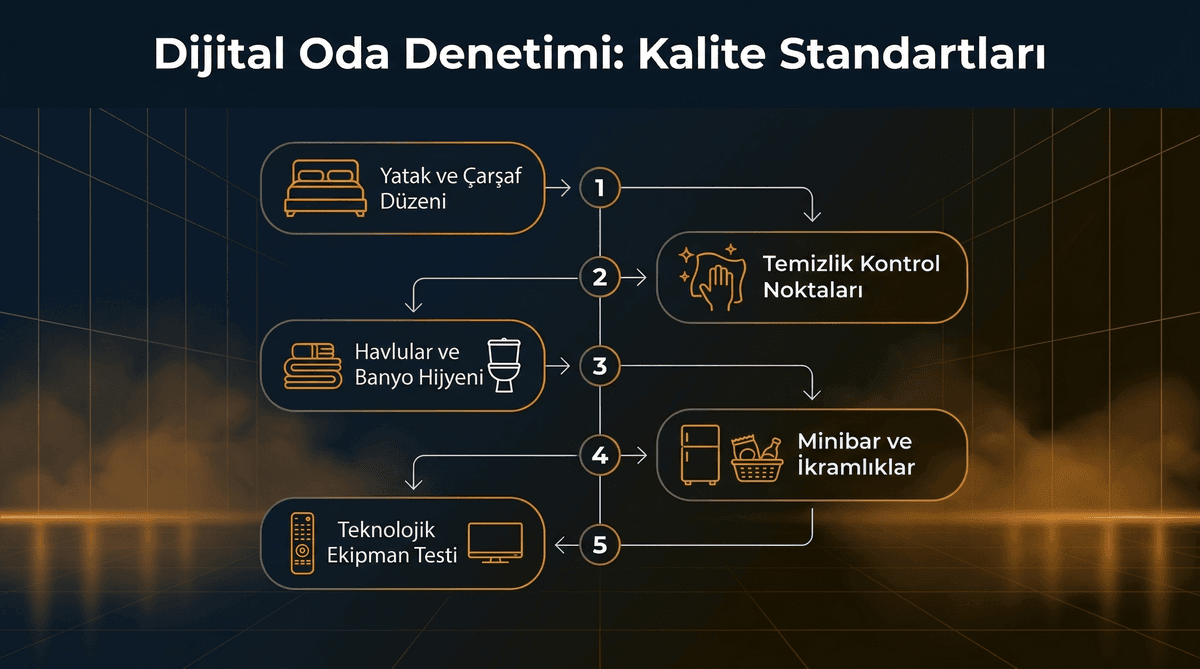
An effective room inspection checklist addresses each area of the room in a separate category. Under each category, concrete, measurable control points are included.
Bed Area (15 Control Points)
- Are the sheets taut and wrinkle-free?
- Are the pillows plump and symmetrically placed?
- Is the bedspread/duvet neat and stain-free?
- Is under the bed clean? (dust, trash control)
- Is the headboard clean and undamaged?
- Are nightstand surfaces dust-free?
- Are nightstand drawers clean and tidy?
- Is the lamp/lighting working and dust-free?
- Is the clock/alarm set correctly?
- Are power outlets and USB charging points working?
- Do the curtain rail and mechanism work properly?
- Does the blackout curtain provide full blackout?
- Is the carpet/floor clean and stain-free?
- Is the ventilation grille dust-free?
- Is the room scent neutral and pleasant?
Bathroom (18 Control Points)
- Are the sink and counter clean and shiny?
- Is the mirror spotless and fog-free?
- Is the shower/tub surface clean and free of limescale?
- Is the shower glass/curtain clean?
- Is the toilet bowl (inside and out) clean?
- Are the toilet seat hinges sturdy?
- Does the flush work properly?
- Do all faucets work without leaks?
- Is the hairdryer working and clean?
- Are towels sufficient in number and neatly folded?
- Is the bathrobe clean and hung?
- Is the amenity set (shampoo, shower gel, soap) complete?
- Is there sufficient toilet paper and is it neatly folded?
- Is the trash can clean and bagged?
- Is the floor dry and clean?
- Are grout and silicone areas clean and intact?
- Is the ventilation working and are the filters clean?
- Is the lighting adequate and are all bulbs working?
Sitting and Working Area (12 Control Points)
- Is the table surface clean and scratch-free?
- Is the chair clean and its mechanism sturdy?
- Is the television working and the remote control battery full?
- Is the Wi-Fi information card present and up-to-date?
- Is the hotel directory/information folder complete?
- Is the air conditioning/heating working and the remote control functional?
- Is the minibar stocked and tidy?
- Is the kettle/tea-coffee set clean and complete?
- Is the safe working?
- Is the wardrobe clean and are there enough hangers?
- Are slippers available and packaged?
- Is the iron and ironing board clean and in working condition?
General Condition (8 Control Points)
- Do the door lock and hinges work properly?
- Is the peephole functional?
- Is the emergency exit plan behind the door?
- Is the smoke detector in place and its indicator light on?
- Do all key card systems work?
- Are there any cracks, stains, or paint peeling on the walls and ceiling?
- Is there any damage or wear on the furniture?
- Is the room number visible and neat on the door?
These 53 control points provide a comprehensive inspection framework for a standard hotel room. For suite rooms, 15-20 additional control points are added.
Scoring System and Evaluation Methodology
Each control point receives one of three values:
- Passed (2 points): Fully compliant with the standard
- Conditionally Passed (1 point): Minor deficiency, can be quickly corrected
- Failed (0 points): Serious deficiency, room not ready for sale
Total point calculation: Standard room: 53 control points x 2 = 106 maximum points
- 90% and above (95+ points): Excellent — ready for sale
- 80-89% (85-94 points): Good — ready for sale after minor corrections
- 70-79% (74-84 points): Average — re-cleaning required
- Below 70% (73 points and below): Failed — comprehensive re-cleaning and maintenance
The goal is for the hotel's overall room inspection average to consistently remain above 90%. Hotels achieving this goal consistently score 8.5+ (on the Booking.com scale) in online reviews.
Related reading: Digitalizing Workflow with Housekeeping Mobile Application
Digital Inspection Application Features
An effective digital inspection application should have the following features:
Photo documentation: The supervisor takes a photo for every point marked as "Failed" or "Conditionally Passed." This photo serves three purposes:
- Concrete feedback to staff — instead of saying "You need to clean this stain in the bathroom," a photo is shown.
- Comparison during re-inspection — has the issue truly been resolved?
- Training material — frequently made mistakes are documented with photos.
Instant notifications: Once an inspection is completed, the results are automatically communicated to the relevant staff. In a "Failed" situation, a re-cleaning task is assigned immediately.
Trend reporting: Which control points fail most often is reported weekly and monthly. For example, if "bathroom grout cleaning" consistently receives low scores, special training is planned on this topic.
Staff performance scorecards: Each employee's average inspection score, strongest, and weakest areas are displayed. This provides objective data for performance evaluations.
Comparative analysis: Comparisons are made between floors, shifts, and periods. If floor A's average is 94 while floor B's is 82, it indicates a systematic problem on floor B.
Continuous Improvement Cycle
The digital inspection system fuels a continuous improvement cycle with its data:
Weekly analysis meeting: The Executive Housekeeper shares weekly inspection data with the team. The top 3 most frequently recurring deficiencies are identified, and a solution plan is developed.
Monthly training plan: Targeted training sessions are organized based on deficiencies identified from inspection data. Data-driven training, rather than general training, ensures efficient use of staff time.
Quarterly standard update: The checklist is updated based on guest feedback and inspection trends. New expectations (e.g., changes in hygiene standards) are added to the list, and unnecessary control points are removed.
Annual benchmark: In hotel chains, comparisons are made between properties. For independent hotels, comparisons are made against industry averages.
This cycle ensures the continuous elevation of the hotel's quality standard. An average inspection score of 85% in the first year can increase to 92% in the second year and 95% in the third year with systematic improvement.
Implementation Cost and Expected Outcomes
Digital room inspection system setup:
Software: Monthly 2,000-6,000 TL (as part of a housekeeping module) Tablet/device: 5,000-10,000 TL per supervisor (3-5 units) Setup and training: 15,000-30,000 TL Annual total cost: 54,000-132,000 TL
Expected return:
- Reduction in cleanliness complaints (35-45%): Annual value of preventing negative reviews 80,000-200,000 TL
- Increase in online review scores (0.3-0.5 points): Annual additional revenue of 100,000-300,000 TL through increased occupancy
- Staff efficiency: Re-cleaning rates decrease, annual time savings 30,000-60,000 TL
- Early maintenance detection: Technical issues detected during inspections are resolved before escalating, annual savings 20,000-50,000 TL
A digital room inspection system is an operational tool that creates a high impact with low cost. Consistent quality standards, objective performance evaluation, and data-driven continuous improvement — these are the cornerstones of guest satisfaction and online reputation. The transition from paper checklists to digital opens a new chapter in a hotel's quality management.

![Europe's Hotel Construction Boom: 2026 Oversupply Risks [Market Analysis]](https://cdn.sanity.io/images/1la98t0z/production/6dfe59137f56aa14bfcba86d9db3cf05ff89f406-2752x1536.jpg?w=1920&q=50&auto=format&fit=max)