![Digital Communication Tools for Hotel Operations [Strategy Guide]](https://cdn.sanity.io/images/1la98t0z/production/eddd4c279bc0662cb868710e772d87137ce9665c-2048x2048.png?w=1920&q=65&auto=format&fit=max)
Key Takeaways
- Communication gaps lead to 23% of guest requests being delayed or missed entirely.
- Traditional methods like radios and paper forms lack the traceability and data analysis required for modern standards.
- A robust digital infrastructure integrates instant messaging, structured task management, and digital shift handovers.
- Digital transformation can reduce guest response times by 45% and decrease operational errors by 55%.
- Successful implementation requires a phased transition and the appointment of "digital champions" within departments.
The Communication Crisis in Hotel Operations
Hundreds of information flows occur in a hotel's daily operation: guest requests, room status updates, maintenance notifications, shift changes, VIP guest notes, and emergency alerts. The delivery of this information to the right person, at the right time, and in the right format is the fundamental determinant of service quality. However, traditional communication methods are increasingly failing to meet these needs.
According to research by the Cornell Hospitality Quarterly, 47% of hotel employees identify a lack of interdepartmental communication as their biggest operational challenge. Due to communication breakdowns, 23% of guest requests are fulfilled late or missed entirely. This situation leads to a 15-20% drop in guest satisfaction scores and a loss of 0.3-0.5 points in online review ratings.
Embed this image on your site
<a href="https://otelciro.com/en/news/digital-communication-tools-for-hotel-operations-strategy-guide">
  <img src="https://cdn.sanity.io/images/1la98t0z/production/eddd4c279bc0662cb868710e772d87137ce9665c-2048x2048.png" alt="Digital Coordination via Team Communication Tools" width="800" />
</a>
<p>Source: <a href="https://otelciro.com">OtelCiro</a> — AI Hotel Revenue Management</p>
Related reading: Hotel Automation and Business Processes: Efficiency Guide
The Limitations of Traditional Communication Methods
Many hotels still attempt to manage operations using walkie-talkies (radios), paper notes, verbal transfers, and personal messaging apps. These methods have critical shortcomings:
Problems with Radio Communication
- Messages cannot be recorded; it is impossible to track who said what and when.
- Channels get congested; a housekeeping request can get lost on the security channel.
- Intelligibility is low in noisy environments (kitchen, technical services).
- Only one person can speak at a time per channel.
- Visual information (photos, documents) cannot be transmitted.
Limitations of Paper-Based Systems
Logbooks, forms, and sticky notes are still common in many hotels. However, this method:
- Is not real-time; information arrives at the end of the shift or the next day.
- Carries the risk of being lost or becoming illegible.
- Does not allow for data analysis and reporting.
- Is problematic in terms of environmental sustainability.
Personal Messaging Applications
Personal apps like WhatsApp are frequently used as informal communication channels. However, this creates several issues:
- It poses a risk to personal data security (KVKK/GDPR non-compliance).
- Message groups grow uncontrollably, leading to information clutter.
- Personnel who leave the job remaining in groups creates a security vulnerability.
- Professional work content becomes intertwined with personal messages.
Components of a Digital Communication Infrastructure
A modern hotel digital communication infrastructure consists of four core integrated components.
Instant Messaging and Channels
Digital messaging channels organized by department, task, and project streamline the flow of information. An effective channel structure includes:
- Departmental channels: Separate channels for departments like housekeeping, front office, kitchen, and technical services.
- Cross-functional channels: Channels involving multiple departments, such as VIP coordination, event management, and emergencies.
- General announcement channel: Information concerning all staff members.
- Management channel: Strategic decisions and high-level coordination.
The purpose, participants, and rules of each channel must be clearly defined. A guide for "what to share and what not to share in this channel" should be established.
Task Management System
Assigning guest requests, maintenance notifications, and operational tasks in a digital environment—and tracking them through to completion—requires a structured task management system beyond simple messaging.
In this system:
- Every task is assigned to a responsible person with a set deadline.
- Task status is monitored in real-time (pending, in progress, completed).
- Automatic reminder and escalation mechanisms trigger for delayed tasks.
- Completed tasks are recorded in the database and reported.
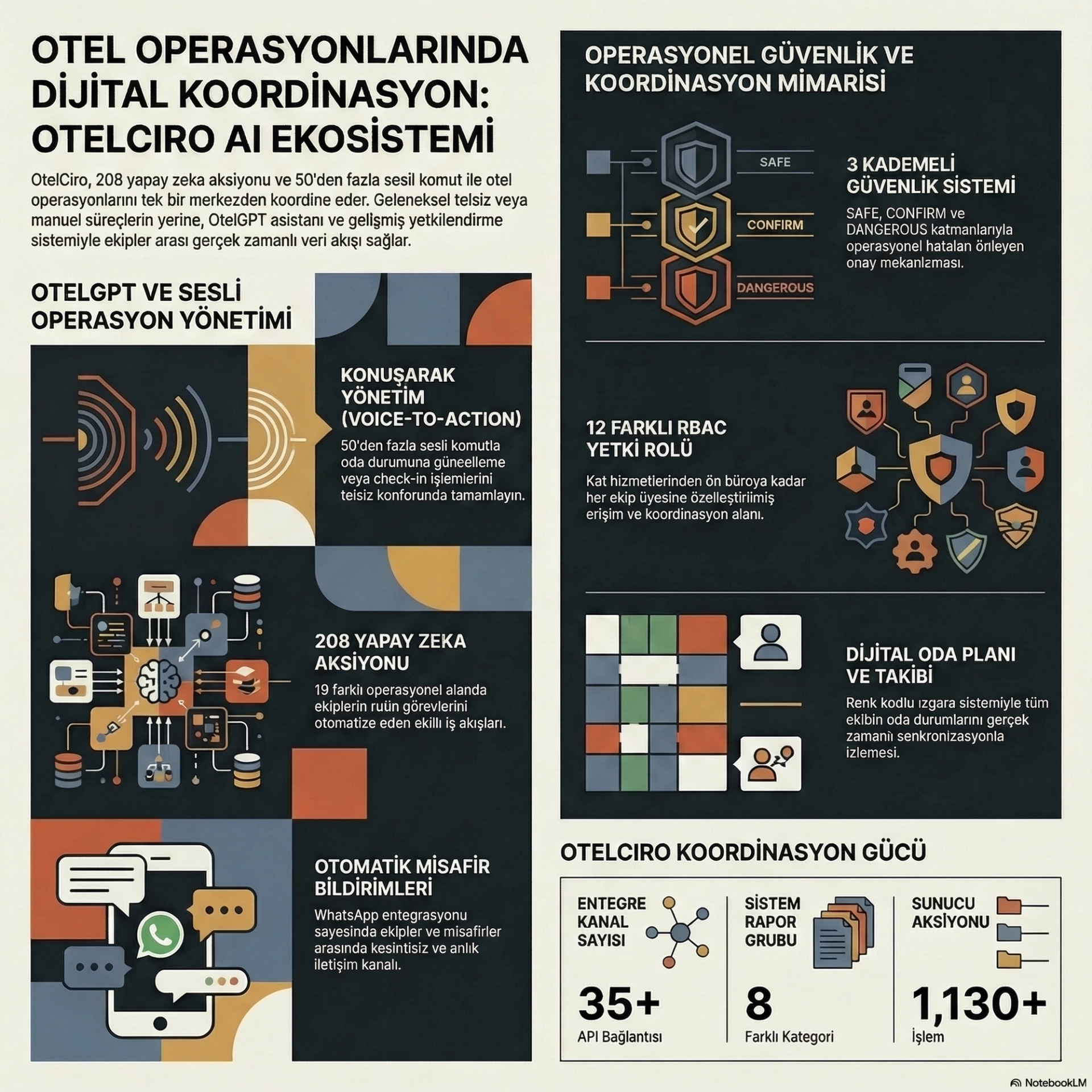
OtelCiro’s operations management module strengthens interdepartmental coordination by managing task assignment, tracking, and reporting processes in a digital environment.
Digital Shift Handover
Information loss during shift changes is one of the most common causes of operational errors. With a digital shift handover system:
- The outgoing shift records important notes (guest requests, pending maintenance work, VIP info) digitally.
- The incoming shift reads these notes to stay informed before taking over the duty.
- Handover records are archived and can be reviewed retrospectively when necessary.
- An alert system works for unread handover notes.
Hotels implementing digital shift handovers see an 80% reduction in information loss during transitions.
Knowledge Base and Procedure Guide
Keeping reference materials such as operational procedures, guest information, frequently asked questions, and emergency plans in a centralized digital knowledge base ensures employees can access the information they need instantly.
- Orientation time for new employees is shortened by 40%.
- Compliance with standard procedures increases by 30%.
- Simple questions directed to managers decrease by 55%.
Related reading: Digitalize Hotel Management with Smart PMS
Implementation Strategies
Transitioning to a digital communication infrastructure is a change management process that goes beyond technology selection. For successful implementation:
Phased Transition Plan
Rather than deploying the entire system at once, a phased transition carries lower risk:
Phase 1 (Months 1-2): Selection of pilot departments (usually front office or housekeeping), starting basic messaging and task management.
Phase 2 (Months 3-4): Evaluation of pilot results, expansion to other departments, and addition of the shift handover module.
Phase 3 (Months 5-6): Inclusion of all departments in the system, creation of the knowledge base, and completion of integrations.
Phase 4 (Month 7+): Optimization, data analysis, and continuous improvement.
User Training
The success of technology depends on user adoption. The training strategy should include:
- Customized training sessions for each department (30-60 minutes).
- Identifying "Digital Champions": Training an enthusiastic employee from each department as a power user.
- Preparation of visual guides and short video tutorials.
- Intensive support and feedback collection during the first 2 weeks.
Research shows that 60% of untrained employees abandon a new system within 30 days, while this rate drops to 15% for employees who receive structured training.
Overcoming Old Habits
The biggest obstacle to digital transition is changing old habits. Practical suggestions:
- Gradually reduce radio usage starting from a specific date (but do not remove radios entirely for emergencies).
- Replace paper forms with digital forms and physically remove the paper versions.
- Move personal messaging groups to the corporate platform and close the old groups.
- It is critical for managers to use the system personally and serve as role models.
Measurable Results
The operational impact of a digital communication infrastructure should be measured with concrete metrics:
- Guest request response time: Average response time decreases by 45% (from 25 minutes to 14 minutes) with digital task management.
- Interdepartmental communication satisfaction: A 30% increase in employee surveys.
- Operational error rate: Errors resulting from information loss decrease by 55%.
- Guest satisfaction score: An 8-12% increase following communication improvements.
- Managerial efficiency: Time spent on communication and coordination decreases by 40%.
- Employee onboarding time: Shortened by 35% thanks to the digital knowledge base.
OtelCiro’s operations management solutions accelerate information flow and raise service quality by unifying the digital coordination of hotel operations on a single platform. Investing in digital communication infrastructure is not just a cost item; it is a strategic decision that directly increases guest satisfaction and operational efficiency.
![Europe's Hotel Construction Boom: 2026 Oversupply Risks [Market Analysis]](https://cdn.sanity.io/images/1la98t0z/production/6dfe59137f56aa14bfcba86d9db3cf05ff89f406-2752x1536.jpg?w=1920&q=50&auto=format&fit=max)