![Co-Living Hotels: The Future of Long-Term Stays [2026 Guide]](https://cdn.sanity.io/images/1la98t0z/production/f83bac2fd54c4311a642765576f0a830c557dc20-2752x1536.jpg?w=1920&q=65&auto=format&fit=max)
Key Takeaways
- Growing Market & Target Audience: Co-living is a rapidly expanding hybrid accommodation model targeting digital nomads, corporate relocations, and lifestyle changers with long-term stays (30-180 days). The global market reached $8.2 billion in 2025 and is projected to exceed $24 billion by 2030, with Turkey showing significant growth potential.
- Distinct Design & Community Focus: Successful co-living hotels allocate 30-40% of their total space to common areas like shared kitchens, lounges, and critical coworking spaces. A dedicated Community Manager is vital for organizing weekly events and fostering guest integration.
- Operational & Technological Shift: Co-living operations require smart PMS solutions that support flexible, duration-based pricing, automated billing, contract management, and in-depth guest profiles, differing significantly from traditional hotel PMS systems.
- Enhanced Financial Performance: The model offers a more stable and predictable cash flow due to lower guest turnover. It dramatically reduces operational costs (e.g., 55-65% lower housekeeping, 70% lower guest acquisition) and reports 5-8 points higher GOP margins compared to traditional hotels.
- Strategic Opportunity: Co-living presents a significant opportunity for hoteliers, especially for diversifying revenue and increasing annual occupancy, potentially by 20-30% through hybrid seasonal models, particularly in high-potential regions like major Turkish cities.
Co-Living Hotel Concept: The New Paradigm of the Accommodation Sector
The accommodation sector is undergoing a much deeper transformation than the traditional "guest arrives, stays, leaves" model. The co-living hotel concept is opening a new frontier in the industry as a hybrid model that combines long-term accommodation with a community experience. This model offers living-accommodation spaces specifically designed for digital nomads, remote workers, and relocating professionals.
The global co-living market reached $8.2 billion in 2025 and is projected to exceed $24 billion by 2030, with a 24.3% compound annual growth rate. In Turkey, the 180% increase in digital nomad visa applications during the 2024-2025 period proves that this segment presents a significant opportunity for the Turkish hospitality sector.
Embed this image on your site
<a href="https://otelciro.com/en/news/co-living-hotels-the-future-of-long-term-stays-2026-guide">
  <img src="https://cdn.sanity.io/images/1la98t0z/production/f83bac2fd54c4311a642765576f0a830c557dc20-2752x1536.jpg" alt="Co-Living Uzun Dönem Konaklama İnfografiği" width="800" />
</a>
<p>Source: <a href="https://otelciro.com">OtelCiro</a> — AI Hotel Revenue Management</p>
Related reading: Bleisure Travel Trend: Business and Leisure Merge
What is a Co-Living Hotel and How Does It Differ from the Traditional Model
A co-living hotel is an accommodation model that brings together private living spaces and shared social areas under one roof. Guests maintain their privacy in their own rooms while experiencing a community in shared kitchens, workspaces, gyms, and social event venues.
Key differences from a traditional hotel include:
- Stay duration: Averaging 2-3 nights in traditional hotels, compared to 30-180 days in co-living
- Pricing: Weekly or monthly packages instead of nightly rates; per-night cost decreases by 40-60% as the stay extends
- Service model: Weekly cleaning instead of daily housekeeping, self-service laundry, shared kitchen
- Community management: Social events, networking organizations, coworking programs
- Technology: Smart locks, app-based service requests, community platform
Target Audience Segmentation
Co-living hotels serve three main target audiences:
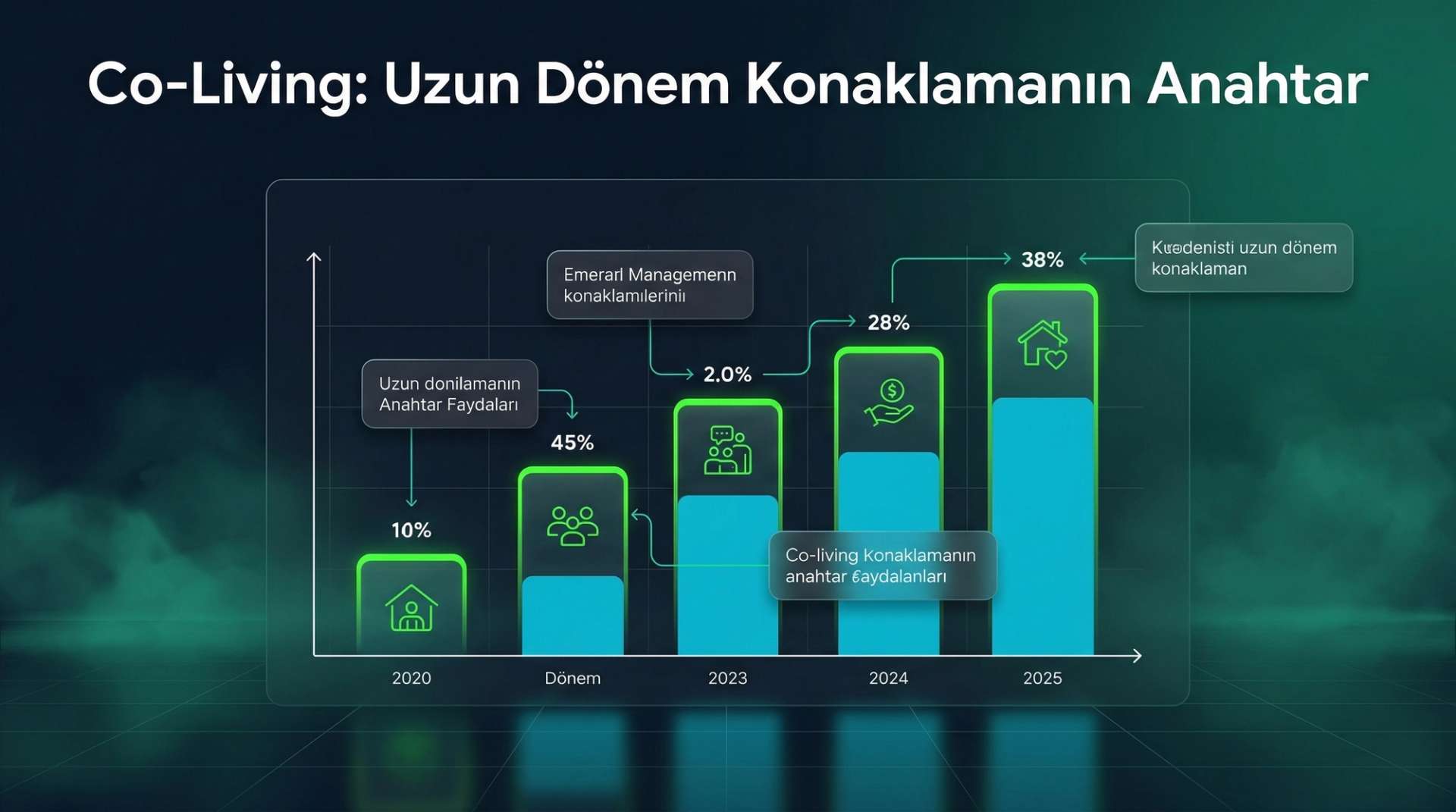
Digital nomads (45%): Professionals who work location-independently and travel from city to city. They seek strong Wi-Fi, ergonomic workspaces, and networking opportunities. Average stay duration 45-90 days.
Corporate relocations (30%): Employees transferring to a new city or on temporary project-based assignments. They provide long-term guaranteed income through corporate contracts. Average stay duration 60-180 days.
Lifestyle changers (25%): Guests looking for a home in a new city, undergoing a post-divorce transition, or exploring after retirement. Average stay duration 30-120 days.
Space Design and Experience Architecture
In a co-living hotel, physical space is the most powerful tool for building community. Design must skillfully balance private and common areas.
Private Spaces
Rooms are designed with a living unit concept, differing from traditional hotel rooms. A minimum of 25 m² space includes a kitchenette (at least tea/coffee facilities and a refrigerator), a work desk, ample storage, and a comfortable bed. Bathrooms must be private; the shared bathroom model has been unsuccessful in the co-living segment.
Common Areas
Successful co-living hotels dedicate 30-40% of their total space to common areas. This compares to 15-20% in traditional hotels. Shared kitchens, lounges, coworking spaces, gyms, rooftop terraces, and event areas are essential components.
Coworking space is particularly critical. It must cater to different work styles with quiet zones, meeting rooms, phone booths, and open desks. Research shows that co-living properties with quality coworking spaces report 32% higher guest satisfaction scores.
Operational Model and Technology Infrastructure
Co-living hotel operations require different processes and tools than traditional hotel management. The expectations of long-term guests are fundamentally different from those of daily guests.
PMS and Reservation Management
In long-term accommodation management, smart PMS solutions are vital. Features like monthly billing, duration-based pricing tiers, contract management, and corporate account tracking are not typically found in standard hotel PMS systems.
Essential features for a co-living PMS include:
- Flexible pricing tiers: Different rate structures for 1-6 nights, 7-29 nights, 30-89 nights, 90+ nights
- Automated billing: Monthly or weekly periodic invoice generation
- Contract management: Corporate agreements, minimum stay guarantees, early departure conditions
- In-depth guest profiles: Detailed profiles including work preferences, dietary requirements, social event participation
Community Management
The core value proposition of co-living is community. Therefore, creating a "Community Manager" role is critical. This individual organizes weekly events, integrates new guests into the community, and manages social dynamics.
Successful co-living properties organize at least 3-4 community events per week: breakfast gatherings, dinners, workshops, city tours, and networking nights. The impact of these events on occupancy is measurable: properties with a regular event program report 28% higher occupancy and 35% longer average stay durations than those without.
Related reading: Digital Transformation in Hotel Management with Smart PMS
Financial Model and Revenue Structure
The financial model of a co-living hotel offers a more stable and predictable cash flow than a traditional hotel. The lower guest turnover resulting from long-term stays significantly reduces operational costs.
Revenue Streams
Accommodation revenue (60-65%): Remains the primary revenue source, but its share of total revenue is lower compared to traditional hotels.
Coworking memberships (15-20%): Daily, weekly, or monthly coworking members from outside provide additional income. Average coworking membership revenue per property ranges between 80,000-150,000 TL per month.
Events and experiences (10-15%): Workshops, yoga classes, gastronomy events, and corporate meetings.
F&B and ancillary services (8-12%): Cafe-restaurant, laundry, bicycle rental, transfer services.
Cost Advantages
The impact of long-term stays on operational costs is dramatic:
- Housekeeping costs decrease by 55-65% (weekly cleaning instead of daily)
- Guest acquisition costs decrease by 70% (less turnover, fewer commissions)
- Laundry costs decrease by 40% (self-service model)
- Front desk staff requirements decrease by 50% (digital check-in, app-based communication)
Consequently, co-living hotels report 5-8 points higher GOP (Gross Operating Profit) margins compared to traditional hotels.
Co-Living Potential in Turkey
Turkey offers highly favorable conditions for co-living hotel investments. Affordable living costs, developing digital infrastructure, and cultural richness are among the primary reasons international digital nomads choose Turkey.
Major cities and tourism centers, especially Istanbul, Antalya, Izmir, and Bodrum, are ideal locations for co-living investments. Karaköy, Kadıköy, and Beşiktaş in Istanbul; Kaleiçi and Lara in Antalya; and Alsancak in Izmir hold high potential.
For Turkish hoteliers, the co-living model can also be considered an alternative revenue source during the off-season. Hybrid approaches, where a property operates as a traditional hotel during the summer season and transitions to a co-living model in winter, have the potential to increase annual occupancy rates by 20-30%.
The co-living hotel concept will continue to be one of the strongest trends shaping the future of the accommodation sector. Success in this segment is achievable with the right technology infrastructure, community management, and flexible pricing strategy.
![Europe's Hotel Construction Boom: 2026 Oversupply Risks [Market Analysis]](https://cdn.sanity.io/images/1la98t0z/production/6dfe59137f56aa14bfcba86d9db3cf05ff89f406-2752x1536.jpg?w=1920&q=50&auto=format&fit=max)