![Cloud PMS vs. On-Premise: Hotel Transition Guide [2026]](https://cdn.sanity.io/images/1la98t0z/production/e7bafa9293f887b24a2d4d0d26684221705d0113-1200x669.png?w=1920&q=65&auto=format&fit=max)
Key Takeaways
- The shift from on-premise to cloud-based PMS is critical for hotel digital transformation, with 92% of new hotels opting for cloud systems by 2026.
- Hotels transitioning to cloud PMS report 22-35% operational cost savings and an 8-15% increase in revenue management performance in the first year.
- Cloud PMS offers a significantly lower Total Cost of Ownership (TCO), with a 63% reduction over 5 years compared to on-premise systems for a 100-room hotel.
- Key advantages include anywhere access, automatic updates, easy integration, enhanced data security, business continuity, scalability, and predictable costs.
- A structured 5-phase roadmap ensures a smooth transition to a cloud PMS, minimizing operational disruptions and maximizing adoption.
From Server Room to Cloud: The Inevitable Transition
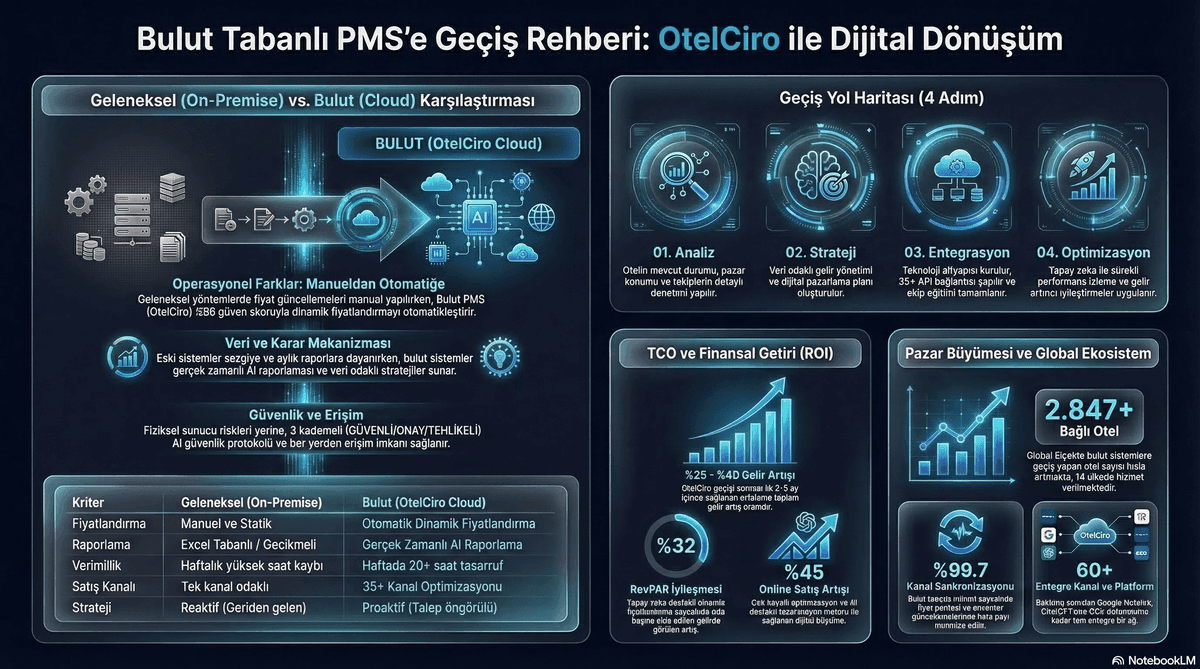
The most critical step in the hospitality industry's digital transformation is migrating the PMS to the cloud. By 2026, 92% of newly established hotels prefer cloud-based PMS, while 45% of existing hotels still use on-premise systems.
According to Phocuswright's research, hotels that switch to cloud PMS report 22-35% operational cost savings and an 8-15% increase in revenue management performance in the first year. Despite these figures, the biggest concerns for hotels delaying the transition are data security and the risk of the transition process disrupting operations.
In this guide, we will provide a detailed comparison of on-premise and cloud PMS, a TCO (Total Cost of Ownership) calculation, and a roadmap for a seamless transition.
Embed this image on your site
<a href="https://otelciro.com/en/news/cloud-pms-vs-on-premise-hotel-transition-guide-2026">
  <img src="https://cdn.sanity.io/images/1la98t0z/production/e7bafa9293f887b24a2d4d0d26684221705d0113-1200x669.png" alt="On-premise vs cloud-based PMS comparison" width="800" />
</a>
<p>Source: <a href="https://otelciro.com">OtelCiro</a> — AI Hotel Revenue Management</p>
Related reading: Hotel Management with Smart PMS: Transitioning from Traditional Systems to AI-Powered Platforms
Related reading: Hotel AI Email Automation: Personalized Communication
On-Premise vs. Cloud PMS Comparison
| Criterion | On-Premise PMS | Cloud PMS |
|---|---|---|
| Setup | Server purchase + installation (weeks) | Account creation + configuration (days) |
| Access | Only from hotel network | Anywhere, from any device |
| Updates | Manual, requires scheduled downtime | Automatic, seamless |
| Backup | Hotel's responsibility | Provider's responsibility |
| Scalability | Requires hardware investment | Scales instantly |
| Initial Cost | High (25,000-100,000€) | Low (monthly subscription) |
| Ongoing Cost | IT staff + maintenance + license | Monthly subscription (all-inclusive) |
| Integration | Limited, requires custom development | API-based, easy integration |
| Security | Hotel's responsibility | Provider (SOC 2, ISO 27001) |
| Disaster Recovery | Requires additional investment | Built-in (multi-region backup) |
Embed this image on your site
<a href="https://otelciro.com/en/news/cloud-pms-vs-on-premise-hotel-transition-guide-2026">
  <img src="https://cdn.sanity.io/images/1la98t0z/production/94430a233fc50ac1fa33aa6540d2d61c577b51bc-1200x2150.png" alt="Smart PMS hotel management system features" width="800" />
</a>
<p>Source: <a href="https://otelciro.com">OtelCiro</a> — AI Hotel Revenue Management</p>
TCO (Total Cost of Ownership) Calculation
For a 100-room hotel over a 5-year period:
On-Premise PMS
| Cost Item | Year 1 | Year 2-5 (Annual) | 5 Year Total |
|---|---|---|---|
| Software License | 30,000€ | 6,000€ (maintenance) | 54,000€ |
| Server Hardware | 8,000€ | 2,000€ (maintenance) | 16,000€ |
| Setup and Training | 5,000€ | - | 5,000€ |
| IT Staff (partial) | 12,000€ | 12,000€ | 60,000€ |
| Backup Infrastructure | 2,000€ | 500€ | 4,000€ |
| Total | 57,000€ | 20,500€ | 139,000€ |
Cloud PMS
| Cost Item | Year 1 | Year 2-5 (Annual) | 5 Year Total |
|---|---|---|---|
| Monthly Subscription | 9,600€ | 9,600€ | 48,000€ |
| Setup and Training | 3,000€ | - | 3,000€ |
| IT Staff | 0€ | 0€ | 0€ |
| Hardware | 0€ | 0€ | 0€ |
| Total | 12,600€ | 9,600€ | 51,000€ |
5-year difference: 88,000€ — Cloud PMS offers 63% lower TCO compared to on-premise.
Related reading: E-Invoice and Digital Accounting in Hotels: GİB Integration Guide (2026)
7 Core Advantages of Cloud PMS
1. Anywhere Access
The hotel manager can access the PMS from home, the executive from the corporate office, and the sales team from the field. This flexibility has become critical in the post-COVID era.
2. Automatic Updates
On on-premise systems, software updates are a planned operation and usually performed during night hours. In cloud PMS, updates are applied automatically and seamlessly.
3. Easy Integration
Modern cloud PMS systems easily connect to channel managers, RMS, CRM, and other systems via API-based integration.
4. Data Security
It may seem surprising, but cloud PMS is generally more secure than on-premise. Large cloud providers hold SOC 2 and ISO 27001 certifications, conduct regular penetration tests, and store data encrypted.
5. Business Continuity
In the event of natural disaster, theft, or hardware failure, the risk of data loss is high with an on-premise system. Cloud PMS guarantees business continuity with automatic backups and multi-region replication.
6. Scalability
When you add new rooms or open a new property, cloud PMS scales instantly. Multi-property management is much easier with the cloud.
7. Cost Predictability
A fixed monthly subscription fee simplifies budget planning. Unexpected hardware failures or emergency update costs are eliminated.
Embed this image on your site
<a href="https://otelciro.com/en/news/cloud-pms-vs-on-premise-hotel-transition-guide-2026">
  <img src="https://cdn.sanity.io/images/1la98t0z/production/8a93e1fc60466341571b6624007b4e830262ba56-1200x670.png" alt="OtelCiro ecosystem all-in-one platform view" width="800" />
</a>
<p>Source: <a href="https://otelciro.com">OtelCiro</a> — AI Hotel Revenue Management</p>
Cloud PMS Transition Roadmap
Phase 1: Preparation (4-6 weeks)
- Clean up existing PMS data (old guest records, data to be archived)
- Create a requirements list for the new PMS
- Identify integration needs (channel manager, POS, accounting)
- Develop a data migration plan
Phase 2: Selection and Contract (2-4 weeks)
- Conduct demos with a minimum of 3 cloud PMS providers
- Contact reference hotels to learn about user experience
- Negotiate SLA (Service Level Agreement) terms
- Clarify data ownership and exit strategy
Phase 3: Setup and Testing (4-8 weeks)
- Perform data migration
- Set up and test integrations
- Provide staff training (minimum 2 full days)
- Initiate a parallel operation period (old and new systems concurrently)
Phase 4: Go-Live (1-2 weeks)
- Transition during a low occupancy period
- Have extra support staff available for the first week
- Perform daily data verification checks
Phase 5: Optimization (Continuous)
- Collect user feedback
- Configure automation rules
- Customize reporting dashboards
Related reading: Housekeeping Automation: 7 Steps to Digitizing Hotel Operations
OtelCiro Smart PMS
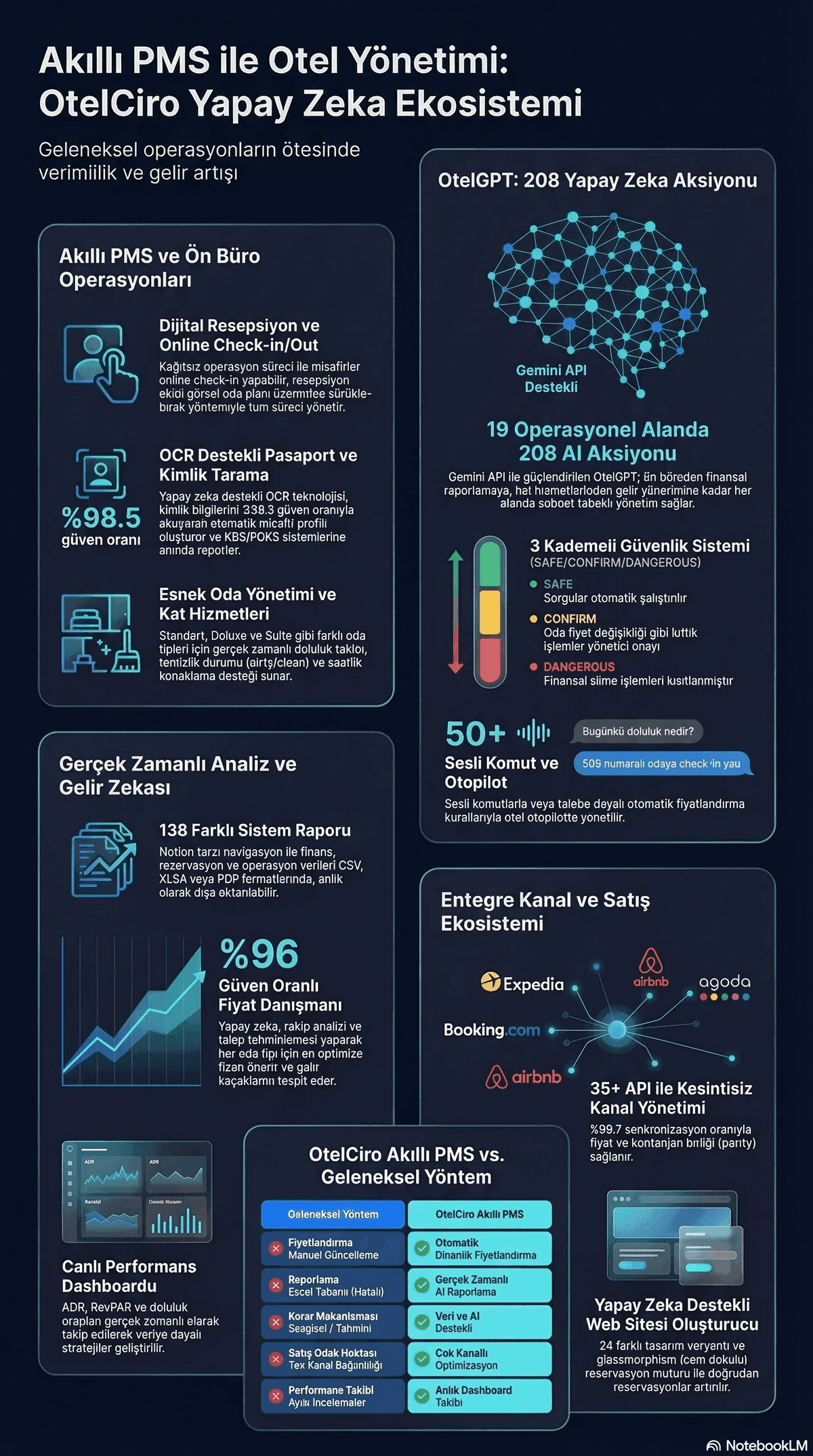
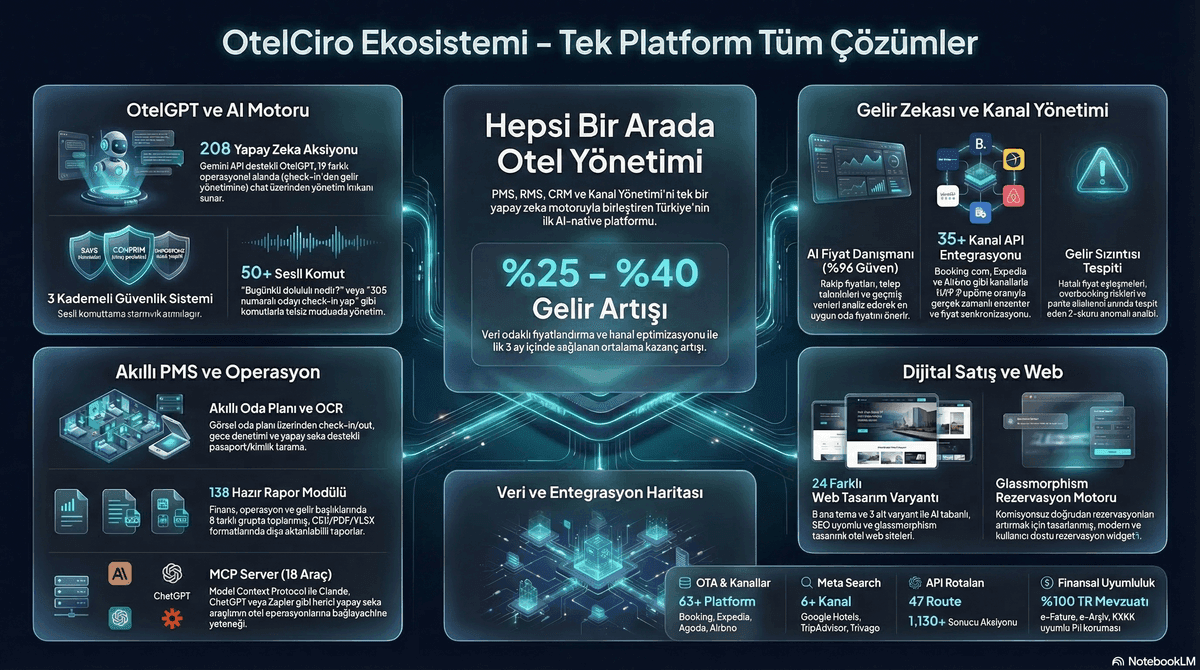
OtelCiro's Smart PMS module is a 100% cloud-based, modern, and integrated hotel management system. Thanks to its API-first architecture, it works seamlessly with all systems in your hotel ecosystem.
Transition to the cloud with OtelCiro Smart PMS
Conclusion
On-premise PMS is a solution belonging to a past era of hotel technology. In 2026, cloud PMS is clearly superior in terms of cost advantage, accessibility, security, and flexibility.
The fear of transition is an understandable concern, but with proper planning and step-by-step implementation, a smooth transition is possible. Every day you delay, you move further away from a competitive advantage.
Discover how OtelCiro's Smart PMS can automate this process for you.
![Europe's Hotel Construction Boom: 2026 Oversupply Risks [Market Analysis]](https://cdn.sanity.io/images/1la98t0z/production/6dfe59137f56aa14bfcba86d9db3cf05ff89f406-2752x1536.jpg?w=1920&q=50&auto=format&fit=max)