![citizenM: AI Drives 18% RevPAR Growth [2026 Case Study]](https://cdn.sanity.io/images/1la98t0z/production/de0db9c9e496f2fef0f552a1a69b470a97aa1c8c-1024x1024.png?w=1920&q=65&auto=format&fit=max)
Key Takeaways
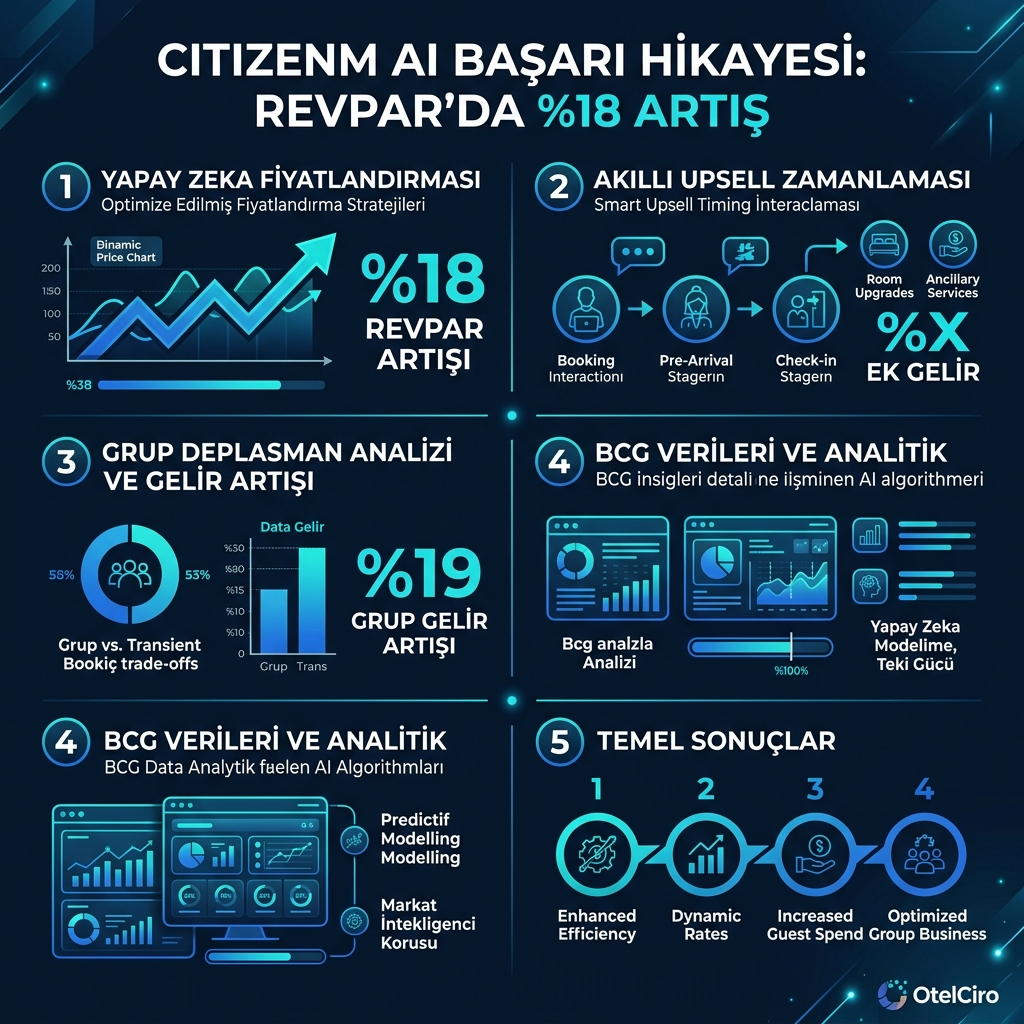
- AI-Driven RevPAR & Revenue Growth: citizenM achieved an 18% RevPAR increase and 19% group revenue growth by implementing an AI-powered dynamic pricing and revenue management system.
- Operational Efficiency: The brand operates with 75% fewer staff per room compared to traditional hotels and utilizes modular construction, resulting in 30% cost savings and 40% faster build times.
- Data-Centric Strategy: Their success is built on combining real-time demand signals, competitor pricing, historical data, and booking window analysis to enable continuous pricing optimization.
- Strategic Upselling & Group Pricing: AI optimizes upsell timing, increasing conversion rates by 42%, and enhances group pricing through sophisticated displacement analysis and F&B revenue projections.
- Applicable Lessons for Boutique Hotels: The citizenM model provides valuable insights for hotels of all sizes, emphasizing robust data infrastructure, a human-machine collaboration model, gradual AI adoption, and leveraging self-service technology.
citizenM: The Hotel Industry's Tech Manifesto
When citizenM opened its first hotel at Amsterdam Schiphol Airport in 2008, the industry regarded it as a "niche experiment." As of 2026, operating 35 hotels and 8,200+ rooms worldwide, the brand is redefining "affordable luxury" with technology, writing one of the sector's most remarkable growth stories.
citizenM's uniqueness stems from positioning itself not as a "hotel company" but as a "technology company." It developed its own PMS, eliminated the front desk with self-check-in kiosks, and digitized all in-room controls (lighting, blinds, AC, TV) via tablet and mobile app. This approach requires 75% less staff per room compared to traditional hotels.
However, citizenM's truly groundbreaking move was the full-scale deployment of its AI-powered revenue management system (RMS) in 2024. Results validated by BCG (Boston Consulting Group) prove that AI has transitioned from a "conceptual discussion" phase to "measurable business outcomes" in the hotel industry.
Embed this image on your site
<a href="https://otelciro.com/en/news/citizenm-ai-drives-18-revpar-growth-2026-case-study">
  <img src="https://cdn.sanity.io/images/1la98t0z/production/de0db9c9e496f2fef0f552a1a69b470a97aa1c8c-1024x1024.png" alt="citizenM AI success story - RevPAR and revenue growth data infographic" width="800" />
</a>
<p>Source: <a href="https://otelciro.com">OtelCiro</a> — AI Hotel Revenue Management</p>
Related reading: Technology Hotel: The Fully Automated Smart Accommodation Concept
18% RevPAR Increase: The Strategy Behind the Numbers
According to BCG's independent assessment, citizenM's AI-powered revenue management system recorded an 18% RevPAR increase in the first 12 months after full implementation. This increase is comprised of three core components.
Component 1: Dynamic Pricing Optimization — 11% ADR Increase
Traditional revenue managers update prices 2-3 times a day. citizenM's AI system optimizes prices on an hourly basis and separately for each room type. The data sources used by the system include:
- Real-time demand signals: Google Flights search data, city event calendars, airline occupancy rates, and weather forecasts
- Competitor price monitoring: Tracking prices of 15-20 competitor hotels in the same location at 15-minute intervals
- Historical performance data: Occupancy and revenue data from the same period, same day, and same event cycle over the last 3 years
- Booking window analysis: Measuring price elasticity based on the reservation timeframe — early bookings and last-minute reservations show different price sensitivities
By combining these four data sets, the AI model uses continuous pricing instead of traditional "fixed price tiers." The result: ADR increased by 11% compared to the pre-AI period — without decreasing occupancy.
Component 2: Occupancy Optimization — 3% Increase
The second component of the RevPAR increase is a 3% improvement in occupancy rate. The AI system detects low-demand periods 14 days in advance, triggering automated actions:
- Launching targeted digital campaigns (Google Ads, Meta)
- Activating OTA visibility enhancement tools
- Sending special promotions to corporate accounts
- Initiating last-minute price reductions at optimal times
This proactive approach provides an intervention opportunity 14 days earlier than traditional "wait-and-see" strategies, thereby boosting occupancy rates.
Component 3: Upsell Timing Optimization — 4% Additional Revenue
One of the most innovative applications of citizenM's AI system is the timing of upsell offers. In the traditional approach, room upgrades are offered at check-in. The AI system, however, presents different offers at various points in the guest's reservation-stay journey:
- Post-booking (48 hours): Room upgrade — while the guest still has budget flexibility
- Pre-stay (72 hours): Early check-in, late check-out, transfer services
- At check-in: Instant room upgrade based on availability — usually discounted
- During stay: Restaurant and experience recommendations — personalized based on guest profile
According to BCG's analysis, this timing optimization increased upsell conversion rates by 42%. The additional revenue contribution per guest was 4%.
Related reading: Hotel Upgrade Revenue Model: Automated Offers with AI
19% Increase in Group Revenue
Another remarkable aspect of citizenM's AI success is the 19% increase in group and corporate segment revenue. This increase was achieved through two mechanisms.
Smart Group Pricing
In traditional group pricing, sales teams apply fixed discount percentages. The AI system, however, optimizes each group offer separately:
- Displacement analysis: Calculates the potential revenue of individual reservations displaced if a group is accepted.
- Optimal discount rate: Dynamically determines the discount based on group size, stay dates, and current occupancy.
- Minimum price floor: AI ensures the group's total revenue contribution does not fall below the individual sales scenario.
- F&B revenue projection: Includes potential non-lodging revenues for a total value analysis.
Corporate Account Scoring
The AI system scores each corporate account based on past performance: cancellation rate, length of stay, ancillary revenue contribution, and growth potential. This scoring makes the sales team's negotiation process data-driven, enabling them to offer competitive proposals while preserving profitability.
75% Less Staff Per Room: Operational Model
citizenM's cost advantage comes not only from AI but also from its meticulously designed operational model. According to STR Global data, while a traditional 4-star hotel employs 0.8-1.2 staff per room, citizenM's ratio is 0.2-0.3 — that's 75% less.
How is this possible?
Reception elimination: 24/7 check-in/check-out with self-check-in kiosks and a mobile app. Instead of a traditional front desk, "ambassadors" — a limited number of multi-skilled staff focused on sales and guest relations.
Tablet-controlled rooms: All in-room functions (lights, blinds, AC, TV) are controlled via tablet and app. The technical fault reporting system is automated — guests report via tablet, and a work order goes directly to the maintenance team.
Standardized room design: All citizenM rooms are nearly identical in size and layout. This standardization reduces housekeeping time to 12 minutes per room — compared to the industry average of 25-30 minutes.
Centralized operation: Revenue management, digital marketing, and guest communication are handled by central teams. An 8-person central revenue management team, supported by AI, manages pricing for 35 hotels.
Modular Construction: 30% Cost and 40% Time Savings
citizenM's technological advantage starts from the construction phase. The brand produces its rooms as prefabricated modules in a factory and assembles them on-site. According to analysis by the Cornell Center for Hospitality Research, this approach offers:
- Construction cost: 30% lower than traditional construction
- Construction time: 40% shorter — a 200-room hotel is completed in 8-9 months instead of 12-14 months
- Quality consistency: Factory production is much more controlled and standardized than on-site conditions
- Waste reduction: Construction waste is 70% less — contributing to sustainability goals
This modular approach significantly shortens the payback period for new hotel investments. The ROI period, which is typically 7-10 years for traditional hotel construction, is reduced to 4-6 years with the citizenM model.
Financial Analysis of AI Investment
Cost-benefit table for citizenM's AI revenue management investment:
- Total AI investment (first year): Approximately 1.2 million Euros (software, integration, consulting, training)
- Annual operating cost: Approximately 400,000 Euros (license, maintenance, data infrastructure)
- Annual additional revenue: Approximately 8.5 million Euros (18% RevPAR increase + 19% group revenue increase)
- Channel optimization savings: 2.8 million Euros (direct channel share from 32% to 41%)
- Net ROI (first year): Approximately 600%
- Payback period: 2.5 months
BCG's industry analysis confirms these figures for a portfolio of 35 hotels, but also indicates that strong results can be achieved on a single-hotel basis. Hotels with 50+ rooms have been found to achieve an average ROI of 200-400% from AI RMS investment.
Forecast Accuracy and Operational Improvements
AI-powered demand forecasting increased citizenM's occupancy forecast accuracy from 78% to 93%. The operational results of this 15-point improvement include:
- Overbooking rate: Decreased from 2.1% to 0.6% — increasing guest satisfaction
- Staff planning: Accurate occupancy forecasts optimize housekeeping and F&B staff scheduling
- Energy management: Floor-by-floor energy consumption is adjusted based on expected occupancy
- Inventory optimization: Minibar, laundry, and amenity stocks are planned according to occupancy forecasts
Applicable Lessons for Turkish Boutique Hotels
The citizenM case offers concrete lessons for hotels of all sizes. How can Turkish boutique hotels benefit from this model?
Lesson 1: Data Infrastructure Comes First
citizenM's AI success was built on 10 years of clean data accumulation. Before implementing AI, the following must be done:
- Consolidating PMS, CRS, and channel manager data into a single data lake
- Cleaning and standardizing historical data
- Establishing real-time data streams
OtelCiro's cloud-based PMS offers this infrastructure pre-built — data is structured and AI-ready from day one.
Lesson 2: Human + Machine Model
citizenM did not eliminate revenue managers but rather transformed their roles. While AI handles routine decisions, revenue managers:
- Monitor the performance of AI models
- Manage exceptional situations (major events, crises)
- Approve strategic pricing decisions
- Evaluate new market and segment opportunities
Lesson 3: Gradual Implementation
The AI system was not deployed at full capacity all at once. A three-phase approach was followed:
- Phase 1 (3 months): Revenue managers review and apply AI recommendations — "shadow mode"
- Phase 2 (6 months): Full automation in specific hotels, hybrid in others
- Phase 3 (12+ months): Full automation across the entire portfolio, except for exceptional circumstances
Lesson 4: Self-Service Technology Adaptation
A Turkish boutique hotel with 50-100 rooms cannot replicate citizenM's entire tech stack. However, it can gradually adopt elements such as:
- Online check-in: Eliminating front desk waiting times with PMS-integrated web check-in
- Mobile key: Removing the need for physical cards with smart lock systems
- AI pricing: Hourly price optimization with OtelCiro's dynamic pricing module
- Digital concierge: Automating guest communication with WhatsApp Business or OtelGPT
Lesson 5: Continuous Calibration
AI models do not operate with a "set and forget" approach. citizenM's models are optimized through the following cycle:
- Weekly performance evaluation
- Monthly parameter calibration
- Quarterly model update
- Annual full model revision
Conclusion: The Future of Data-Driven Hospitality is Here
The citizenM case study is one of the most concrete proofs of artificial intelligence's transformative power in the hotel industry. Figures such as 18% RevPAR increase, 19% group revenue growth, 75% staff efficiency, and 600% ROI demonstrate that the AI investment question is no longer "should we?" but "how and when?"
The critical takeaway for Turkish hotels: AI success is achieved not merely by purchasing software, but through data infrastructure, organizational transformation, and a gradual implementation strategy. OtelCiro's AI-powered revenue management and dynamic pricing solutions offer a framework adapted to the Turkish hospitality sector to yield citizenM-like results, enabling facilities of all sizes to benefit from this transformation.
Technology is no longer the sole domain of large chains — with the right tools, every boutique hotel can write its own digital transformation story.
![Europe's Hotel Construction Boom: 2026 Oversupply Risks [Market Analysis]](https://cdn.sanity.io/images/1la98t0z/production/6dfe59137f56aa14bfcba86d9db3cf05ff89f406-2752x1536.jpg?w=1920&q=50&auto=format&fit=max)