![Boutique Hotel Branding: Niche Marketing Strategy [2026 Guide]](https://cdn.sanity.io/images/1la98t0z/production/f557d267618595b29246eb30abbdd514f1bca065-2048x1143.png?w=1920&q=65&auto=format&fit=max)
Key Takeaways
- The boutique hotel segment has grown by 45% in five years, with over 4,500 hotels in Turkey by 2026, making strong branding crucial for differentiation.
- Boutique hotels with robust brand identities achieve 22-35% higher ADR and 18-28% higher occupancy rates compared to unbranded competitors.
- A strong brand is built upon a specific, single-sentence value proposition, a consistent visual identity, a unique brand voice, and a seamless guest experience.
- Niche positioning is key; focusing on specific audiences (e.g., gastronomy, wellness, pet-friendly) can lead to ADR premiums of 10-50%.
- Digital presence (website, social media, email marketing) and a consistent guest experience across all touchpoints are vital for brand integrity and achieving 40%+ direct bookings.
Brand in Boutique Hotels: The Sole Path to Differentiation
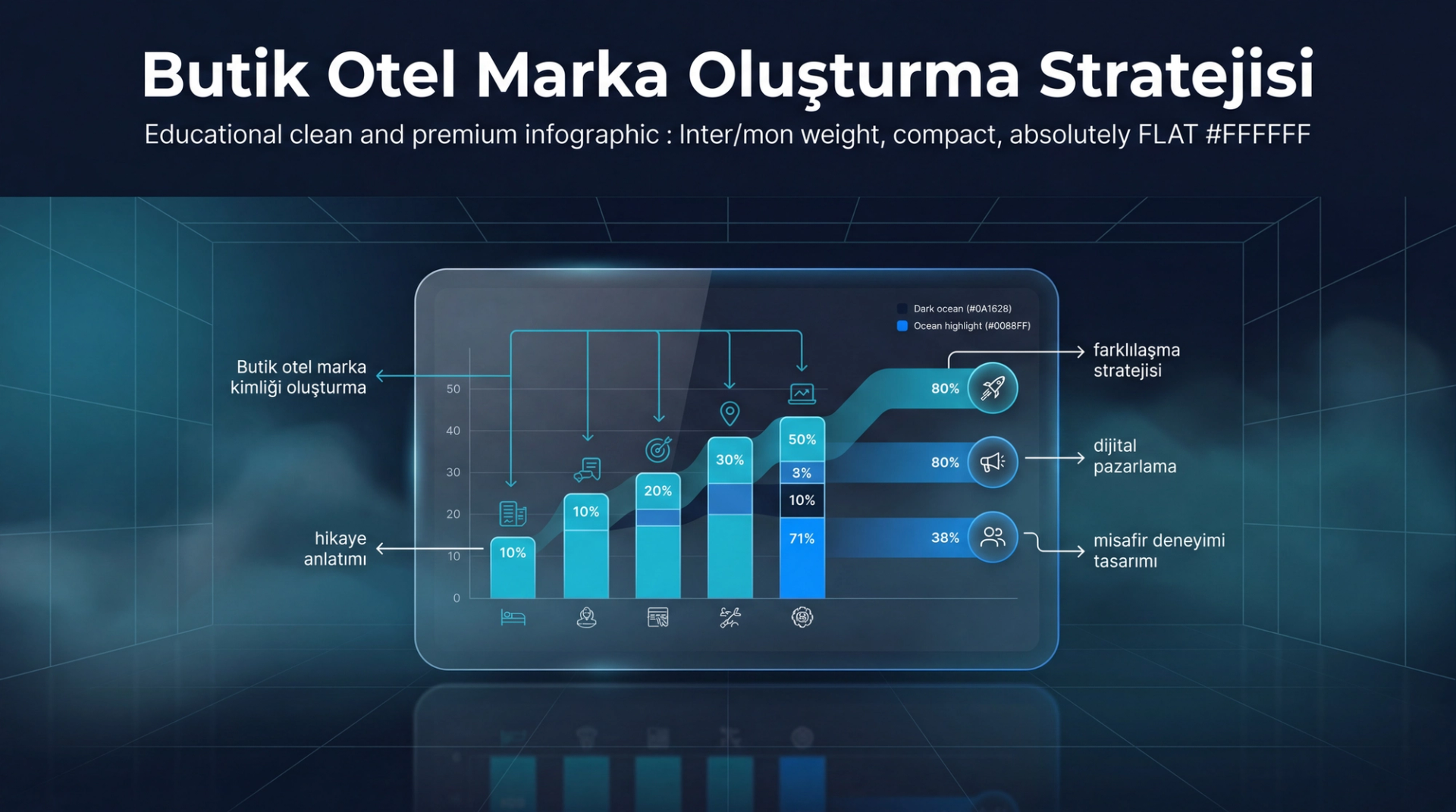
The boutique hotel segment has grown by 45% in the last five years, becoming the most dynamic area of the hospitality industry. However, rapid growth also means exponentially increasing competition. In 2026, over 4,500 boutique hotels operate in Turkey, and this number grows by 12% annually. In this highly competitive environment, the way to differentiate is by creating a strong brand identity.
Research indicates that boutique hotels with a strong brand identity achieve 22-35% higher ADR (Average Daily Rate) and 18-28% higher occupancy rates compared to unbranded counterparts. A brand is not just a logo or a color palette — it is a holistic experience that guests feel at every touchpoint with your property.
Embed this image on your site
<a href="https://otelciro.com/en/news/boutique-hotel-branding-niche-marketing-strategy-2026-guide">
  <img src="https://cdn.sanity.io/images/1la98t0z/production/f557d267618595b29246eb30abbdd514f1bca065-2048x1143.png" alt="Boutique Hotel Brand Creation Strategy Infographic" width="800" />
</a>
<p>Source: <a href="https://otelciro.com">OtelCiro</a> — AI Hotel Revenue Management</p>
In this article, we delve into every step of the boutique hotel branding process, niche marketing strategies, and ways to build a brand in the digital world.
Related reading: Franchise vs. Independent Hotel: Decision Guide
Brand Identity Design: Building from the Foundation
A boutique hotel brand is built upon four interconnected core elements: value proposition, visual identity, brand voice, and guest experience.
Value Proposition
What is the reason for your boutique hotel's existence? Why should a guest choose your hotel? The value proposition is the clear answer to these questions and the starting point for your entire brand strategy.
Examples of strong value propositions:
- "The living Hittite heritage in stone mansions, at the heart of Cappadocia" (history-focused)
- "A gastronomic experience where you discover the secrets of Aegean cuisine" (gastronomy-focused)
- "Reconnect with yourself and nature through a digital detox" (wellness-focused)
- "A hotel designed by artists, where every room is a gallery" (art-focused)
The value proposition should fit into one sentence and be specific. Boutique hotel brands that try to promise "everything" fail because the strength of a boutique hotel lies in its focus.
Visual Identity
The visual identity of a boutique hotel is the physical expression of the brand and must be consistent across every touchpoint:
- Logo: Simple, timeless, legible at small sizes. Avoid overly decorative logos.
- Color palette: Primary color + 2-3 complementary colors. Should reflect the brand's emotional tone.
- Typography: Heading and body text fonts. Legibility and character harmony.
- Photography style: Consistency in lighting, angle, tone, and atmosphere. Do not use stock photos.
- Materials and textures: Paper and print quality for printed materials such as business cards, menus, and room guides.
Brand Voice
How does your brand speak? The brand voice must be consistent, from website copy to social media posts, from guest greetings to email communication.
Effective brand voice characteristics for boutique hotels:
- Friendly but professional: Avoid corporate coldness while not being overly casual.
- Knowledgeable and local: Offer deep insights into the region, history, and culture.
- Personal: Address the individual rather than using general statements.
- Consistent: Maintain the same character and tone across all channels.
Target Audience Identification and Niche Positioning
The biggest mistake a boutique hotel can make is trying to appeal to "everyone." Niche positioning, by focusing on a narrow but deep audience, increases both marketing effectiveness and guest loyalty.
Niche Identification Process
1. Existing guest analysis: Review reservation data from the last 2-3 years. Which guest segment is the most profitable? Which profile yields the highest satisfaction scores? Which segment returns repeatedly?
2. Competitive gap analysis: Which niches are other boutique hotels in your region focusing on? Is there an untapped niche?
3. Property alignment: Which niche is best suited for your physical space, location, and team?
4. Market size: Is your chosen niche large enough to generate sustainable revenue?
Popular Boutique Hotel Niches
| Niche | Target Audience | ADR Premium | Growth Rate |
|---|---|---|---|
| Gastronomy | Foodie travelers, chef enthusiasts | +%30-45 | %18/year |
| Art & Design | Culture enthusiasts, creative professionals | +%25-35 | %15/year |
| Wellness & Yoga | Health-focused, mindful travelers | +%35-50 | %22/year |
| Historical Heritage | History enthusiasts, cultural tourists | +%20-30 | %10/year |
| Ecological & Sustainable | Environmentally conscious travelers | +%15-25 | %25/year |
| Pet-friendly | Pet owners | +%10-20 | %30/year |
Related reading: Hotel Reputation Management and ROI
Digital Brand Building
Building a brand in the digital world is as important for boutique hotels as the physical experience. 80% of the guest journey begins in the digital realm.
Website
A boutique hotel website is the digital home of the brand and the most important sales tool:
- Visually-driven design: High-quality photos, video, and virtual tours. Convey the brand's atmosphere on the first screen.
- Mobile-first: 72% of visitors come from mobile devices. The mobile experience should be designed before desktop.
- Fast loading: If page load time exceeds 3 seconds, 53% of visitors abandon the page.
- Direct booking: Easy and secure online booking engine. Avoid redirecting to OTAs.
- Content marketing: Attract organic traffic with blogs, local guides, and gastronomy stories.
Social Media Strategy
For boutique hotels, social media is the most powerful tool for brand building. However, instead of being present on every platform, it is necessary to focus on platforms appropriate for the target audience.
Instagram: The primary platform for boutique hotels. Visual storytelling, room details, food presentations, local experiences. Use hashtag strategy and geo-tagging for discoverability. Target: 4-5 posts per week, daily stories.
Pinterest: Strong impact during wedding, honeymoon, and travel planning stages. High-quality pins provide long-term organic traffic.
TikTok: To reach a young audience and create viral content. Behind-the-scenes, staff stories, local experiences.
Email Marketing
A boutique hotel's most valuable digital asset is its email list. Sending regular, value-adding content to a list composed of past guests, website subscribers, and event attendees increases repeat visit rates by 35-45%.
Brand Integrity Through Guest Experience
Consistency between the brand promise and the guest experience determines the credibility of a boutique hotel brand. If there is a disconnect, even the most beautiful logo and best website cannot save the brand.
Touchpoint Audit
Every touchpoint must reflect brand values:
- Pre-arrival: Tone of confirmation email, WhatsApp communication, speed of response to special requests.
- Welcome: Alignment of physical space with visual identity, welcome ritual, scent.
- Stay: Room design, amenity quality, minibar selection, bed comfort.
- Departure: Farewell ritual, gift, thank you note.
- Post-departure: Feedback request, special offers, anniversary reminder.
With OtelCiro's sales and marketing solutions, every stage of the guest journey can be managed digitally, personalized communication can be automated, and brand consistency can be maintained at every touchpoint.
Brand Measurement and Continuous Improvement
Brand performance should be tracked with measurable metrics:
- Brand awareness: Social media reach, website organic traffic, press release coverage.
- Brand preference: Direct booking rate (target: 40%+ of total bookings).
- Brand loyalty: Repeat visit rate (target: 25%+), recommendation rate (NPS 70+).
- Brand equity: ADR premium over regional average (target: 20%+).
- Brand consistency: References to brand values in guest reviews.
A boutique hotel brand is not built overnight. With consistency, patience, and continuous improvement, building a strong brand takes 18-36 months. However, once established, a strong brand is the most sustainable competitive advantage in the hospitality industry — it cannot be copied, bought, or easily destroyed.

![Europe's Hotel Construction Boom: 2026 Oversupply Risks [Market Analysis]](https://cdn.sanity.io/images/1la98t0z/production/6dfe59137f56aa14bfcba86d9db3cf05ff89f406-2752x1536.jpg?w=1920&q=50&auto=format&fit=max)