![Boosting Hotel Guest Engagement via SMS Marketing [2026 Guide]](https://cdn.sanity.io/images/1la98t0z/production/d94b510e0a9a1b79db51e271a12324bbb4eaf5c0-1200x669.png?w=1920&q=65&auto=format&fit=max)
Key Takeaways
- SMS marketing delivers a 98% open rate, with 90% of messages read within the first three minutes.
- Hotels utilizing SMS see a 62% increase in guest engagement and a 34% rise in direct repeat bookings.
- Automated SMS workflows for check-in and check-out can reduce front desk call volume by 35% and operational workload by 60%.
- Compliance with local regulations (such as Law No. 6563 and IYS in Turkey) is critical to avoiding heavy administrative fines.
- Integrating SMS with WhatsApp and email creates an omnichannel strategy that boosts overall conversion rates by 40%.
SMS Marketing: The Power of a 98% Open Rate
While dozens of channels compete in the digital marketing world, SMS marketing remains a quiet but exceptionally effective powerhouse. With a 98% open rate, SMS offers reach far beyond email (20-25%) and push notifications (3-5%). More importantly, 90% of SMS messages are read within the first 3 minutes of delivery.
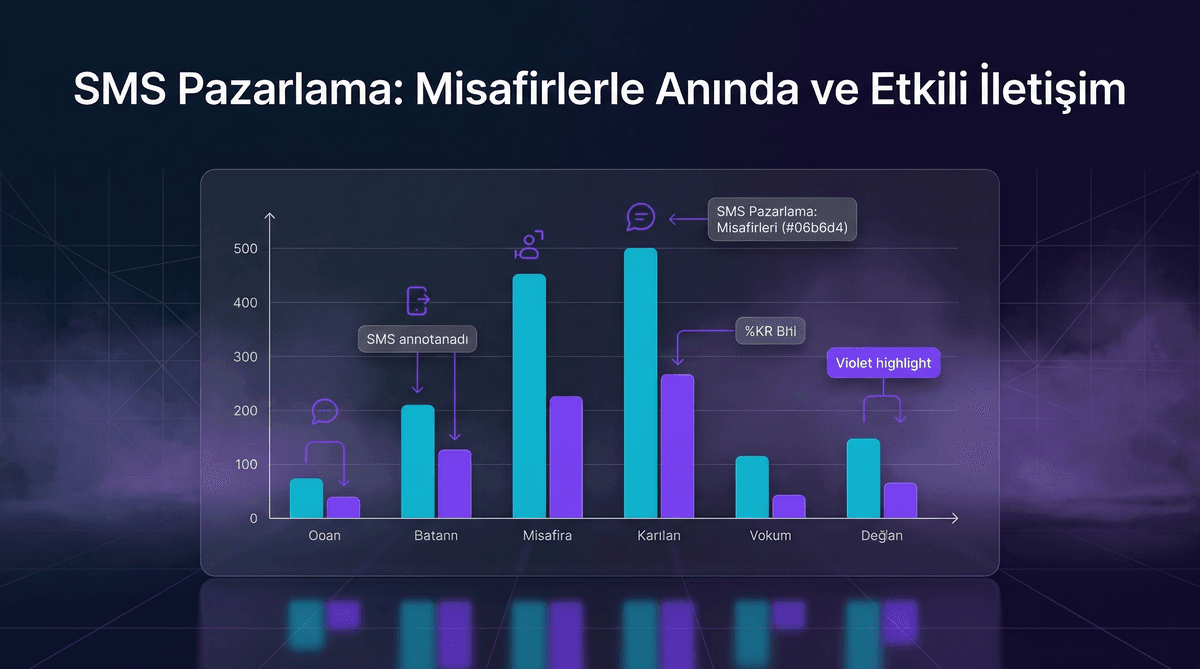
In the hospitality industry, SMS marketing provides a unique channel to deliver the right message at the right time—directly into the guest's hand—at critical moments of their journey. According to 2026 data, hotels using SMS marketing see guest engagement rates 62% higher than those who do not, and their direct booking repeat rate is 34% higher.
Embed this image on your site
<a href="https://otelciro.com/en/news/boosting-hotel-guest-engagement-via-sms-marketing-2026-guide">
  <img src="https://cdn.sanity.io/images/1la98t0z/production/d94b510e0a9a1b79db51e271a12324bbb4eaf5c0-1200x669.png" alt="SMS Marketing Guest Engagement Infographic" width="800" />
</a>
<p>Source: <a href="https://otelciro.com">OtelCiro</a> — AI Hotel Revenue Management</p>
However, the power of SMS also brings responsibility. When used incorrectly, it is perceived as spam and can damage brand reputation. In this article, we discuss strategies for using SMS marketing ethically and effectively in the hospitality sector, message templates tailored to the guest journey, and measurement methods.
Related reading: Hotel Guest Communication with WhatsApp Business: Best Practices
Legal Framework and Permission Management
In Turkey, SMS marketing is subject to strict regulations under Law No. 6563 on the Regulation of Electronic Commerce and the Message Management System (IYS). Legal compliance is an absolute must for any SMS strategy.
Requirement for Explicit Consent: Before sending an SMS to guests, clear and freely given consent must be obtained. This consent can be collected via reservation forms, the hotel website, or during check-in. A clear checkbox such as "I want to receive campaign and informational SMS messages" should be used.
IYS Registration: It is mandatory to register collected permissions with the Message Management System (IYS). Commercial messages sent to numbers not registered in the IYS can result in administrative fines of up to 15,000 TL per message.
Opt-out Mechanism: Every SMS must provide an easy opt-out mechanism, such as "Text STOP to cancel." Cancellation requests must be processed within 24 hours. If the opt-out rate exceeds 5%, message frequency and content should be re-evaluated.
Sending Hours: Commercial SMS messages can only be sent between 08:00 and 21:00. This restriction is mandatory under Information and Communication Technologies Authority (BTK) regulations.
Hotels that manage permissions correctly maintain an active rate of over 85% in their SMS lists, achieving high engagement performance.
SMS Usage Scenarios in the Guest Journey
SMS is ideal for short, urgent messages. It should be used for different purposes at every stage of the journey.
Booking Confirmation: Send an automated SMS with confirmation and summary info once a booking is made. Stay within 160 characters using a format like: "Booking confirmed! [Hotel Name], [Date], [Room Type]. Details: [Short Link]." The confirmation SMS is the first touchpoint that builds guest trust.
Check-in Reminder (24 hours before): "We look forward to seeing you tomorrow! Check-in: 14:00. Online check-in: [Link]. Need help? [WhatsApp Link]." This message reduces no-show rates by 18% and increases online check-in usage by 45%.
Welcome Message (After Check-in): "Welcome [Name]! WiFi: [Password]. For any needs, dial 0 or click [WhatsApp Link]. Enjoy your stay!" This practical message reduces routine calls to the reception by 35%.
In-Stay Offers: "Today only! 20% off at our Spa, until 17:00. Book now: [Link]." Time-sensitive offers leverage the urgency of SMS and generate an average 12% conversion rate.
Check-out Reminder: "Check-out time is 12:00. Want a late check-out? Extend until 14:00 for 250 TL. Reply YES to confirm." One-click purchasing via SMS increases late check-out sales by 200%.
Post-Stay Thank You: "Thank you for choosing us, [Name]! Rate your experience: [Link]. Your 10% discount code for your next stay: REPEAT10"
Related reading: Email Drip Campaigns: A Series Tailored to the Guest Journey
SMS Content Strategy and Best Practices
The 160-character limit of SMS requires every word to be chosen carefully. Effective hotel SMS messages follow a few fundamental rules.
Personalization: Using the guest's name increases the post-open reading rate by 29%. Through PMS integration, the guest's name, room number, and stay dates are automatically added to the message.
Value-Oriented: Every SMS must offer tangible value to the guest—information, an offer, convenience, or a solution. Vague messages sent "just for information" increase opt-out rates.
Clear CTA (Call to Action): Define a single, clear action in every SMS. Use specific directions like "Click for details," "Reply YES to confirm," or "Reply to book an appointment."
Frequency Management: Send a maximum of 3 messages before the stay, 1 per day during the stay, and a maximum of 2 after the stay. Monthly campaign SMS messages should not exceed 2. Excessive messaging leads to a 7.3% opt-out rate, while optimum frequency keeps this rate at 1.5%.
Timing: Transactional SMS (confirmations, reminders) should be sent at the moment of the event. For promotional SMS in Turkey, the highest engagement hours are between 10:00-12:00 and 18:00-20:00.
Syncing SMS campaigns with email and WhatsApp via a sales and marketing ecosystem to run a multi-channel communication strategy increases the total conversion rate by 40%.
Integration of SMS with Other Channels
SMS shows its greatest impact when working in integration with other communication channels. An omnichannel approach allows the guest to communicate through their preferred medium.
SMS + Email: Send an SMS reminder 24 hours later to guests who did not open the campaign email. This tandem approach increases campaign conversion by 50%.
SMS + WhatsApp: Send a short notification via SMS and direct detailed communication to WhatsApp. "Our Spa campaign has started! Details and booking: [WhatsApp Link]." This method combines the reach of SMS with the rich media support of WhatsApp.
SMS + Push Notification: Send push notifications to guests who have the hotel app installed and SMS to those who do not. To avoid channel conflict for the same message, each guest should receive a notification from only one channel.
Trigger-Based Automation: SMS automation integrated with the PMS ensures correct timing without manual intervention. Automated SMS is triggered when a reservation is created, when a check-in is performed, or when check-out approaches. Hotels using automation reduce staff workload by 60% while maintaining communication consistency.
Measurement and Optimization
Detailed metric tracking is essential to continuously improve SMS marketing performance.
Key KPIs:
- Delivery Rate: Target 97%+. A low delivery rate indicates outdated numbers.
- Open Rate: Cannot be measured directly in SMS but is generally accepted as 98%.
- Click-Through Rate (CTR): Target 15-25% for SMS containing links.
- Conversion Rate: Target 3-8% for campaign SMS; 10-15% for transactional SMS.
- Opt-out Rate: Should be kept below 2% per month.
- Cost-per-Conversion: While the cost per SMS is between 0.15-0.35 TL, the cost per conversion should be maintained at 5-15 TL.
A/B Testing: Test different message texts, CTAs, and delivery times for the same campaign. The short format of SMS is an environment where small changes make a big impact. A single word change can increase the click-through rate by up to 23%.
SMS marketing continues to be one of the oldest yet most effective channels of the digital age. In the hospitality sector, SMS campaigns implemented with the right strategy enrich the guest experience, increase operational efficiency, and generate direct revenue with low costs. The key is to use this powerful channel respectfully and with a focus on value—because the privilege of reaching a guest's pocket is a trust that must be carefully guarded.
![Europe's Hotel Construction Boom: 2026 Oversupply Risks [Market Analysis]](https://cdn.sanity.io/images/1la98t0z/production/6dfe59137f56aa14bfcba86d9db3cf05ff89f406-2752x1536.jpg?w=1920&q=50&auto=format&fit=max)