![Boost Profit: Hotel Channel Mix Strategy 2026 [Guide]](https://cdn.sanity.io/images/1la98t0z/production/8fccf2ace4db8a3c997bd8122da3620aee6cd834-1200x669.png?w=1920&q=65&auto=format&fit=max)
Key Takeaways
- Net Profit Focus: In 2026, an optimal channel mix is critical for a hotel's financial health, prioritizing net revenue over gross bookings.
- Significant Revenue Boost: Hotels that optimize their channel distribution can increase annual net revenue by 12-18% without altering room count or pricing.
- Targeted Distribution: Aim for a strategic channel breakdown: Direct (35-45%), OTAs (30-40%), GDS (10-15%), Wholesale (5-10%), and New Channels (5-10%).
- AI for Dynamic Optimization: Leverage AI to dynamically adjust channel strategies daily, even hourly, based on real-time market data to maximize profitability.
- Understand True Costs & Prevent Conflict: Accurately calculate the net cost per acquisition for each channel (e.g., OTA total cost 22-35% vs. direct 5-12%) and implement value-added strategies to mitigate channel conflict.
What is Channel Mix and Why is Everything Changing in 2026?
Channel mix refers to the proportion of a hotel's total revenue generated from various distribution channels. OTAs, direct website, GDS, wholesale, metasearch, social media, and voice assistants—each channel has a different cost structure, customer profile, and profitability rate. In 2026, channel distribution strategy has become one of the most critical factors determining a hotel's financial health.
In the traditional approach, hotels would consider the channel bringing in the most bookings as the "best channel." This understanding is no longer valid. A hotel receiving 70% of its 1,000 monthly bookings from OTAs might look good in gross revenue but could be experiencing significant net revenue loss. This is because OTA commissions range from 15-25%, while the cost of the direct channel generally remains at 3-5%.
According to industry data, hotels that optimize their channel distribution increase their annual net revenue by 12-18%—without changing room count or rates, simply by attracting the same guests through lower-cost channels.
Ideal Channel Distribution Ratios for 2026
The ideal channel distribution for each hotel varies based on its location, segment, scale, and target market. However, the general framework adopted by industry leaders for 2026 is as follows:
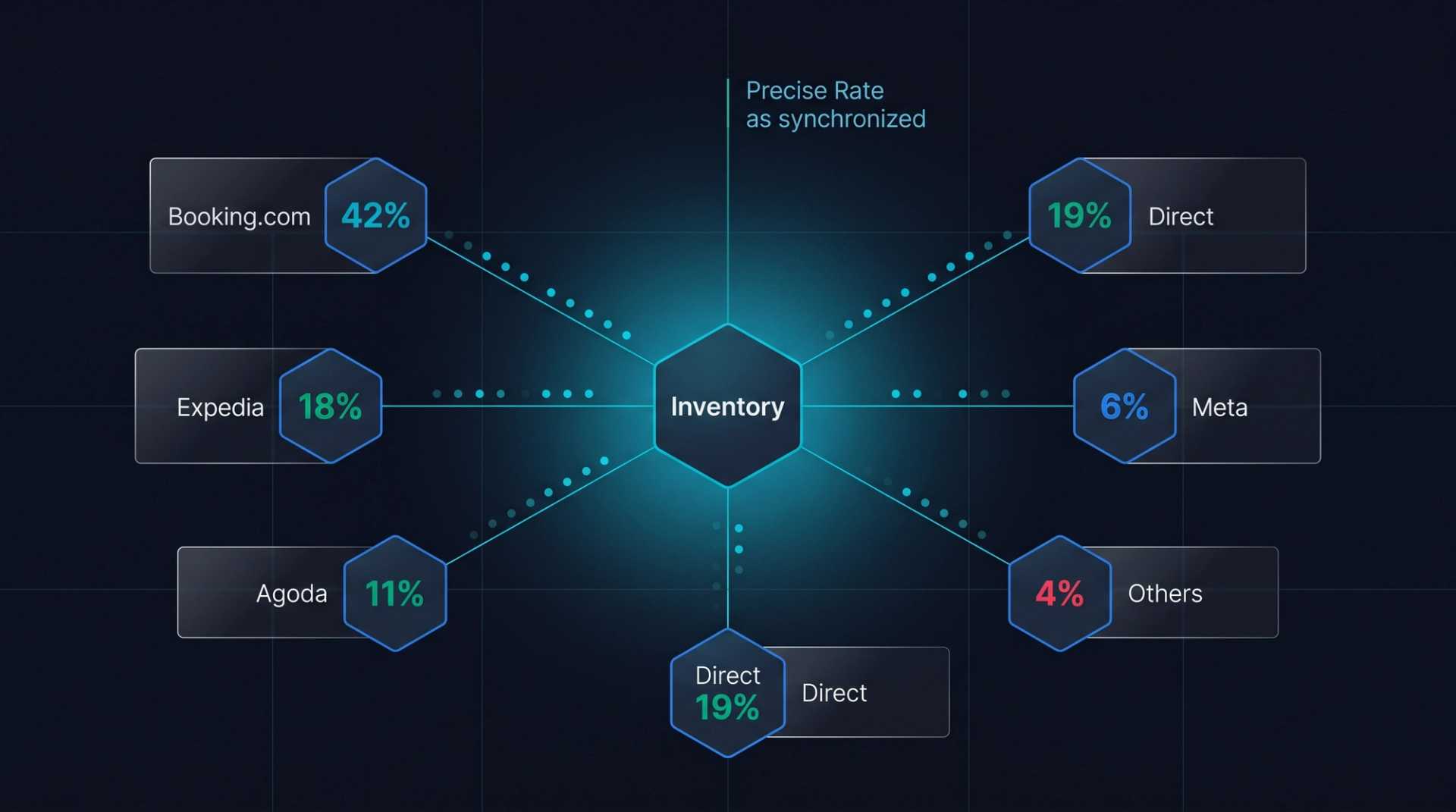
Direct channels (target: 35-45%): Commission-free or low-commission bookings from the website, phone, email, WhatsApp, and social media. This is the most valuable channel group in terms of profitability. The average in Turkey is currently 22%—even increasing this to 35% yields a significant revenue boost.
OTAs (target: 30-40%): Platforms like Booking.com, Expedia, and HRS. They provide high visibility but come with high commission costs. They also offer an indirect contribution to direct channels through the "billboard effect." They should be managed strategically rather than completely cut off.
GDS (target: 10-15%): Corporate and travel agency bookings via Amadeus, Sabre, and Travelport. An important segment, especially for city hotels. The commission rate is lower than OTAs, and the average room revenue is 20% higher.
Wholesale (target: 5-10%): Bedbanks like Hotelbeds and WebBeds, and tour operators. A low-price, high-volume model. Provides occupancy guarantees but offers low profitability. Should be used strategically to fill empty rooms during the low season.
New channels (target: 5-10%): Metasearch, voice assistants, social commerce, AI assistants. These are fast-growing and low-cost channels.
Related reading: 7 Advanced Tactics in OTA Sales
Dynamic Channel Optimization with AI
Setting a fixed channel distribution ratio and sticking to it throughout the year is no longer sufficient in 2026. AI-powered dynamic channel optimization automatically adjusts the channel strategy according to market conditions that change daily, even hourly.
AI-based channel mix optimization instantly analyzes parameters such as current occupancy rate, remaining inventory, competitor prices, demand forecast, event calendar, weather, and historical data. Evaluating this data, the algorithm determines which channel to sell through and at what price.
For example, in a week of high demand, an AI system might decide to: list rooms on OTAs at 5% higher prices to redirect guests to the direct channel, temporarily close wholesale quotas, or offer a "best price guarantee" on the direct channel. During periods of low demand, actions such as activating OTA visibility boosters, expanding wholesale quotas, or launching flash sale campaigns are triggered.
OtelCiro's sales ecosystem automates all these channel management processes with AI support through a single platform. You can optimize channel distribution in real-time to maximize profitability, requiring no manual intervention.
Channel-Based Cost Analysis: The Real Numbers
To optimize your channel distribution, you need to calculate the true cost (net cost per acquisition) of each channel. This calculation should include not only the commission rate but all indirect costs as well.
Booking.com true cost: 15-18% commission + Genius discount (10-20%) + Visibility Booster (1-5% additional commission) + Preferred Partner (3% additional commission) = total cost can range between 22-35%.
Direct website true cost: Google Ads click cost + SEO investment + website maintenance cost + payment gateway commission (1.5-2.5%) = total cost between 5-12%.
GDS true cost: Connection fee + per-transaction commission + travel agency commission = total cost between 12-18%, but with a higher average room revenue compared to other channels.
Knowing these figures clarifies how much savings each additional direct booking provides. For a 500 TL room, selling through Booking.com results in a net income of 325-390 TL, while selling through the direct channel increases net income to 440-475 TL. This difference can mean a saving of 500,000-1,000,000 TL per year for a 100-room hotel.
Channel Conflict Prevention Strategies
One of the biggest dangers when optimizing your channel mix is channel conflict. Price parity pressure from OTAs can make it difficult to offer lower prices on your direct channel. Some strategies should be implemented to manage this situation.
Value-add strategy: Offer more value at the same price on the direct channel—such as free breakfast, room upgrade, late checkout, or a welcome package. The price remains the same, but the perceived value increases.
Loyalty program: Reward guests who book directly with points. These points can be used for discounts, free services, or room upgrades on their next stay.
Package sales: While only selling rooms on OTAs, offer "room + experience" packages on the direct channel. When direct offers become incomparable, the price parity issue disappears.
Member rate: Establish a membership system on your website, keeping member prices 5-10% lower than OTA prices. Booking.com's own rules even allow for loyalty program discounts.
Performance Tracking and Continuous Improvement
To measure the success of your channel mix strategy, track the following metrics monthly: channel-based revenue share, channel-based net revenue (post-commission), channel-based average daily rate (ADR), channel-based conversion rate, direct channel share trend, and total distribution cost ratio.
The goal is to reduce your total distribution cost to below 15% of your revenue. Most hotels in Turkey currently pay 20-28% in distribution costs. This gap represents a significant profitability opportunity that can be closed with the right channel mix strategy.
Review your channel performance quarterly, re-evaluate underperforming channels, and test new channel opportunities. In 2026, success in hospitality is achieved not by relying on a single channel but through a intelligently diversified and continuously optimized channel ecosystem.
![Europe's Hotel Construction Boom: 2026 Oversupply Risks [Market Analysis]](https://cdn.sanity.io/images/1la98t0z/production/6dfe59137f56aa14bfcba86d9db3cf05ff89f406-2752x1536.jpg?w=1920&q=50&auto=format&fit=max)